


- Object numberCOMWG.103
- Artist
- Title
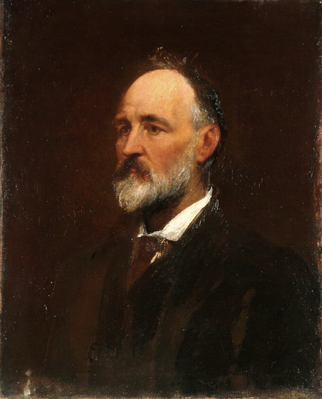
George Andrews
- Production dateexact 1898 - exact 1898
- Medium
- Dimensions
- Painting height: 63.5 cm
Painting width: 51 cm - Description
A careful portrait study of a faithful employee and long-term friend. Watts first came to know George Andrews (1838–1924) when he worked as a London police-officer based in the lodge of Holland House. When he retired, Watts offered him a position as gardener at his Isle of Wight residence, and later at Limnerslease which George and Mary Watts established in 1891. Painted in the style of a ‘Hall of Fame’ portrait, Watts depicts Andrews as one of the great men of the age: cementing the great respect the artist had for his friend.
- In depth
‘Andrews is delightful’ is how Mary described the Watts’s faithful companion in her diary, shortly after they established their home at Limnerslease, Compton, in the summer of 1891 [1]. As a frequent character in her diaries, Andrews’s service to the artistic couple went beyond the formal title of estate steward. He assisted both in their artistic endeavours; stretching canvases, preparing gesso mixtures and cutting terracotta. In the house itself, he helped Mary create the gesso ceiling panels and the reading niche, which is now lost.
Andrews was also an accomplished photographer and during his time at Limnerslease, he was also tasked with documenting the estate and studios in photographs. These records have been used in recent years to inform the creation of the Watts Studios at the Watts Gallery – Artists’ Village.
As a tribute to his long-standing service, Watts paints Andrews as a great man of the age in this ‘Hall of Fame’ style portrait. Against a non-descript background, Andrews sits in three-quarter profile, with his gaze looking beyond the viewer. He wears a plain, black overcoat and white shirt with a high collar, completed with a deep brown cravat. With the light radiating from the right-hand side, Andrews’ face and forehead are highlighted, making visible the delicate and fine brushwork used to depict the sitter’s greying hair. In doing so, Watts ensures that the viewer’s focus is on Andrews’s face.
A direct comparison can be drawn between this portrait and Watts’s portrait of Walter Crane, 1891, now in the National Portrait Gallery collection. The only difference between the two is the slightly less stylised beard and unkempt hair of Andrews. As with the majority of the ‘Hall of Fame’ series portraits, there are no indicators of Andrews’s occupation or social status in this portrait. In his democratic treatment, Watts presents Andrews in the same way he did the leading artists, politicians and thinkers of the Victorian age.
Although exhibited at the memorial exhibitions which took place at the Royal Academy in 1905, before touring to Manchester, Newcastle and Edinburgh later that year, the portrait has always remained in the Watt’s collection as a personal tribute to Andrews, and was never intended for the National Portrait Gallery collection [2]. Andrews continued to work at Limnerslease after Watts’s death in 1904 and on his own death he was laid to rest in the cemetery of the Watts Chapel. The inscription of his Compton Pottery gravestone reads, ‘George Alfred Andrews 1891–1924 “Forasmuch as he was faithful”’ [3].
Footnotes:
[1] Desna Greenhow ed., The Diary of Mary Watts: 1887-1904 (London: Lund Humphries in association with Watts Gallery, 2016), p.90.
[2] Mary Seton Watts, Catalogue of Portraits by G.F. Watts O.M. R.A., Vol. II, c.1915, p.3.
[3] Mark Bills and Desna Greenhow (eds.), The Word in the Pattern (1905): A facsimile with accompanying essays on Mary Watts’s Cemetery Chapel drawn from the Watts Gallery Symposium 2010 (Surrey: Society For The Arts And Crafts Movement In Surrey, 2012) p.99.
Further Reading:
Mark Bills and Desna Greenhow (eds.), (Surrey: Society For The Arts And Crafts Movement In Surrey, 2012).
Barbara Bryant, G. F. Watts portraits: fame & beauty in Victorian society (London, National Portrait Gallery, 2004).
Barbara Bryant, G.F. Watts in Kensington: Little Holland House and Gallery (Compton, Surrey: Watts Gallery, 2009).
Caroline Dakers, The Holland Park circle: artists and Victorian society (New Haven: Yale University Press, 1999).
Desna Greenhow ed., The Diary of Mary Watts: 1887-1904 (London: Lund Humphries in association with Watts Gallery, 2016).
Leoneé and Richard Ormond, G. F. Watts: The Hall of Fame: portraits of his famous contemporaries, National Portrait Gallery (Compton, Surrey: Watts Gallery, 2012).
Mary Seton Watts, Catalogue of Portraits by G.F. Watts O.M. R.A., Vol. II, c.1915.
Text by Dr Stacey Clapperton
|
|
