


- Object numberCOMWG.2
- Artist
- Title
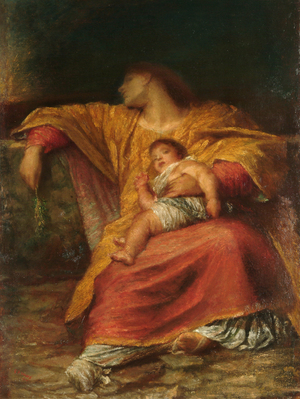
Peace and Goodwill
- Production date1887 - 1887
- Medium
- Dimensions
- Object height: 66 cm
Object width: 53.3 cm
Frame height: 105 cm
Frame width: 87 cm - Description
This is a symbolic picture where the setting, poses and clothing are used to suggest abstract ideas. When Watts was designing it he said, ‘Peace is to be a queen, though she is a wanderer and outcast from her kingdom. She will turn wearily towards a streak of light which may mean the dawn of better things.’ Watts sometimes asked pessimistically, ‘Is it dawn or conflagration?’ Goodwill, her son and heir, is the child on her knee. In 1907, Mary Watts presented a large version to St. Paul’s cathedral as a pair to 'Time Death and Judgement', which G F Watts had given in 1898.
- In depth
Mary Watts provided quite a bit of insight on this work. While noting that this is the first, and smaller of the copies of this painting and that it was displayed in the New Gallery in 1899, she also provided information on G F Watts’s thoughts and techniques [1]. She wrote:
When this design was first maturing in the painter’s mind and sketches were being made in gouache, he remarked- ‘Peace is to be a queen, though she is a wanderer and out cast from her Kingdom. She will turn wearily towards a streak of light which may mean the dawn of better things. The son her heir is still only a child upon her knee.’ He did not depart in any way from this first conception- but used sometimes ask the question ‘Is it dawn or conflagration?’ [2].
Here Mary provides an interpretation of this work following Symbolist tenets. Similar to another Watts painting Outcast Goodwill, 1895 (COMWG.118), she noted that the central figure is an outcast representing an admirable aspect of mankind and how people have lost this quality. Moreover, according to Mary, G F Watts was not sure whether to be positive or negative about the return of this quality. Mary also noted that the larger version of this work was given to St. Paul’s Cathedral after the painter died, to be grouped with a version of Time, Death, and Judgment, 1886 (COMWG2006.54) by Watts.
Later Watts scholars have taken this interpretation much further adhering to symbolist ideas. Hilary Underwood notes the bandages on the woman’s feet and her right hand which is too weary to hold an olive spring upright, while noting the ambiguity in this work [3]. She writes, “Watts avoids comforting dogmas and attractive escapism. He conveys a reality which is complex and uncertain but never entirely pessimistic” [4]. Here Underwood notes how Watts is presenting this idea of Peace in a way the viewers would understand while also leaving the conclusions open to interpretation.
Additional Watts scholars focused on the composition of this work and its similarity to the works of others. David Stewart argues that Watts used this painting to parody and reverse the iconography of his fellow painter and friend Lord Leighton while noting the figure in this work is bandaged and broken [5]. Staley compares this work to other paintings by Watts such as Humanity in the Lap of Earth, 1851-1852 and The Slumber of Ages, 1898-1901 (COMWG.53) as all three works include a child sitting on the lap of another figure, reminiscent of a Madonna and child [6]. He later also compares this work to Hope, 1886 and Watchman, what of the night?, c.1867, also by Watts, while noting that this work is less optimistic than the latter. Adhering to the principles of Symbolism, all of these scholars note how Watts used these figures to comment upon society and mankind.
Footnotes:
[1] Mary Watts, Catalogue of the Works of G.F. Watts, page 118.
[2] Mary Watts, Catalogue of the Works of G.F. Watts, page 118.
[3] Hilary Underwood, G.F. Watts Parables in Print, page 11.
[4] Hilary Underwood, G.F. Watts Parables in Print, page 11.
[5] David Stewart, “Of Angst and Escapism: George Frederic Watts and Frederic, Lord Leighton,” Victorian Institute Journal 22 (1994), page 46.
[6] Allen Staley, “32. Peace and Goodwill c, 1888-1900,” Victorian High Renaissance (ed. Richard Dorment, Gregory Hedburg, Leonee Ormand, Richard Ormand, Allen Staley), page 91.
Text by Dr Ryan Nutting
|
|
