


- Object numberCOMWG.200A
- Artist
- Title
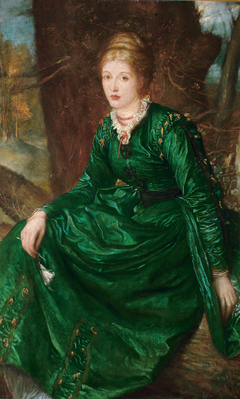
Miss Virginia Julian Dalrymple also known as Mrs Francis Champneys
- Production dateexact 1872 - exact 1872
- Medium
- Dimensions
- Painting height: 132 cm
Painting width: 84 cm
Frame height: 164 cm
Frame width: 113 cm - Description
An experimental portrait of a young Miss Virginia Dalrymple. Referring to her as ‘the Lady in Green’ this portrait belongs to a series of portraits that Watts created of women in strikingly coloured dresses. First meeting Miss Dalrymple as a child at Little Holland House, her youth and vivacity are celebrated in this portrait. Holding a white lily which symbolises chastity and virtue, she is juxtaposed with the wild and decaying landscape that surrounds her.
- In depth
An experimental and imaginative portrait of the young ‘Lady in Green’ [1]. In this portrait, a young Virginia Dalrymple sits on a fallen branch amid a woodland. With her legs swung round to the side and her hand resting on her knee, she holds a single white lily, which symbolises her chastity and virtue. Dalrymple’s fair blonde hair sits high atop her head in a mass of braids. Set against her fair complexion and bold coral jewellery, the intense green of her dress is arresting and sets her apart from the natural setting in which she sits.
Yet, the landscape which surrounds her it is not a perfectly pruned setting, nor one in full bloom. The wildness of the shrubbery to the right of the picture and the hint of autumnal tones in the trees in the distance suggest the passing of time. The vitality and youth of the sitter is at odds with the decaying landscape that surrounds her [2].
Watts came to know Miss Dalrymple through her parents. Sophia Pattle, the youngest of the seven Pattle sisters, married Sir John Warrender Dalrymple in 1847. With Dalrymple posted overseas with the Bengal civil service, Sophia and her daughter Virginia spent most of their time at Little Holland House, at the same time that Watts lived there as artist in residence. As he had painted her mother before her, Watts painted the young Miss Dalrymple several times, including when she was a child, in a picture named Goldilocks and in a portrait from 1865 of a youthful Dalrymple in a blue dress, positioned in front of a holy bush (Harvard Art Museums) [3].
Although Miss Virginia Dalrymple debuted at the Royal Academy’s summer exhibition in 1872, Watts revealed in his personal correspondence that he was reworking the portrait two years later, whilst staying at the Briary, Freshwater. ‘[…] indeed since I have been here I have done nothing with the exception of retouching the picture of the young Lady in Green (Miss Dalrymple) the face of which I had rubbed out’ [4]. Altering and changing his paintings many years after they were first exhibited was not unusual to Watts’s practice. May Prinsep (COMWG.88, 1867-69) is another portrait that we know Watts reworked after it was first exhibited as he altered the position of the face and the hair.
Women dressed in intensely coloured fashions appeared in earlier works by Watts including Jane 'Jeanie' Elizabeth Hughes, 1857-8 (Wightwick Manor, National Trust) and the portrait of Virginia’s aunt, Countess Somers, 1860–89. In fact, Miss Virginia Dalrymple was one of three portraits of young women in rich green dresses that debuted at the London exhibition season that year. Seemingly unaware of each other’s work, Leighton contributed After Vespers, 1871 (Princeton University Art Museum) which hung in Gallery III at the Royal Academy, as was Miss Virginia Dalrymple and Rossetti offered Veronica Veronese, 1872 (Delaware Art Museum). Of the three portraits, Watts was the only one to immerse his sitter in a natural setting.
The dress which Virginia wears in this portrait is now in the archive at Watts Gallery – Artists Village. Created entirely from green velvet, the black silk bows down the front of the chest and black silk ties around the waist, help punctuated the design, which is offset with yellow trimmings to the shoulders and base of the dress. Its style is in accordance with the fashionable silhouette of c.1868-9 and is comprised of a tunic made from a front-fastening bodice and an apron front and puffed back section, with an underskirt [5]. The colour and material are considered to be unusual for a day dress of this period and not wholly suitable for walk in the countryside. This demonstrates that it was the appearance of the dress, rather than its realistic practicality, which interested Watts most.
With its symbolic nature, and imaginative setting this work remains an ‘unexpected departure’ in Watts’ portraiture, demonstrating a ‘modern approach to the genre’ [6].
Explore:
Sophia Dalrymple [COMWG.200]
Colour Chalk Study of Virginia Julian Dalrymple [COMWG2007.897]
May Prinsep [COMWG.88]
Footnotes:
[1] Letter from G.F. Watts to C.H. Rickards, 29 November 1874, Watts Correspondence, Heinz Archive, National Portrait Gallery, London, GFW/1/2.
[2] Marks Bills and Barbara Bryant, G.F. Watts: Victorian Visionary (New Haven and London: Yale University Press in association with Watts Gallery Compton, 2008), p.184.
[3] Mary Seton Watts, Catalogue of Portraits by G.F. Watts O.M. R.A., Vol. II, c.1915, p.35.
[4] Letter from G.F. Watts to C.H. Rickards, 29 November 1874, Watts Correspondence, Heinz Archive, National Portrait Gallery, London, GFW/1/2.
[5] Edwina Ehrman, ‘Velvet two-piece dress work by Virginia Dalrymple-Champneys’, 16 August 2016, unpublished, Watts Gallery – Artists’ Village archive.
[6] Marks Bills and Barbara Bryant, G.F. Watts: Victorian Visionary (New Haven and London: Yale University Press in association with Watts Gallery Compton, 2008), p.184.
Further Reading:
Marks Bills and Barbara Bryant, G.F. Watts: Victorian Visionary (New Haven and London: Yale University Press in association with Watts Gallery Compton, 2008).
Edwina Ehrman, ‘Velvet two-piece dress work by Virginia Dalrymple-Champneys’, 16 August 2016, unpublished, Watts Gallery – Artists’ Village archive.
Watts Correspondence, Heinz Archive, National Portrait Gallery, London, GFW/1/2
Mary Seton Watts, Catalogue of Portraits by G.F. Watts O.M. R.A., Vol. II, c.1915.
Text by Dr Stacey Clapperton
|
|
