


- Object numberCOMWG.25
- Artist
- Title
Jacob and Esau
- Production dateexact 1878 - exact 1878
- Medium
- Dimensions
- Painting height: 106.7 cm
Painting width: 99.1 cm
Frame height: 140 cm
Frame width: 130 cm - Description
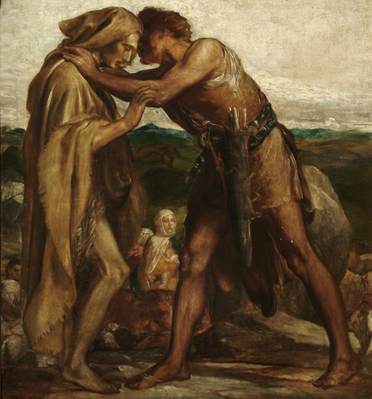
G. F. Watts’s painting of the Biblical twin brothers Jacob and Esau, and the end of their fraternal rivalry, had its origins in his illustrations for the Bible commissioned by George and Edward Dalziel. The painting shows the brothers’ embracing as described in Genesis 33, as they reunite after their falling out many years earlier when Jacob tricked his brother into giving up his birthright (Genesis 25-36).
- In depth
Watts’s paintings that take their inspiration from Genesis are remarkable for their freshness and inventiveness. Jacob and Esau was one of three designs that Watts submitted in 1863 together with The Sacrifice of Noah (COMWG2006.25, 1862-1863 and Noah Building the Ark (COMWG.111, 1862-1863) [1]. Roger E. Fry singled out the ‘nobly dramatic composition’ of Jacob and Esau as one of Watts’s most ‘memorable interpretations’ of the Bible [2]. In 1868, when it was exhibited at the Royal Academy, the reviewer in St James’s Magazine called it a grand ‘and masterly work’ [3]. This scene also draws to mind the biblical paintings of the Nazarene movement, and harkens back to a very early work by Watts Ruth and Boaz (1835-37). The Nazarenes were a group of German romantic painters in Rome. It is particularly reminiscent of Joseph von Führich’s Jacob encountering Rachel with her father’s herd (1836).
J. E. Phythian observed that one may mark a certain expression of ‘contempt at the sorry figure of her husband’ on the face of Jacob’s wife as she observes the brothers’ embrace while cradling her child [4]. There is indeed a stark contrast between the hooded, frail, and pale figure of Jacob and the muscular, bronzed, and heroic Esau. Yet the overall impression is dominated by a sense of profound respect for Esau and his ‘embodiment of the unstrained quality of mercy’ [5].
In 1905, at the retrospective that marked Watts’s passing, a critic noted that the ‘grandeur’ of Watts’s biblical scene was ‘generally and deservedly recognized’ [6]. In particular, the critic noted the ‘daring pictorial invention of a sky that is virtually white’, which the ‘wonderful force’ of Watts’s composition depends on [7]. Such a sky can also be seen in other paintings by Watts, such as Una and the Red Cross Knight (COMWG2007.802, 1869) and Esau (COMWG.129, 1860-1865). The white sky highlights the visibility of the figures, and creates a sense of depth reminiscent of a frieze. A notable art historical precedent is the overcast sky of Michelangelo’s biblical scenes that decorate the Sistine Chapel, which was one of Watts’s greatest inspirations. He had seen the frescoes himself when he resided in Italy with Lord Holland.
The ‘daring pictorial invention’ of a ‘virtually white’ sky assured Watts a place among ‘the greatest colourists’, and was an example of Watts’s unique ‘power of inventing new schemes of colour.’ His powers as a colourist were so great that one critic described how one had to puzzle one’s wits ‘to find terms for the degree and qualities of his white’. Watts’s biblical works were a testament to his talents as a colourist, who was seen to use colour ‘not as a mere outward adornment of a design’, but instead ‘as an integral part of its emphatic quality’ [8]. Watts’s fine colour-sense was praised by the painter Sir George Clausen R.A and the critic and member of the Bloomsbury Group Roger E. Fry [9].
Watts’s reputation as a great colourist lasted long after his death. In 1923, another critic wrote of Watts and Rembrandt and how they may at first appear as examples of two painters for ‘the essence of whose art colour, it might be argued, is less essential’ [10]. As the critic continued, Watts’s message ‘is clear even in monotone.’ However, this was merely an illusion for ‘Watts himself thought differently, because he knew the importance of the decorative element in painting and the emotional value of colour’ [11].
In the 1870s Watts returned to the Biblical theme of sibling rivalry in The Denunciation of Cain (COMWG.76, 1871-1872) and The Death of Cain (COMWG.66, 1885-86), as well as a later version of Jacob and Esau’s reconciliation. In 1881, that painting was given by the ironworkers Messrs. Mather and Platt to the Salford Museum and Art Gallery, in Manchester [12].
Explore:
Chalk Compositional Study for Jacob and Esau [COMWG2007.687]
Photos of Watts’ Paintings – Jacob and Esau [COMWG2010.1.150]
Footnotes:
[1] Hilary Underwood and Veronica Franklin Gould, ’56. The Meeting of Jacob and Esau, 1862-68’ in The Vision of G. F. Watts OM RA (1817-1904) ed. by Veronica Franklin Gould (Compton: Watts Gallery, 2004), p. 67. However, the Bible Gallery was not published until 1881.
[2] Roger E. Fry, ‘Watts and Whistler’ in The Quarterly Review April 1905, pp. 607-623, p. 620.
[3] Anon. ‘A Peep at the Royal Academy’ in The St. James’s Magazine (Apr 1868), pp. 297-307, p. 303.
[4] J. E. Phythian, George Frederick Watts (London: Grant Richards Ltd, 1911), p. 109.
[5] Ibid., p. 109.
[6] Anon. ‘G. F. Watts at Burlington House’ in The Athenaeum Jan 28, 1905, pp. 119-120, p. 119.
[7] Ibid., p. 119.
[8] Ibid., p. 119.
[9] Sir George Clausen, Aims and Ideal in Art; Eight Lecture delivered to the Students of the Royal Academy (London: Methuen, 1906), p. 45. See also Roger E. Fry, ‘Watts and Whistler’ in The Quarterly Review April 1905, pp. 607-623.
[10] R. F., ‘Master-Painters of the World’ in The Bookman 65.387 (Dec 1923), pp. 2-5, p. 3.
[11] Ibid., p. 3.
[12] Anon. ’Notes on Art and Archaeology’ in The Academy Oct 29, 1881, pp. 336-337.
Text by Dr Eva-Charlotta Mebius
|
|
