


- Object numberCOMWG.29
- Artist
- Title
Britomart and her Nurse.
- Production dateexact 1865 - exact 1865
- Medium
- Dimensions
- Painting height: 56 cm
Painting width: 38 cm - Description
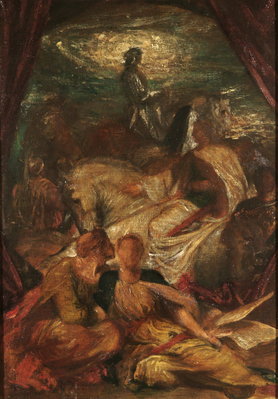
More than a decade after his fresco for the Poets’ Hall in the Palace of Westminster, Watts returned to Edmund Spenser’s (1552/1553- 1599) epic poem The Faerie Queene (1590) for inspiration for two compositions of Una and the Red Cross Knight and Britomart and her Nurse (c. 1878, Birmingham Museum and Art Gallery). This is one of several studies produced between 1850 and 1878 which was done in preparation for the finished painting that was shown at the Royal Academy in 1878.
- In depth
Britomart is a lady knight of chastity and this study shows Britomart and her nurse who go off in search of Britomart’s love Arthegal, who she has fallen in love with after seeing his reflection in a magical mirror [1]. Britomart and Una became two of the favourite characters for nineteenth-century painters as they were particularly suitable to celebrate the new reign of a female monarch, Queen Victoria [2]. Britomart in Spenser’s epic poem signifies the Virgin Queen, Elizabeth I [3]. In Victorian Britain, Britomart came to represent a peculiarly Victorian female ideal, as seen in The Britomart Windows of Cheltenham Ladies’ College, and the writings of its second Principal the suffragist Dorothea Beale (1831-1906) [4]. Britomart was ‘a real woman’, wrote Beale, and ‘not merely the usual appendage of a knight’ [5]. She travels ‘alone’ and was ‘no mere satellite, for she owns a squire’, Beale observed with delight [6]. Britomart was an early incarnation of the New Woman of the nineteenth century. Around the same time as he painted Britomart, Watts was also at work on a painting of another famous lady knight, Joan of Arc (COMWG2007.835, 1879).
To Watts’s contemporaries, the painter’s visionary depictions of Britomart did not only represent a Victorian ideal, but a Wattsian ideal too. As Lewis Lusk argued in an essay from 1904 which was published two months after the painter’s death, ‘in many of G. F. Watts’ beautiful women is Britomart the type’ and one could ‘say that they are rather Britomartial’ [7]. Perhaps unintentionally, Watts had created a feminist image in which the New Woman was reflected, Lewis Lusk argued. ‘And I take it as a curious truth’ Lusk wrote ‘that the New Woman, so-called, is very appreciative of this Britomartial quality in Watts’ painting, and that those who face life unaided by the masculine arm are fond of adorning their walls with Mr. Hollyer’s reproductions’ [8]. Not only did Britomart become a feminist icon in Watts’s depiction of her, the painting was also exemplary of his genius as a colourist, his ‘autumnal way of looking at things’ and his ‘love of crumbled surfaces, of vast masses, of dusky browns and yellows, of blue, which is purpureal, of red which is the swan-song of the Virginia creeper’ [9]. Furthermore, to Lewis Lusk, this Britomartial quality was found in Watts’s best portraits as well. For example Watts’s portrait Mrs Leslie Stephen (1874), Virginia Woolf’s mother, suggested Britomart’s vision to Lewis Lusk, which meant a ‘beauty of rare intellectual quality’ of the ladies that had ‘wielded such an influence in social life’ [10].
Britomart was met with high praise when it was exhibited at the Royal Academy in 1878. A critic in the Athenaeum wrote that apart ‘from Spenser’s quaintly charming story, much of the interest in the work naturally centres in the face and expression’ of Britomart [11].
Footnotes:
[1] See a photograph of the finished painting (COMWG2008.38, 1878). It may be the case that G. F. Watts had considered painting a fresco of Britomart for the Poets’ Hall. See the early experimental work of Britomart on plaster (c. 1850) in the Falmouth Art Gallery and the preparatory drawingat the Royal Academy. The features of Britomart in these studies looks remarkably similar to Virginia Pattle, Lady Somers (COMWG.71, 1860). Mary Watts’s catalogue notes that G. F. Watts continued to work on it until its sale in 1900.
[2] Norman K. Farmer, Jr. ‘“A Moniment Forever More” The Faerie Queene and British Art, 1770-1950’ in The Princeton University Library Chronicle 52.1 (1990), pp. 25-77.
[3] Britomartis can also be found in Greek mythology where she is a Greek goddess.
[4] Dorothea Beale was the founder of St Hilda’s College, Oxford.
[5] Dorothea Beale, ‘Britomart, or Spenser’s Ideal of Woman’ in Literary Studies of Poems, New and Old (London: George Bell and Son, 1902), pp. 25-51, p. 27.
[6] Ibid., p. 27.
[7] Lewis Lusk, ‘G. F. Watts’ Type of Beauty’ in Art Journal (Aug 1904), pp. 259-264, p. 259. See also Henriette Corkran’s article on Watts that accompanied an etching of his painting Esau, ‘Etchings from Pictures by Contemporary Artists’ in The Portfolio 10 (Jan 1879), pp. 128-131.
[8] Ibid., p. 260.
[9] Ibid., p. 260.
[10] Ibid., p. 264. See another example in Watts’s portrait of Jane Nassau Senior (1858-9) See also a photograph by Frederic Hollyer of Watts’s Britomartial portrait of Julia Leslie Stephen (née Jackson) (COMWG2007.736, 1874) and Black and White Chalk Portrait Study of Mrs Leslie Stephen (Head and Shoulders) (COMWG.370).
[11] Anon. ‘The Royal Academy’ in The Athenaeum 2636 (May 4, 1878), pp. 575-577. See also more and less appreciative reviews in Anon. ‘The Royal Academy Exhibition’ in the Art Journal (8 Aug, 1878), pp. 165-168, Anon. ‘The Royal Academy’ in The Spectator 51.2606 (Jun 8, 1878), pp. 730-731, and William Michael Rossetti’s scathing review, ‘The Royal Academy Exhibition’ in The Academy 314 (May 11,1878), pp. 422-424.
Text by Dr Eva-Charlotta Mebius
|
|
