


- Object numberCOMWG.38
- Artist
- Title
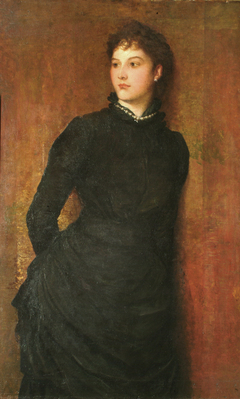
Rachel Gurney
- Production dateexact 1885 - exact 1885
- Medium
- Dimensions
- Painting height: 111.8 cm
Painting width: 66.6 cm
Frame height: 143 cm
Frame width: 101 cm - Description
A portrait of a fellow houseguest of Little Holland House. Painted when she was 15 years old, this portrait of Rachel Gurney (1867–1920) belongs to a series of three-quarter and full-length portraits Watts painted of beautiful females during his late career. This painting was considered to be a companion piece to the three-quarter length portrait of Rachel’s older sister Laura, although the two paintings were never exhibited together. Standing in a plain black day dress, and wearing modest pearl jewellery, the future Countess of Dudley is presented as a serious figure of grace and poise, despite her young years.
- In depth
Rachel Gurney and her older sister Laura were born to Charles Henry and Alice Gurney, a banking family based in Norfolk. However, after Overend, Gurney and Company ran into financial difficulty in 1866, the sisters were largely raised in the home of their grandparents; Thoby and Sara Prinsep at Little Holland House. For a time, they lived in the house with Watts and Laura affectionately recalled growing up around the talented artist whom she referred to as the ‘the fixed star in the Little Holland House firmament’ [1].
In this almost life-sized portrait, Gurney stands with her hands behind her back, leaning against a wall. With her body facing the right, her face is turned towards the left, as if something beyond the picture plane has momentarily caught her attention. She wears a full length, black day dress cinched at the waist with a voluminous skirt. A pearl necklace disrupts the dress’s high collar and is offset with matching pearl earrings. Her brunette hair is arranged tightly behind her, but dark brown curls fall onto her forehead. The rosiness of her cheeks and complexion is matched with the deep pink of her lips.
Believed to be painted when the sitter was aged 15, Rachel’s sister described her as a girl who had ‘more affinity with the ugly duckling than the swanlike creature she afterwards became’ [2]. Despite her age when this portrait was painted, there is a seriousness to her expression, which is matched by her graceful and confident stance.
The indistinguishable background behind Gurney is composed of red, orange and brown tones, with a flurry of green visible around her left shoulder. There is also evidence of scraping and scrubbing in the application of these colours. The inclusion of green could suggest that Watts intended to position Rachel in an outdoor setting and develop the background with foliage.
Curiously, down each side of the canvas a thick band of darker red is visible, which appears thicker down the righthand side. Along the top and bottom edge of the canvas, approximately three inches from the frame, pin holes at regular intervals are also evident. Although we don’t know when these occurred, these interventions suggest that the canvas was extended and placed on a larger stretcher, perhaps to give the portrait grander proportions.
After leaving the home of her grandparents, Rachel married William Humble Ward, the second Earl of Dudley in the autumn of 1891, but the marriage was far from happy. Living for the most part in Ireland, the couple travelled extensively, with trips to the West Indies and a prolonged stay in Australia. During this time the Countess involved herself in many causes, including serving as the president of the Irish Industries Association, founding the Lady Dudley’s Scheme for the Establishment of District Nurses for the Poor of Ireland in 1903 and helping to establish the Irish Central Bureau for the Employment of Women in 1904 [3].
When Rachel Gurney debuted in 1885 at the Grosvenor Gallery, it was deemed to be ‘a delightful portrait of a fresh English girl’ [4]. In the same season however, a three-quarter length portrait of her sister Laura (COMWG.54, 1880-1889) ‘dressed in a furred robe of red plush’ made its debut at the Royal Academy Summer Exhibition. The decision to exhibit the two companion pieces separately left some critics wondering which of the two was the better portrait [5]. According to Mary, Watts’s contemporaries singled out the portrait of Rachel Gurney as ‘specifically admirable’.
In 1905 when it was exhibited at the Royal Academy Memorial Exhibition for Watts, King Edward VII who had been a friend of the Gurney’s expressed his desire to purchase the work [6]. Mary, however, politely refused to sell the portrait and it has always remained in the Watts Gallery Trust collection.
Explore:
Laura Gurney [COMWG.54]
Footnotes:
[1] Laura Troubridge, Memories and Reflections (London: Heinemann Ltd., 1925) p.9.
[2] Laura Troubridge, Memories and Reflections (London: Heinemann Ltd., 1925) p.125.
[3] Martha Groppo, ‘Ward [nee Gurney], Rachel Anne, countess of Dudley’, Oxford Dictionary of National Biography, 12 December 2019.
[4] ‘The Grosvenor Gallery’, Manchester Guardian, 27 April 1885, p.6.
[5] ‘The Royal Academy: First Notice’, Manchester Guardian, 2 May 1885, p.9; ‘Fine Art Gossip’, The Athenaeum, issue 2999, 18 April, p.512.
[6] Mary Seton Watts, Catalogue of Portraits by G.F. Watts O.M. R.A., Vol. II, c.1915, p.62.
Further Reading:
‘Fine Art Gossip’, The Athenaeum, issue 2999, 18 April, p.512.
‘The Grosvenor Gallery’, Manchester Guardian, 27 April 1885, p.6.
‘The Royal Academy: First Notice’, Manchester Guardian, 2 May 1885, p.9.
Victoria Franklin Gould, G.F. Watts: the last great Victorian (New Haven and London: Yale University Press, 2004).
Martha Groppo, ‘Ward [nee Gurney], Rachel Anne, countess of Dudley’, Oxford Dictionary of National Biography, 12 December 2019.
Laura Troubridge, Memories and Reflections (London: Heinemann Ltd., 1925).
Mary Seton Watts, Catalogue of Portraits by G.F. Watts O.M. R.A., Vol. II, c.1915
Text by Dr Stacey Clapperton
|
|
