


- Object numberCOMWG.6
- Artist
- Title
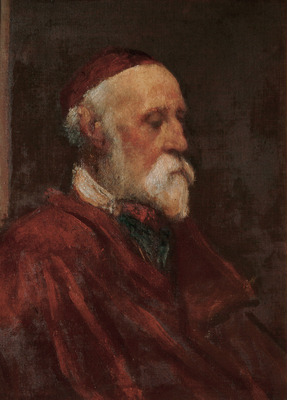
Self-Portrait of G. F. Watts in Old Age
- Production date1903 - 1904
- Medium
- Dimensions
- Painting height: 63.5 cm
Painting width: 45.7 cm
Frame height: 99 cm
Frame width: 81 cm - Description
Watts’s last self-portrait closely resembles a 1566 self-portrait by the Italian painter, Titian. By depicting himself in profile with a white beard, skullcap and robes, Watts alligns himself with the Old Master painter. Of his self-portraiture Watts wrote: ‘I paint myself constantly, that is to say whenever I want to make an experiment in method or colour and I am not in the humour to make a design’.
- In depth
This unfinished painting, started just a few weeks before his death in 1904, is the final self-portrait Watts created. When describing this painting Mary Watts provided a brief history of this work. She wrote:
In the memorial exhibition of 1905 at the R.A. [Royal Academy] this portrait was made the centre of the large gallery. Painted but a few weeks before the last illness, chiefly to experiment once more with a former method of under painting in tempera. Mr. Watts made use of a fine photograph instead of the mirror, and to this is owed the contemplative expression absent in other portraits [1].
Similarly to Mary, scholars of Watts often compare Watts during this period to some of his other self-portraits. In his work on G F Watts, published in 1904, G.K. Chesterton also compared this work to an earlier self-portrait. He wrote:
Of Watts as he was at this time there remains a very interesting portrait painted by himself. It represents him at the age of nineteen, a dark, slim, and very boyish-looking creature…. And there is something about this contrast between the unconsciously leonine hair and the innocent and almost bashful face, there is something like a parable of Watts. His air is artistic, if you will. His famous skull cap, which makes him look like a Venetian senator, is as pictorial and effective as the boyish mane in, the picture. But he belongs to that, older race of Bohemians of which even Thackeray only saw the sunset, the great old race of art and literature [2].
Although likely not directly referencing this painting, here Chesterton notes the differences between Watts’s look later in his life (referencing a skull cap also seen in this work) and an earlier self-portrait of Watts at nineteen - possibly Self-Portrait aged Seventeen (COMWG.10) or Charcoal Self-Portrait Study known as 'Fear' (COMWG2007.904). Chesterton is reverential to Watts during this period noting that he appears to look like a Venetian senator (COMWG2014.10) and includes him in a group of wise old artists and authors.
Mark Bills also noted how Watts presented himself in this work. Bills specifically notes how the skull cap Watts wears, his beard, his pose, his robes, and his pose are similar to a self-portrait by Titian (a painter Watts greatly admired) painted in 1566 [3]. Like Chesterton, Bills emphasises how these robes (which are the doctoral robes he received for his honorary degree at Oxford University in 1882), combined with the warm colours of this work, highlight a pensive old master [4]. In this way, Watts uses this self-portrait to compare himself to earlier artists, as he had done previously, for example in his Self-Portrait in the Style of Van Dyck (COMWG2007.273).
Footnotes:
[1] Mary Watts, Catalogue of Portraits by G.F. Watts, page 169.
[2] G.K. Chesterton, G.F. Watts, page 26.
[3] Mark Bills, “83 Portrait of the Painter (1904), 1904,” G F Watts Victorian Visionary (ed. Mark Bills and Barbara Bryant), page 282.
[4] Mark Bills, “83 Portrait of the Painter (1904), 1904,” G F Watts Victorian Visionary (ed. Mark Bills and Barbara Bryant), page 282.
Text by Dr Ryan Nutting
|
|
