


- Reproduction
- رقم الكائنCOMWG.15
- المنشيء
- العنوان
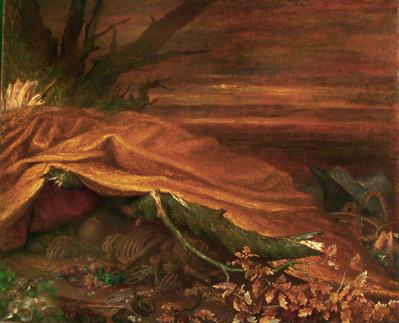
Can These Bones Live?
- التاريخ1897 - 1898
- مادة
- الأبعاد
- Painting height: 152.4 cm
Painting width: 190.5 cm
Frame height: 186 cm
Frame width: 224 cm - الوصف
The title of this dark apocalyptic painting was taken from one of the most important prophetic books of the Old Testament, the Book of Ezekiel. Ezekiel is transported to the valley of bones and as he looks upon them God asks him ‘Son of man, can these bones live?’ (Ezekiel 37:3). Watts’s painting was painted at his home Limnerslease in Surrey in the 1890s, the same decade in which H. G. Wells’s (1866-1946) apocalyptic science fiction, such as The Time Machine (1895) and The War of the Worlds (1897) appeared.
However, the words carved into the bark of the shattered oak in Anglo-Saxon ‘Alfred me planted’ convey a problematic nostalgia for an England that perhaps never even existed. If we interpret it generously, the painting critiques the destructive forces of industrialisation, capitalism, and imperialism, as Watts himself confirmed. Yet, Watts’s thoughts on imperialism are problematic and complex, and often contradictory, and this paining is a case in point. Does this blighted oak represent the destruction of an England that Watts longed to return to? Is it nostalgic or critical? Is it a warning or is it depicting the ruins of the present as Watts saw them? After all, Watts did not refrain from critiquing social evils of nineteenth-century society in his social realist paintings and even his symbolist work, such as Mammon (COMWG.49, 1885). And he had been preoccupied with apocalyptic imagery long before Can These Bones Live? as seen in his paintings of the four riders of the apocalypse, and prophetic paintings such as St John the Baptist and Jonah (COMWG2007.486a).
Can These Bones Live? was shown at the New Gallery in 1898, in the ‘year of Portraits’, as one reviewer designated it. To this critic, writing under the signature W., Watts’s allegory and other works contributed to ‘make up a remarkably good exhibition; but they are lost in the human and artistic interest of the portraits’ [1]. Fernand Khnopff (1858-1921), the Belgian painter, on the other hand, thought it was a ‘powerful work, an imposing composition, expressively coloured’ which ‘compels the mind to deep and gloomy meditation’ and reminded him of an earlier similarly horizontal composition by Watts: the fresco-like Sic Transit (1891-92) [2]. The reviewer in The Athenaeum was similarly appreciative. The ‘desert scene, strewn with skeletons of men, and parts of engines, tools, &c., suggests more of the artist’s meaning than we can attempt to set forth…the picture displays much of his artistic powers and resources. [3].
Footnotes:
[1] W. ‘At the New Gallery’, in The Academy 1356 (Apr 30, 1898), 479-479, p. 479.
[2] Fernand Khnopff, ‘The New Gallery’ in The Magazine of Art (Jan 1898), pp. 427-431, pp. 430-431.
[3] Anon. ‘The New Gallery’ 3680 (May 7, 1898), pp. 603-605, p. 604.
Text by Dr Eva-Charlotta Mebius
|
|
