


- Reproduction
- رقم الكائنCOMWG.83
- المنشيء
- العنوان
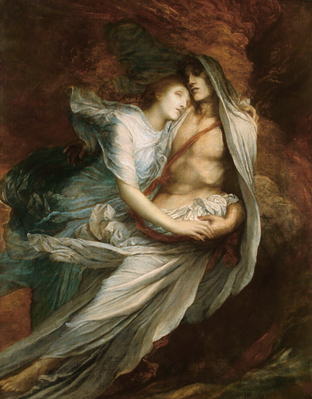
Paolo and Francesca
- التاريخfrom 1872 - to 1884
- الأبعاد
- Painting152.4Painting129.5Frame height: 184 cm
Frame width: 159 cm
Black and gold frame height: 236 cm
Black and gold frame width: 209.5 cm
Black and gold frame depth: 22.5 cm - الوصف
Paolo and Francesca were adulterous lovers in Dante’s ‘Inferno’, part of his 14th-century epic poem the Divine Comedy. When the couple’s affair was discovered, they were murdered by Giovanni, Francesca’s husband and Paolo’s brother. Condemned to the Second Circle of Hell, the lovers were doomed to spend eternity in the black winds of the underworld. Watts painted this subject four times over as many decades. In this final and most complete version, the exhausted lovers still hold each other tenderly.
Like many of his works G.F. Watts created multiple versions of this painting during his lifetime including a version in the late 1840s and this, the final, version finished in the 1880s. In the catalogue of G.F. Watts work completed after his death his wife Mary provided a brief history of this work. She wrote:
This later version of the design was worked upon at interval for many years though undoubtedly the greater part was painted during the years 1872-5. It was varnished in 1884 which points to the painting having remained untouched for four or five years previously [1].
Here she stressed, and later noted that Watts returned to this painting over the course of many years including noting that Watts himself stated he repainted and improved it in 1875 [2]. In this catalogue she details that this work showed in places such as New York, Stockholm, and Chicago, among others, during his lifetime and offers high praise for this work when she stated, “the verdict of time will in all probability place this picture as one on the highest level of the painter’s attainment, both as to technical perfection and for the imaginative conception” [3].
Multiple scholars and artists have previously explored the themes found here based upon the story of the doomed lovers Paolo and Francesca from the fifth canto of Dante’s Inferno, including, Dante Gabriel Rossetti in a triptych created in 1855 and a work by Ary Scheffer in 1835. Here Watts depicts the story of the doomed lovers Paolo and Francesca from the fifth canto of Dante’s Inferno. Dante based his depiction the real life thirteenth century figures Francesca di Rimini, the daughter of a lord and Paola Malatesta, who fell in love with the also married brother of her husband Giovanni. Giovanni later surprised the two lovers and killed them both between 1283 and 1286. In this work Watts shows the two lovers as embracing one another within the swirling winds of the second circle of hell which is reserved for the lustful.
In the approximate three decades Watts created his different versions of this work he made a number of changes. While the depictions of Paolo changed little over time, first three versions of this painting depict Francesca as nude in this version Watts placed a cloth over her. Underwood argues that this covering draws the viewer’s attention more to her face while Staley, Underwood, and Bills point how this accentuates the sense that the two are floating in the Inferno with winds blowing around them [4]. Furthermore, scholars have also noted the differences in Francesca’s face over these four various and speculated that Francesca represented women Watts knew or felt a romantic attachment to at the time he painted these works while Paolo may have represented Watts himself [5].
Footnotes:
[1] Mary Watts, Catalogue of the Works of G.F. Watts, page 117.
[2] Mary Watts, Catalogue of the Works of G.F. Watts, page 117.
[3] Mary Watts, Catalogue of the Works of G.F. Watts, page 117.
[4] Hilary Underwood, “50. Paolo and Francesca,” The Vision of G F Watts (ed. Veronica Frank'in Gould), page 64; Mark Bills, “49. Paolo and Francesca,” G.F. Watts Victorian Visionary (ed. Mark Bills and Barbara Bryant), page 201; Allen Staley, “28. Paolo and Francesco c, 1872-84,” Victorian High Renaissance (ed. Richard Dorment, Gregory Hedburg, Leonee Ormand, Richard Ormand, Allen Staley), page 86.
[5] Hilary Underwood, “50. Paolo and Francesca,” The Vision of G F Watts (ed. Veronica Franklin Gould), page 64; Mark Bills, “49. Paolo and Francesca,” G.F. Watts Victorian Visionary (ed. Mark Bills and Barbara Bryant), page 201l Allen Staley, “28. Paolo and Francesco c, 1872-84,” Victorian High Renaissance (ed. Richard Dorment, Gregory Hedburg, Leonee Ormand, Richard Ormand, Allen Staley), page 86.
Text by Dr Ryan Nutting
|
|
