


- Reproduction

- ObjektnummerCOMWG2007.957
- Ophav
- Titel
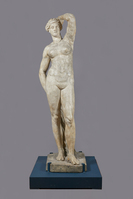
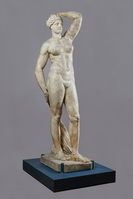
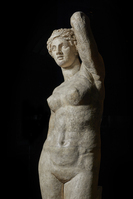
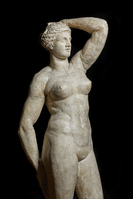
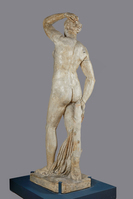
Plaster Sculpture of Standing Female Nude, 'Aurora', also represented in G. F. Watts's Painting of the Same Title (also known as 'Dawn')
- Produktionsdato
- Materiale
- Mål
- Sculpture height: 243 cm
Sculpture width: 78 cm
Sculpture depth: 79 cm - Beskrivelse
Aurora was the personification of the dawn and the twin of Helios, who represented the actual sun. Watts painted a version of Aurora before he travelled to Italy in 1843. The pose of Aurora in that painting is the basis for this statue, made in the 1860s or 1870s. The over-life-size statue of a nude woman was never exhibited in Watts’s lifetime. He was unsatisfied with it and he destroyed another version of the same subject. According to Mary Watts, he was attempting ‘something far more archaic, straight and flat in line like a ray of sunlight.’ He was not trying to make a life-like statue of a real person, but something that was more impressive than a ‘merely big woman,’ like the lost sculpture of Athena by Pheidias.
The over-life-size plaster model of Aurora is the sculptural version of a figure Watts revisited across his career, the stylised female nude with one arm raised above the head, either standing or reclining. This is seen in numerous sketches and paintings, including A Study with the Peacock’s Feathers (private collection), the four versions of The Judgement of Paris (COMWG2007.843, 1874) or Olympus on Ida (COMWG.30, 1885), the two versions of Thetis at Watts Gallery, and the painting Aurora, which significantly predates the sculpture (Oldham Hall, 1842). A similar pose may even be seen in the reclining figure of Earth in the study Sun, Earth, and Their Dead Daughter Moon (COMWG.70, 1899-1902). The Watts Gallery holds numerous drawings of a nude woman in similar positions, probably based on earlier drawings Watts made of his favourite model, Mary ‘Long Mary’ Bartlett (COMWG.180) [1].
About the sculpture, Mary Watts recorded George as having written:
I have great hopes of making something really good of Aurora.' When I call it 'Aurora' I mean a good deal more by it; I want the form to be in harmony with, and so far expressive of, the awakening and unveiling of all that is great in resolve and perfect in hope; the idea carried out in all the directions you will be able to imagine. Of course all this cannot be expressed, but, as I say, the form, by its power and spring, may be in harmony with the idea [2].
Despite early satisfaction with the sculpture, Watts kept reworking it and eventually found it unsuccessful:
But something he was trying for eluded him, and feeling unhappy he cut the figure to pieces. Talking of this at Limnerslease the following spring he deeply regretted it: "I was a fool to change it, I cannot think what I was about," were his words. " I thought it was wrong, but if it looked right what did it matter? We think now-a-days that we must get our work to be mechanically exact, but that has nothing to do with it; the quality of exactness is quite another element." [3].
Mary suggested that Watts had been working for ‘something far more archaic, straight and flat in line like a ray of sunlight’ [4]. Writing to Charles Rickard, Watts had suggested that the work might be put into marble, or possibly ivory and gold [5]. From the earliest days of his artistic career Watts had been invested in the work of Pheidias, the sculptor responsible for the overall design of the Parthenon sculptures and of the chryselephantine (gold and ivory) sculpture of Athena Parthenos, housed within the temple. Watts wrote that most ancient chryselephantine sculptures ‘would shock modern ideas, for it is certain no natural effects were imitated or recalled’ [6]. He noted that the Athena Parthenos would not have been lifelike, and that ‘a merely big woman, however like life, would not have over-awed the army of Attila’ [7]. Although Watts sought a sense of ‘largeness’ and grandeur in his sculptures (apart from just making them big, like Physical Energy), he noted that what made the Athena so powerful—and the expression he sought in his own work—was that ‘it is possible to realise the “tender grace” and serene divinity of the goddess as she stood a miracle of beauteous yet awful dignity.’ [8] It may have been that in attempting an archaic, planar, and large figure of Aurora that captured the character of a ray of sunlight, Watts was pursuing a Pheidian sense of expressive power beyond the mere expression of anatomical accuracy and human features.
Although Aurora was not exhibited in Watts’s lifetime, the formal characteristics of the work, such as the stiff pose, schematic body and facial features, and a sense of non finito surface find echoes in British and Continental modernist sculpture by artists like Rodin (whose work Watts was reputed to dislike, although Rodin reportedly visited Limnerslease in 1903 [9]), Antoine Bourdelle, and Henri Gaudier- Brzeska. The Watts Gallery also holds related casts of heads and limbs that relate to Aurora. A bronze statuette of the composition was sold at Bonhams, London, in 2004, which had previously been in the collection of Lillian Chapman, the Wattses’ ward [10].
Explore:
Aurora (COMWG2007.954)
Two Pencil Studies of a Standing Female Nude (possibly study for 'Dawn') (COMWG2007.413a)
Pencil and Ink Study of a Standing Female Nude (possibly Study for 'Dawn') (COMWG2007.414a)
Two Pencil and Ink Studies of a Standing Female Nude (possibly Study for 'Dawn') (COMWG2007.414b)
Pencil and Ink Study of a Standing Female Nude (possibly Study for 'Dawn') (COMWG2007.415a)
Pencil and Ink Study of a Standing Female Nude (possibly Study for 'Dawn') (COMWG2007.415b)
Four Rough Pencil Figure Studies (COMWG2007.526b)
A Pen and Ink Study of a Standing Female Nude (COMWG2007.531a)
Footnotes:
[1] Mary Seton Watts, George Frederic Watts: the Annals of an Artist’s Life, vol. 2 (London: Macmillan and Co., Ltd, 1912), pp. 44-5.
[2] Mary Seton Watts, George Frederic Watts: the Annals of an Artist’s Life, vol. 2 (London: Macmillan and Co., Ltd, 1912), pp. 314-5.
[3] Mary Seton Watts, George Frederic Watts: the Annals of an Artist’s Life, vol. 2 (London: Macmillan and Co., Ltd, 1912), p. 315.
[4] Mary Seton Watts, George Frederic Watts: the Annals of an Artist’s Life, vol. 2 (London: Macmillan and Co., Ltd, 1912), p. 315.
[5] G. F. Watts to Charles H. Rickards, 19 August 1879, National Portrait Gallery Archives GFW1/3/75.
[6] Mary Seton Watts, George Frederic Watts: the Annals of an Artist’s Life, vol. 3 (London: Macmillan and Co., Ltd, 1912), p. 23.
[7] Mary Seton Watts, George Frederic Watts: the Annals of an Artist’s Life, vol. 3 (London: Macmillan and Co., Ltd, 1912), p. 23.
[8] Mary Seton Watts, George Frederic Watts: the Annals of an Artist’s Life, vol. 3 (London: Macmillan and Co., Ltd, 1912), p. 23.
[9] Rodin reportedly visited the Wattses in December 1903. R.E. Gutch, ‘Watts’s Sculpture,’ The Burlington Magazine Vol. 110, No. 789 (Dec., 1968), pp. 693-4; Wilfrid Blunt, England’s Michelangelo (London: Hamish Hamilton, 1975) p. 196.
[10] Bonhams, London, 19th Century Paintings, November 17, 2004, lot 151.
Further Reading:
Stephanie Brown, ‘Indefinite Expansion: Watts and the Physicality of Sculpture,’ in Representations of G.F. Watts: Art Making in Victorian Culture, ed. Colin Trodd and Stephanie Brown (Farnham: Ashgate, 2004), pp. 83-106.
R.E. Gutch, ‘Watts’s Sculpture,’ The Burlington Magazine Vol. 110, No. 789 (Dec., 1968), pp. 693-99.
Elizabeth Prettejohn, ‘Between Homer and Ovid: Metamorphoses of the ‘Grand Style’ in G. F. Watts,’ in Representations of G.F. Watts: Art Making in Victorian Culture, ed. Colin Trodd and Stephanie Brown (Farnham: Ashgate, 2004), pp. 49-64.
Text by Dr Melissa Gustin
|
|


