


- Reproduction
- ObjektnummerCOMWG2008.124
- Ophav
- Titel
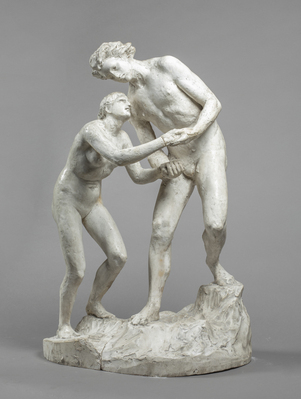
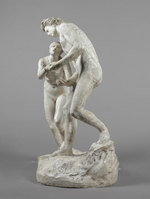
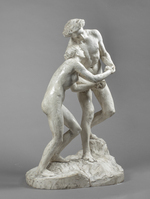
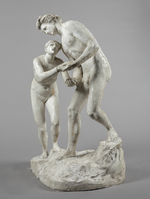
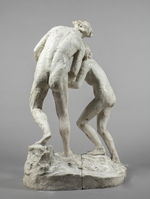
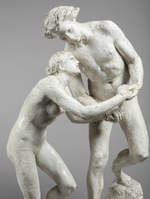
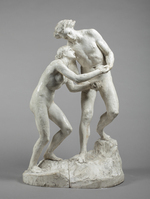
Plaster maquette for oil painting 'Love and Life'
- Produktionsdatocirca 1880 - circa 1884
- Materiale
- Mål
- Case height: 64.4 cm
Case width: 55.3 cm
Case depth: 41.2 cm - Beskrivelse
Watts often made small sculptures in wax, clay and plaster to use as models for his paintings. This model made in plaster was a study for the oil painting Love and Life, also in the Watts collection. The allegorical figures depict Love, a nude man, guiding the figure of Life, a hunched and frail woman, across a rocky landscape. Described by Watts as a ‘painted parable’, Love and Life aimed to convey the message that love, kindness and charity were vital for the elevation of human life. This model was made by Watts to eliminate the need for human models in working out poses for figures. In the final composition Love also is depicted with large wings, which are not included in preparatory sketches or models.
Watts painted multiple versions of the composition Love and Life and produced several studies on paper and in plaster models. These include early oil sketches and sanguine studies (COMWG2007.697), as well as many sketches of poses in the Watts Collection. The painting (COMWG.175, 1880-1889), described by Watts as his ‘best composition’ was one of his most well-regarded and widely exhibited symbolist works. It presented Love, in the guise of a strong athletic youth with powerful red wing, leading the small and frail female figure of Life across a rocky landscape, symbolic of the difficult conditions we must face in life and the role love provides through life’s struggles. On his symbolist works, Watts expressed that he wished for them to express the ‘great moral conception of life, its difficulties, duties, pains and penalties’ [1].
This model seems to be an early compositional study in plaster, made to understand the pose and relationship between the two figures as well as the way light and shadow played on the body. Watts often made models in wax, plaster, and clay in order to work out early ideas for bodies and composition [2]. In doing this he eliminated the need for life models in preparation and sketching. In the case of this plaster model for Love and Life, it allowed Watts to understand the spatial relationship between the two figures and their proportional positions.
As a preparatory study for the oil painting several areas are raw and unfinished such as the feet and parts of the faces of each figure. The emphasis of the figures is on the poses, the body, and the relationship between the two individuals. In the final composition Watts added large wings to the figure of Life which loom protectively. The maquette was made in two parts, connecting at the rocky base and at the wrists of Life. This was likely due to the complexity of the large figure and the need for ease of movement. However, this does draw attention to the key moment of connection in both the painting and the preparatory studies – the clasped hands of Love and Life.
In response to criticism of Life’s physical fragility, Watts noted ‘I may have pushed this slightness too far, but I wanted to insist on the weakness of human existence far down among the lower creatures but for the vivifying and uplifting impulse of sympathy’ [3]. In many of Watts’s symbolist works the meaning of the figures is expressed in the physique and gesture of the body, as opposed to the face and its expressions. In doing this Watts subverted traditional forms of allegory.
Footnotes:
[1] Mary Seton Watts, The Annals of an Artists Life, Vol. II, (London: Macmillan and Co., 1912), pp, 227-8
[2] Stephanie Brown, ‘Watts and Sculpture’, in Mark Bills & Barbara Bryant, G. F. Watts Victorian Visionary: Highlights from the Watts Gallery Collection (New Haven & London: Yale University Press, 2008), pp.59-73.
[3] Mary Seton Watts, The Annals of an Artists Life, Vol. II, (London: Macmillan and Co., 1912), pp, 234.
Text by Dr Nicole Cochrane
|
|


