


- Reproduction
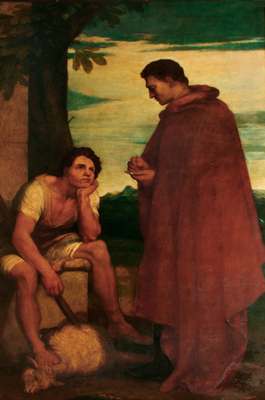
- ObjektnummerCOMWG.33
- Ophav
- Titel
Aristides and the Shepherd
- Produktionsdatonot before 1848 - not after 1852
- Materiale
- Mål
- Painting height: 305 cm
Painting width: 213 cm
Frame height: 313 cm
Frame width: 221 cm - Beskrivelse
Aristides was an Athenian politician in Ancient Greece in the 5th Century BC. He was a rival of the famous general and politician Themistocles. The scene from Aristide’s life that Watts chose to depict was his Ostracism in 483/2 BC. [3] In Plutarch’s Lives it is told that of ‘all the virtues of Aristides, the people were most struck with his justice’. [4] But the moniker ‘the Just’ angered Themistocles and his supporters, who said that Aristides was becoming too powerful, and so they called for a vote on Aristide’s banishment, his ostracism. Perhaps G. F. Watts admired Aristides’ stoicism. The shepherd mindlessly keeps his foot pressed down on the neck of the lamb. Is the lamb Aristides? The moral of the story seems to warn against a herd mentality. Remember, the citizen who was for Aristides’ banishment, did not recognise the man when he stood right in front of him. Nor did he have any quarrel with him. Yet, he was still ready to sign his shell with the name of Aristides. Hence, it seems likely that Watts saw Aristides as a Christ-like figure. The anachronistic scarlet robe he wears recalls the colour of the robes of the cardinals of the Catholic church, or the red gown of a Venetian lawyer. In turn, this colour refers to a quote from the Gospel of Matthew of the New Testament when the Roman soldiers mock Jesus ‘And they stripped him, and put on him a scarlet robe’ (27:28). Aristides’ red robe also recalls a self-portrait by G. F. Watts from 1853, in which the painter wears a garment of a similar colour (COMWG2014.10).
When Aristides and the Shepherd was exhibited in the east gallery of the Grosvenor Gallery in 1882 one pesky reviewer remarked that the painting ‘need not have been exhibited’ [1]. There was something about the size of the figure that seemed to put off other critics too. One reviewer noted how a ‘coldness possesses us as we look at…a large Hyperion sitting on the clouds; an equally large Aristides marking his own ostracism on the shell at the shepherd’s dictation; a large Satan, turning a somewhat unmuscular back towards us’ [2]. In many ways, it is a slightly startling composition. Why is the shepherd’s foot on the poor sheep and lamb’s neck for example?
Plutarch explains the process of ostracism, how the citizens gathered and ‘took a piece of a broken pot, or a shell, on which he wrote the name of the person he wanted to have banished’ [3]. There needed to be six thousand votes for banishment. Furthermore, Plutarch says that as voters inscribed their shells or pieces of pottery for or against Aristides there was a citizen who could not write. So, not recognizing Aristides, he gave the latter his shell and asked him to write the name of Aristides. Aristides asked if the man had ever been injured by the man he wished to have banished, to which the citizen was said to have replied no ‘but it vexes me to hear him every where called the Just’ [4]. At this, Aristides stoically proceeded to inscribe the piece of shell with his own name and returned it. However, a mere three years later, all exiles were recalled to Athens to fight against Xerxes. Plutarch tells of how Aristides returned to the Athenians to fight alongside his old rival Themistocles to repel the second Persian Invasion of Greece (480-479 BC). Later, events transpired that led to the ostracism of Themistocles, yet Plutarch writes that Aristides played no part in this and did not take the opportunity to seek revenge [5].
Ultimately, this large fresco-like composition is perhaps not one of G. F. Watts’s most successful paintings. It is also a rare subject and perhaps it was simply too unfamiliar to the audience, although there were others who had attempted it, such as, the Swiss painter Angelica Kauffman (1741-1807) who was one of the founding members of the Royal Academy, and the French painter Eugène Ernest Hillemacher (1818-1887). As such, despite all its faults, Aristides and the Shepherd is a painting which speaks to our own time and tells an important story about government, courage, and selflessness.
Explore:
Self-portrait 'Venetian Senator' (COMWG2014.10)
Footnotes:
[1] Anon. ‘Notes on Current Events’ in British Architect 17.5 (Feb 3, 1882), pp. 50-52, p. 51.
[2] Anon. ‘ART. VI.—Exhibition of Works of G. F. Watts, R.A., Grosvenor Gallery.’ in London Quarterly Review 58.115 (Apr 1882), pp. 150-176, p. 166.
[3] Plutarch, ‘Aristides’ in Plutarch’s Lives, Translated from the Original Greek by John Langhorne and William Langhorne (London: Thomas Tegg, 1828), p. 234.
[4] Ibid., p. 234.
[5] Ibid., p. 243.
Text by Dr Eva-Charlotta Mebius
|
|
