


- Reproduction
- ObjektnummerCOMWG.51
- Ophav
- Titel
Giuseppe Garibaldi
- Produktionsdatoexact 1864 - exact 1864
- Materiale
- Mål
- Painting height: 68.6 cm
Painting width: 59.9 cm
Frame height: 99 cm
Frame width: 86 cm - Beskrivelse
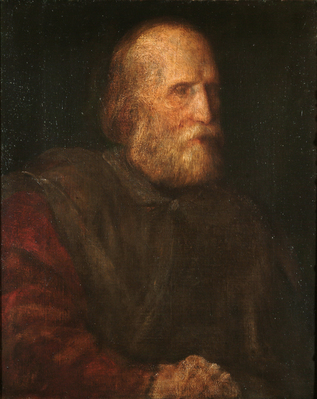
A mysterious portrait of a great hero. Giuseppe Garibaldi (1807–1882) was an Italian patriot and soldier who was instrumental in the unification of Italy that took place between 1848–1871. Garibaldi’s popularity, as a result of his numerous military campaigns and ability to rouse public support, cemented his position as a great man of the 19th century. During a brief visit to England in 1864, in order to encourage support for his cause, Watts was able to secure a number of short sitters with Garibaldi. The resulting portrait shows a dignified and composed character, yet one clouded in mystery.
Nicknamed the ‘Hero of Two Worlds’ Garibaldi tirelessly campaigned from 1848 until 1871 for the unification of Italy and its liberation from Austrian rule. Although exiled twice to both North and South America during this time, Garibaldi successfully led military campaigns against French, Spanish and Austrian troops. In addition to being named after the biscuit which he is believed to have handed out to his troops, Garibaldi is regarded as a key character of the 19th century’s concern with nationalism and liberalism.
Garibaldi sat for Watts in 1864 during his brief visit to England when he was aged 57. On his arrival in Southampton, a large admiring crowd gathered, and he received an ovation [1]. The meeting with Watts came about through their mutual friend the Duchess of Sutherland. However, Garibaldi’s schedule was so demanding that he could only arrange to sit for Watts between the hours of seven and eight in the morning. During these short sittings the Duchess would read to Garibaldi whilst Watts painted [2].
In the portrait, Garibaldi is wearing a bold red shirt, with a buttoned and collared poncho on top, and sits formally with his hands firmly clasped in front of him. His power and status are reflected in the way that his body dominates the space of the painting, with his broad shoulders stretching across the width of the canvas, despite being presented in three-quarter profile. The overall tone of the picture is quite low, and Garibaldi appears to emerge from the shadows. His face is the brightest part of the composition and appears to almost glow in comparison to his surroundings.
In the depiction of the head, Watts demonstrates a masterly use of the chiaroscuro effect, whereby the solidity of form has been established using the contrast between the light hitting the face from the right-hand side and the shadow which obscures the left-hand side. Close inspection reveals that there are few definite edges to the facial features, which is best demonstrated in the rendering of the eyes. In this depiction of an Italian hero, Watts has used the effect of chiaroscuro as developed by the Italian Old Master’s including Leonardo da Vinci and Caravaggio.
For Watts, the finished portrait was ‘integral to his gallery of great men’ but did not enter the National Portrait Gallery collection due to their restriction on accepting portraits of foreign sitters [3]. Like his portrait of Joseph Joachim (COMWG.34, 1867), which was painted a year later, this study of Garibaldi remained in Watts’s own collection. A photograph of the portrait, which was taken by Frederic Hollyer at a later date was sent to Garibaldi. In a letter to the Countess Martinengo Cesaresco it was declared that the photograph was received with ‘the greatest pleasure and the portrait was considered to be ‘wonderfully like’ the great man himself [4].
Explore:
Joachim [COMWG 34]
Footnotes:
[1] Mary Seton Watts, George Frederic Watts: Annals of an Artist’s Life, vol. I (London: Macmillan and Co. Ltd., 1912), p.220.
[2] Mary Seton Watts, George Frederic Watts: Annals of an Artist’s Life, vol. I (London: Macmillan and Co. Ltd., 1912), p.220.
[3] Leonée and Richard Ormond, G.F. Watts: The Hall of Fame: Portraits of his Famous Contemporaries, National Portrait Gallery (Compton, Surrey: Watts Gallery, 2012), p.16
[4] Mary Seton Watts, George Frederic Watts: Annals of an Artist’s Life, vol. I (London: Macmillan and Co. Ltd., 1912), p.220.
Further Reading:
Victoria Franklin Gould, G.F. Watts: the last great Victorian (New Haven and London: Yale University Press, 2004).
Leonée and Richard Ormond, G.F. Watts: The Hall of Fame: Portraits of his Famous Contemporaries, National Portrait Gallery (Compton, Surrey: Watts Gallery, 2012).
M.H. Spielmann, G.F. Watts, R.A., O.M., as a Great Painter of Portraits: A Lecture, delivered in the Memorial Hall Manchester, 7th June 1905 (London, Sherratt & Hughes, 1905).
Mary Seton Watts, Catalogue of Portraits by G.F. Watts O.M. R.A., Vol. II, c.1915.
Text by Dr Stacey Clapperton
|
|
