


- Reproduction
- InventarnummerCOMWG.142
- Hersteller
- Titel
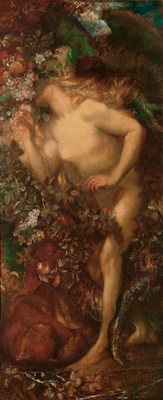
Eve Tempted
- Datumcirca 1868 - circa 1868
- Medium
- Format
- Painting height: 251.5 cm
Painting width: 109.2 cm
Frame height: 284 cm
Frame width: 143 cm - Beschreibung
This work is the second in a three-part series of works by Watts depicting his version of the biblical story of Eve. In this work, Eve is tempted by a serpent-like Satan to taste the forbidden fruit in the Garden of Eden. In theology, this act of original sin is said to have brought sexual shame and death upon humanity. Watts described how, in his final scene, Eve is ‘restored to beauty and nobility by remorse’.
G F Watts considered his three pictures of Eve, her creation (COMWG.11, 1881-1882), her temptation, and her repentance (COMWG.141, 1868-1903) to ‘form part of one design’. They were intended to constitute ‘parts of an epic poem’ together with his paintings of her son Cain [1].
For Eve Tempted it is perhaps not so surprising then, that his design relies more on John Milton’s Epic poem Paradise Lost (1667), rather than the Biblical account of the temptation of Eve in the Book of Genesis, chapter 3 ‘when the woman saw that the tree was good for food, and that it was pleasant to the eyes, and a tree to be desired to make one wise, she took of the fruit thereof, and did eat, and gave also unto her husband with her; and he did eat.’ (Genesis 3:6). This account seemingly has little to do with the sensual picture before us.
Rather than Genesis, Watts appears to have found inspiration in John Milton’s Paradise Lost, as William Blake did too for his tempera painting Eve Tempted by The Serpent (c. 1799-1800, V&A). As M. H. Spielmann observed, ‘Blake is perhaps nearest to him in imagination, but furthest from him in ordered thought and power of execution’ [2]. As for Blake, Watts’s depiction of the temptation of Eve is closer to John Milton’s account in Book 9 of Paradise Lost when Satan returns to Eden as a mist and whereby he is able to enter the body of the serpent. In Book 9 of Paradise Lost Eve ventures on her own through her garden like ‘a wood-nymph light’ (Bk 9, l. 387), a hamadryad, a Pomona with ‘goddess-like deport’ (l. 389). She moves through the Garden of Eden where the roses grow so thick that Satan can safely spy on her unseen ‘Veiled in a cloud of fragrance’ (l. 425). Similarly, we can barely make out the serpent which graces Eve’s left leg in Watts’s painting.
In this manner, Watts envisions Milton’s Eve, and in turn Ovid’s, as a gardening Pomona, as a goddess of fruit trees in ‘This flowery plat, the sweet recess of Eve/Thus early, thus alone; her heavenly form/Angelic, but more soft, and feminine,/Her graceful innocence’ (l. 456-459). Analogously, in Book 14 of the Roman poet Ovid’s Metamorphoses (8 AD) Pomona was seduced by Vertumnus who manged to enter her orchard disguised as an old woman [3]. In so doing, Watts’s painting draws on what Mandy Green calls ‘Milton’s Ovidian sensibility’ whereby Milton ‘plays upon and yet subverts the reader’s expectations, which have been programmed by the Ovidian mythic paradigm in which the violation of a virginal landscape is deployed to suggest the rape of a helpless female victim’ [4]. Moreover, Watts had painted Vertumnus and Pomona which was shown in the South Room at the British Institution in 1841 (nr 264). Height: 6 Ft 8 In Width 6 6 p. 18 Catalogue of the Works of British Artists in the Gallery of the British Institution, Pall-Mall, for Exhibition and Sale (London: William Nicol, 1841).
At first glance, Watts’s contemporary, and Evelyn De Morgan’s uncle, John Roddam Spencer Stanhope’s Eve Tempted (c. 1877), which won the Heywood Prize at the Royal Institution in 1877, may appear to respond more directly to the sinister undertones of the temptation of Eve (Manchester Art Gallery) [5]. Both paintings reinforce the view that Eve was alone in her sin, as Jo Cheryl Exum notes in reference to Stanhope’s Eve ‘Adam is not even present’ [6]. However, if we consider the Miltonic and Ovidian associations of Watts’s painting, this is not merely a sensual nude. On the contrary, Watts presents us with a moral dilemma, as we are also prompted to reflect on our own role, and perhaps our complicity, as observers of this moment. As the critic M. H. Spielmann noted in the Nineteenth Century the ‘synthetic series of “Eve”’ was ‘intended to present a series of reflections of an ethical character, a pictorial Book of Ecclesiastes, or Omar Khayyam with a liberal admixture of spirituality’ [7]. But as is also clear from Watts’s undogmatic rendering of the temptation of Eve, while he devoted ‘a lifetime to ethical and religious thought’ he did not deal ‘with dogma or doctrine’ [8].
This is one of several versions of Eve. Can you spot the lioness resting at her feet? In the version that was exhibited in 1885, which is now at Tate, the lioness was a leopard. Similarly, the Scottish painter William Strang chose to include a leopard in his The Temptation (1899), which was part of his Eve cycle for the library at Compton Hall (at Tate). In the Watts Gallery collection we also have several preparatory sketches for the figure of Eve including Chalk Study of Standing Female Nude(COMWG2007.290, 1868), Three Pencil Rough Studies of the Figure of Eve by the Tree for 'Eve Tempted' (COMWG2007.635, 1869), and Chalk Study of Four Nude Female Figures for 'A Bacchanal and a Study of the Figure of Eve for 'Eve Tempted' (COMWG2007.639, 1865-1869).
Footnotes:
[1] Quoted in Mary Watts, George Frederic Watts: The Annals of an Artist’s Life Vol. I (London: Macmillan and co., 1912), p. 262.
[2] M. H. Spielmann, ‘Mr G. F. Watts: His Art and His Mission’ in The Nineteenth Century 41.239, pp. 161-172, p. 168.
[3] On the violent and destructive nature of this deception see Roxanne Gentilcore, ‘The Landscape of Desire: The Tale of Pomona and Vertumnus in Ovid’s “Metamorphoses”’ in Phoenix 49.2 (1995), pp. 110-120.
[4] Mandy Green, ‘”Joy and Harmles Pastime”: Milton and the Ovidian Arts of Leisure’ in A Handbook to the Reception of Ovid ed. by John F. Miller and Carole E. Newlands (Oxford: Wiley Blackwell, 2014), pp. 324-338, p. 334.
[5] Anon. ‘Some Art Exhibitions’ in The City Jackdaw 3.106, (Nov 23, 1877), pp. 13-13
[6] J. Cheryl Exum, Art as Biblical Commentary: Visual Criticism from Hagar the Wife of Abraham to Mary the Mother of Jesus (London: T&T Clark, 2019) Note: Cannot see the page number on Google Books.
[7] M. H. Spielmann, ‘Mr G. F. Watts’, p. 168.
[8] Ibid., p. 169.
Text by Dr Eva-Charlotta Mebius
|
|
