


- Reproduction
- InventarnummerCOMWG.31
- Hersteller
- Titel
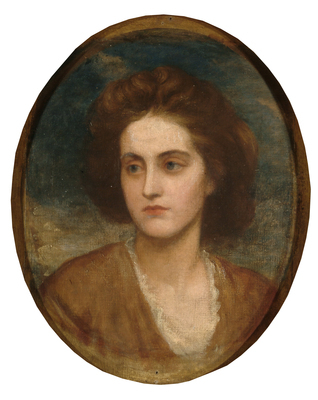
Lady Lilford
- Datumexact 1860 - exact 1860
- Medium
- Format
- Painting height: 50.8 cm
Painting width: 40.6 cm
Frame height: 62 cm
Frame width: 51 cm - Beschreibung
Considered by Watts to be ‘perhaps the most beautiful of all his sitters’, Lady Lilford (c.1826–1884) was a frequent guest at Little Holland House. Painted shortly before her marriage, Thomas Littleton Powys, later Lord Lilford, this portrait illustrates the composure and beauty of the young woman. However, the same cannot be said of Lilford’s singing voice and it was widely reported that Tennyson had to step in at one musical evening at the Prinsep household and advised her ‘never to sing’ again.
Emma Elizabeth Brandling was the daughter of Robert William Brandling, a wealthy coal owner and locomotive engineer from Low Gosforth in Northumberland, who played a crucial role in the formation of the North British Railway in the North East of the country. By the 1850s, his daughter came to be a frequent guest of social events at Little Holland House, London. The future Lady Lilford began sitting for ‘vibrant, informal’ portraits by Watts shortly after they first met [1]. One of these sketches was gifted to the Pre-Raphaelite artist William Holman Hunt who remarked that Watts had succeed in capturing 'the very fullness of personality […] the incarnation of the soul’ [2].
One likeness of Lilford was incorporated into Watt’s ambitious fresco painting for Lincoln’s Inn entitled Justice: A Hemicycle of Law-Givers, 1852-59. Not an artist who relied on professional models, studies of his friends were used for the scheme. The fresco includes more than 30 figures who are presided over by Truth, Mercy and Justice and include: Val Prinsep as Servius, Thoby Prinsep as a Druid, William Holman Hunt as King Ina, Alfred Tennyson as Minos, Sophia Dalrymple as Theodora and Lady Lilford herself as Alfred [3]. The fresco survives as a record of Watts’s inner circle of friends and a who’s who of Little Holland House guests at the time. Although she was famed for her beautiful looks, the same could not be said of Lilford’s singing voice. At one of the musical evenings hosted by the Prinseps, Tennyson had to step in to advise Lilford ‘never to sing’ again [4].
This portrait however, which Watts ‘would not part with’ seems to have been painted for his personal pleasure [5]. Although this bust length portrait appears in an oval shape, it is actually painted on a rectangular support. Oval shaped portraits are rare in Watts’s career and there are indications on the canvas this portrait may have been presented in a rectangular frame at some stage in its history. The blue background, painted in thin and broad sweeps of colour suggests a sky, is a background that Watts often used in his early female portraits. Further examples include Miss Marietta Lockhart (COMWGNC.10, 1845) and Miss Mildmay (COMWG.65, 1854-55). In these portraits the deep blue that sits behind, allows the skin tones of the young female sitters to appear as porcelain, which highlights the delicacy and youthfulness of their features.
After this portrait was painted, a replica was requested by Watt’s patron in the North of England, Charles Rickards, after his plea for the original was denied. Watts had begun work on a second version by December 1870, but warned Rickards that when exhibiting the portrait he ‘must not call it by her name or say who it represents, Lord Lilford has a special distaste of any publicity and will not allow it to be photographed’ [6].
In June 1859, a then Miss Brandling married the nephew of Lord Holland and the son of Mary Elizabeth Fox, Thomas Littleton Powys who succeeded his father in becoming the fourth Baron Lilford in 1861. As a leading ornithologist, her husband’s passion for birds of prey was enviable and his aviaries at their family home at Lilford Hall in Northamptonshire was enviable to those in the field.
In 1884, after 25 years of marriage whereby she raised three sons, Lady Lilford died. Watts’s version of the portrait was exhibited only once during her lifetime, at the Grosvenor Gallery in 1881. During Watts’s later career, and after Lilford’s passing, the work was exhibited more frequently including in Munich in 1893, the Grafton Galleries in 1894 and the New Gallery in 1896. With her name now attached publicly to the portrait, a critic remarked that ‘The beautiful face of ‘Lady Lilford’ might have been painted by Romney’, referring to George Romney, the fashionable English portrait painter of the 18th century [7]. The comparison is not one that Watts would have been particularly fond of as he once remarked that Romney ‘had no backbone; he is absurdly overrated at the present day, and the vogue, which is quite a mistake, could not last’ [8].
Explore:
Marietta Lockhart [COMWGNC.10]
Miss Mildmay [COMWG.65]
Footnotes:
[1] Victoria Franklin Gould, G.F. Watts: the last great Victorian (New Haven and London: Yale University Press, 2004), p.42.
[2] Victoria Franklin Gould, G.F. Watts: the last great Victorian (New Haven and London: Yale University Press, 2004), p.42.
[3] Wilfred Blunt, ‘England’s Michelangelo’: A Biography of George Frederic Watts (London: Hamish Hamilton, 1975), p. 97.
[4] Wilfred Blunt, ‘England’s Michelangelo’: A Biography of George Frederic Watts (London: Hamish Hamilton, 1975), p. 127.
[5] Mary Seton Watts, Catalogue of Portraits by G.F. Watts O.M. R.A., Vol. I, c.1915, p.95.
[6] Letter from G F Watts to C.H. Rickards, 20 December 1872, Watts Correspondence, Heinz Archive, National Portrait Gallery, GFW/1/2
[7] ‘The Artist’, February 1897, p.57.
[8] M.H. Spielmann, G.F. Watts, R.A., O.M., as a Great Painter of Portraits: A Lecture, delivered in the Memorial Hall Manchester, 7th June 1905 (London, Sherratt & Hughes, 1905), p.31.
Further Reading:
‘The Artist’, February 1897
Wilfred Blunt, ‘England’s Michelangelo’: A Biography of George Frederic Watts (London: Hamish Hamilton, 1975).
Victoria Franklin Gould, G.F. Watts: the last great Victorian (New Haven and London: Yale University Press, 2004).
M.H. Spielmann, G.F. Watts, R.A., O.M., as a Great Painter of Portraits: A Lecture, delivered in the Memorial Hall Manchester, 7th June 1905 (London, Sherratt & Hughes, 1905).
Mary Seton Watts, George Frederic Watts: Annals of an Artist’s Life, vol. I (London: Macmillan and Co. Ltd., 1912).
Mary Seton Watts, Catalogue of Portraits by G.F. Watts O.M. R.A., Vol. I, c.1915.
Watts Correspondence, Heinz Archive, National Portrait Gallery, GFW/1/2 and GFW/1/3.
Text by Dr Stacey Clapperton
|
|
