


- Reproduction
- InventarnummerCOMWG2007.398
- Hersteller
- Titel
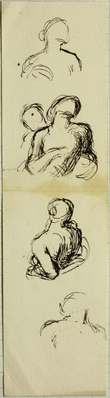
Four Ink Studies of Half-length Female Nude (Study for 'Clytie')
- Datum
- Medium
- Format
- drawing height: 24.4 cm
drawing width: 6.4 cm - Beschreibung
This sheet, probably removed from a sketchbook, shows four simple outline drawings that relate to Watts’s bust Clytie. They may also relate to other pictures from the same period that show a reclining woman with one arm raised over her head. The drawings are simple outlines without faces or details. They show a female figure looking over her shoulder from the front and the back. Watts carried sketchbooks throughout his life, using them to capture quick sketches, notes, and more detailed studies of the world around him. Even the roughest, smallest sketch could be worked up into paintings years later.
This small, narrow sheet of paper, probably taken out of a sketchbook, shows four simple outline drawings of a nude woman looking back over her shoulder in front and rear view. The major indication that these refer to Clytie is the raised shoulder caused by an elbow propped up and head twisted backwards. It may also refer to the reclining figure of Earth in Sun, Earth, and their Daughter Moon (COMWG.70, 1899-1902), a study for which is held at the Watts Gallery—Artists’ Village or the Wife of Pluto [1]. A sheet with two drawings of a reclining nude woman (COMWG2006.38, 1860-1869), probably Mary Bartley, the housemaid known as Long Mary (COMWG.180, 1860), may be some of the first instantiations of this idea for Watts [2].
Watts often recycled poses taken from rough sketches for multiple works. Once he found a pose he liked, it could appear across numerous paintings and drawings, often without using a living model. His repertoire of poses was not an indication of lack of originality, but rather formed a connection between a large body of work that reinforced Watts’s idiosyncratic visual language: the reclining figure of Earth is related to both these early sketches of Clytie and to Aurora (COMWG2007.957) and the pose of the Sun is related to his images of Progress (COMWG.139, 1902-1904) [4].
Explore:
Clytie (COMWG.73)
Chalk Study for 'Clytie' (COMWG.352)
Clytie (COMWG2007.126)
Clytie (COMWG2007.177)
Clytie (COMWG2007.1075)
Clytie (COMWG2008.152)
Footnotes:
[1] Walker Art Gallery, National Museums Liverpool WAG 2135
[2] Chloe Ward, The Drawings of G. F. Watts (London: Phillip Ward Publishers, 2016) p. 96.
Text by Dr Melissa Gustin
|
|
