


- Reproduction
- InventarnummerCOMWG.94
- Hersteller
- Titel
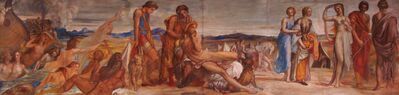
Achilles and Briseis
- Datumfrom 1858 - to 1860
- Medium
- Format
- Painting height: 122 cm
Painting width: 518.5 cm - Beschreibung
This fresco, a painting made on wet plaster, was commissioned by the 4th Marquess of Lansdowne in 1858 for the entrance of Bowood House, with the companion piece of Coriolanus. Watts’ fresco Achilles and Briseis was sold to the Watts Gallery—Artists’ Village in 1956 when Bowood was partially demolished. The fresco shows the moment Briseis, Achilles’ enslaved woman from an earlier war, was taken from the Greek hero by the messengers of Agamemnon. This was a key moment in the Trojan war, leading to Achilles withdrawing from combat because of the insult. At the left, ocean nymphs watch with Poseidon, god of the sea. In the centre, Achilles twists and puts his hand his mouth. His companions, Patroclus in blue armour and a figure in a leopard skin cloak, try to calm him down. Briseis looks back at her first owner while two men in red cloaks lead her off to the left.
The two Bowood wall decorations—Achilles and Briseis, and Coriolanus (COMWG2022.2)—show the hero in a moment of indecision and personal, moral, and political tension, over which they would eventually triumph and choose the ‘correct’ path. The long, narrow space for the pictures caused Watts some difficulty, and required him to work in a more compressed, linear space than he normally would. Watts wrote of Coriolanus, ‘the shape of the space does not lend itself to picturesque general treatment, which might compensate for want of grandeur; but I must get over it as best I may.’ Coriolanus, unlike Achilles and Briseis, was oil on canvas, rather than a fresco. The Watts Gallery holds small oil and watercolour studies of the two (COMWG.258.1, 1885-1886) compositions (COMWG.258.2, 1885-1886), while the Royal Academy has a red chalk study of the picture, and a half-size (26.5 x 107 inch) oil study, which toured the memorial exhibitions of Watts’ work after his death, was sold by Mrs Michael Chapman (the Wattses’ ward) in 1956 [1].
Watts was a key figure in the English fresco revival. His four years spent in Italy, from 1843-7, introduced him not only the Italian Renaissance frescoes and techniques but also to the aristocratic, artistic social circles that would provide commissions and even models for such monumental projects [2]. The Bowood fresco of Achilles and Briseis, for example, includes Virginia, Lady Somers as Briseis (in white drapery at the far right of the scene), Janet Ross as Patroclus, and Mrs Caroline Norton was another (unnamed) figure. Ross recalled in her later memoirs, ‘I was pressed into the service, and stood for Patroclus, dressed up in a magnificent suit of armour, which hurt my shoulders. As a recompense “Signor” gave me the study of my head’ [3]. Ross as Patroclus is probably the figure in blue behind Achilles, but even a relative of Ross had trouble identifying her by the late twentieth century [4]. The figure of Achilles derives from the twisting ignudi of the Sistine Ceiling by Michelangelo and would later appear as the Genius of Greek Poetry in painting (COMWG.22, 1857-1878) and sculpture (COMWG.452, 1904).
When Bowood House was partially demolished, the Watts Gallery received support from the National Art-Collections Fund (now the Art Fund) in 1956 to ship and remount the fresco onsite [5]. This required cutting the 515 cm/17.8-foot-long fresco into six sections, removing them from the wall, and reassembling and restoring on site in the gallery; the lines from this removal can still be seen on the fresco. Restoration carried out in 2009 showed that this was not ‘true’ fresco, that is, painted into fresh wet plaster so the pigment merges fully with the support [6]. Rather, he painted in layers onto dry plaster, leading to Mary’s remarks that she had heard some of the colours had faded. The restoration work confirmed Watts’ own statements that his work in Lincoln’s Inns were the only true buon fresco in England, which Mary recorded in the Annals [7]. Mary’s notes on the Achilles material are not without confusion, however: she calls Coriolanus a fresco as well, when it was an installed canvas, and confused the half-size study a fresco in her catalogue of Watts’ output [8].
Footnotes:
[1] Small Oil Study for 'Achilles and Briseis' (COMWG.258.1, 1885-1886), Compositional Study for a fresco of 'Achilles and Briseis by ca. 1858 George Fredric Watts RA (1817-1904), Mary Seton Watts, Catalogue of Subject Pictures by G.F. Watts O.M. R.A., v. I, c. 1912, p. 10. Here, Mary treats the canvas and fresco as the same object, despite giving the dimensions of the catalogued object as 26 ½ x 107 inches (67.3 x 271 cm) to the fresco’s 122 x 515.5 cm. She noted that the (painted) Achilles toured the Royal Academy, Royal Scottish Academy, Manchester Gallery, and Laing Art Gallery, Newcastle memorial exhibitions of George’s work in 1905. The Royal Academy exhibition catalogue correctly notes that this was the study for the fresco at Bowood rather than the fresco itself. Exhibition of works by the late George Frederick Watts, R.A. O.M. and the late Frederick Sandys, (London: W. Clowes and Sons, 1905), cat. 107, p. 20.
[2] Janet Ross, The fourth generation; reminiscences by Janet Ross (London: Constable and company ltd, 1912) p. 49.
[3] Janet Ross, The fourth generation; reminiscences by Janet Ross (London: Constable and company ltd, 1912) p. 49.
[4] Gordon Waterfield to Richard Jefferies, 7 May 1985. In a letter held at the WGAV, Waterfield (the son of Caroline ‘Lina’ Waterfield, nee Duff Gordon, and nephew and biographer of Janet Ross) wrote, “I am still puzzled as to which one, if anyone, is Janet Ross posing as Patroclus.” This is clearer in the study on paper (COMWG.258.1, 1885-1886).
[5] The fresco was given by Lord Lansdowne to the gallery but the removal, reinstallation, and restoration incurred significant costs; the NACF awarded the trustees of the Gallery £150 to support the preservation of the fresco. The object file at WGAV holds copies of trustee letters and meeting notes, as well as invoices from the carpenters and restorers.
[6] Conservation Technologies, ‘The Conservation and Restoration of the Achilles Frieze,’ 2009, p. 11. Report in the object file for Achilles and Briseis.
[7] Mary Seton Watts, George Frederic Watts: the Annals of an Artist’s Life, vol. 1 (London: Macmillan and Co., Ltd, 1912), p. 196.
Text by Dr Melissa Gustin
|
|
