


- Object numberCOMWG.175
- Artist
- Title
Love and Life
- Production datecirca not before 1880 - circa not after 1889
- Medium
- Dimensions
- Painting height: 66 cm
Painting width: 43.2 cm
Frame height: 99 cm
Frame width: 75 cm - Description
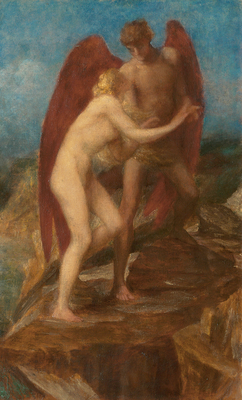
One of his most internationally renowned paintings, Love and Life was considered by Watts to be his ‘best composition’, for which this was an early sketch. Described by Watts as a ‘painted parable’, Love, depicted as a male winged angel, guides the frail nude woman, representing Life, tenderly by the hand, using his wings to block her from the sun. The two figures ascend a rocky landscape, symbolic of the difficult conditions which humanity must face in life. Watts cemented his reputation in the international art scene through donating various paintings. Versions of Love and Life were given to the people of the United States of America in 1893. Another was given to the Musée du Luxembourg in Paris in 1894 and one of the paintings was also included in his 1897 Tate gift.
- In depth
Love and Life was considered by Watts to be his ‘best composition’. While never directly identified as a symbolist work, Watts choosing instead to describe it as a ‘painted parable’, it shows his desire to express through his art the ‘great moral conception of life, its difficulties, duties, pains and penalties’ mirroring Symbolist ideals of showing the universal concepts of human existence through art and literature [1].
The allegorical work depicts Life as a young woman, thin and frail, to indicate the fragility of human life. She is guided by the hands by the figure of Love, a young, muscular man with strong red wings which protect her from the sun. In some versions of the work flowers spring in Love’s footsteps. The two are nude, ‘unclothed as they are only symbols’ [2]. The figures ascend the landscape, which Watts records as ‘the path from baser existence to the nobler region of thought and character’ [3]. The symbolic painting aimed to show the powers of love, charity, tenderness, and sympathy to support and elevate mortal life.
Watts’s personification of love rejected eroticism, choosing instead to depict Love as a nude man in young adulthood, suggesting the strength and vitality of love, a theme he repeated in the paintings Love and Death (c.1885-7) and Love Triumphant (COMWG.90, 1893-1898). While not planned as a triptych, the three paintings form an informal series reflecting of the importance of love for existence. Writing of the spiritual roots of his conception of love, Watts explains ‘Love is not intended to be either personal or carnal. It is the great love St. Paul speaks of which can be dwelt on and amplified to any extent’[4].
Watts was criticised for his use of dark colours and atmospheres, repainting several works in the 1880s to remove excess darkness. Love and Life’s markedly lighter tone and palette can be seen as a direct desire to counteract this earlier style in the 1880s. Watts continued to revisit the composition, producing at least seven versions of the painting. It was one of his most internationally exhibited paintings, included in his retrospective at the Metropolitan Museum of Art in New York 1884-5, the first living artist to stage a solo exhibition at the museum. In 1893, Director of the Luxembourg Museum in Paris, Léonce Bénédite (1859-1925), chose Love and Life as an example of British art to be purchased for the French state. In response Watts offered the painting as a gift, in part due to his moral objection to financial gain for the work, writing to Bénédite that ‘it belongs to a class in which I have endeavoured to identify art with thought, and for which I have never intended to take money, I beg to say that the honour of its acceptance is only too great a recompense’ [5].
In the same year Watts also gifted a version of Love and Life to the people of America, ‘due to it having the widest scope of significance. It was accepted by an Act of Congress in 1894 and displayed in the White House, where the figures nudity came under scrutiny from the Women’s Christian Temperance Union of the United States. The group described it as a ‘vulgar nude painting’, causing its removal to the Corcoran Gallery in Washington until 1902 when it was returned to the White House by President Theodore Roosevelt (1858-1919), where it remained until 1932 and then the Smithsonian Institution until 1987 [6]. It is now in a private collection.
The version held in the Watts collection is an early, unfinished, sketch version (COMWG2007.697, 1884-1885) of the composition, described as ‘an experiment in a markedly different colour scheme’ [7]. Watts disliked painting from live models, instead choosing to create maquettes to work from. A plaster model for Love and Life (COMWG2008.124, 1880-1884), made in two parts, which does not include Love’s wings is also in the Watts collection [8].
Footnotes:
[1] Mary Seton Watts, The Annals of an Artists Life, Vol. II, (London: Macmillan and Co., 1912), pp, 227-8
[2] ibid, p. 235
[3] ibid, p. 235
[4] ibid, extra leaf pp. 226-227
[5] Mary Seton Watts, Catalogue of Subject Pictures by G. F. Watts O.M. R.A., Vol. I, c.1912, p. 93
[6] Mark Bills & Barbara Bryant, G. F. Watts Victorian Visionary: Highlights from the Watts Gallery Collection (New Haven & London: Yale University Press, 2008), pp. 224-227.
[7] Mary Seton Watts, Catalogue of Subject Pictures by G. F. Watts O.M. R.A., Vol. I, c.1912, p. 94
[8] COMWG2008.124, plaster maquette for oil painting ‘Love and Life’
Further Reading:
Mark Bills & Barbara Bryant, G. F. Watts: Victorian Visionary (New Haven & London: Yale University Press, 2008)
Barbara Bryant, ‘G. F. Watts and the Symbolist Vision’ in Wilton (eds) The Age of Rossetti, Burne-Jones and Watts: Symbolism in Britain 1860-1910 (London: Tate Publishing, 1997)
Michelle Facos, Symbolist Art in Context (University of California Press, 2009)
Text by Dr Nicole Cochrane
|
|
