


- Object numberCOMWG.36
- Artist
- Title
For He Had Great Possessions
- Production dateexact 1894 - exact 1894
- Medium
- Dimensions
- Painting height: 94 cm
Painting width: 45.7 cm
Frame height: 113 cm
Frame width: 66 cm - Description
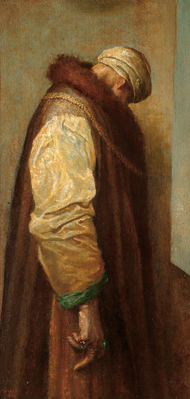
The source is from the New Testament, the story of the rich young man who appears in all three of the synoptic gospels using the identical phrase, ‘For he had great possessions.’ The story tells of a rich young man who asks Christ what he must do to gain eternal life. Jesus answers that he must give his wealth to the poor and follow him, something the young man is unable to do. He ‘went away grieving, for he had great possessions’, and Christ tells his disciples that ‘it is easier for a camel to go through the eye of a needle, than for a rich man to enter into the kingdom of God’. Through this painting Watts makes clear his belief that spiritual health is the direct opposite of materialism. The stifling effects of such materialism are portrayed as a source of great social injustice as well as of the containment and destruction of the spiritual. It is not simply a social matter but also a religious one, and rarely does he make this point so lyrically and succinctly. The single figure is alone and isolated. He is smothered by the rich clothes that he wears, to the point where his face is only just visible.
- In depth
G.F. Watts based the title of this painting on the Bible verses Mark and Matthew which all tell the story of man who met Jesus and wants to gain eternal life noting that he followed the Ten Commandments. However, when Jesus instructs him that he has to sell everything he has and give to the poor the man hesitates and notes that he has great wealth and leaves. In these stories Jesus then notes that it is hard for the rich to enter the kingdom of Heaven.
G.F. Watts’s widow Mary Watts details how Watts wanted to depict this figure through his gestures and costume. In describing this work she wrote, “I had ventured to say that the irresolute right hand, half closed, and with the jewel on it, told a story words could hardly tell, when he answered with pleasure that such was his meaning, his deliberate representation on the canvas” [1]. Here Mary described how G.F. Watts meant to portray this figure as wealthy, through the rings on his hand, but also discontent
Contemporaries of Watts and current Watts scholars note how Watts portrayed this Bible story in this painting. G.K, Chesterton described the figure in this work as sad and sardonic while noting he is wearing “intolerable pomp” and that his head is turned away [2]. Phythian compares this work to another painting and notes how Watts portrayed this figure. He wrote
Over against the Happy Warrior, dying for his ideal, and knowing that his sacrifice is not in vain, we may put Watts’s picture of the young man, who, because he had great possessions, with which he could not bear to part, turned away from Christ himself. We do not see his face, for he has already turned away. But the head, bowed in shame he cannot hide from himself, the rich apparel, and the jewelled hand, are enough. He is neither for God nor for God’s enemy, but only for himself [3].
Here Phythian picks up on some of these same themes as Chesterton, that the figure is bowed and looking away while wearing luxuriant clothing and jewellery. Phythian also emphasises the central theme of both this Bible story and painting, that this man is only for himself and his wealth.
Hugh Macmillan also noted these themes in this work by Watts. When describing this the figure in this work he wrote:
His face droops and is turned aside, so that we do not see any features, but we imagine that we can read in it the sharp conflict between the command of the "Good Master,” to sell all that he had and give to the poor and then follow Him, and the covetousness of his heart, for he had great possessions. His rich dress and fur-lined cloak and massive gold chain tell us of his wealth. But it is incapable of satisfying the craving of his soul for some good which is still beyond his reach [4].
Like both Chesterton and Phythian, Macmillian emphasized the how the figure is turned away as well as the wealth which is apparent in the clothing he wears. Going a step further than Phythian Macmillan argues that this figure’s wealth cannot provide him what he really wants.
Current Watts scholars also highlight how the figure’s posture and clothing point to these lessons from the Bible story. However, they also take this analysis further based upon the wider body of Watts’s work. Hilary Underwood relates this work to Watts’s belief that possessions and materialism were harmful, a theme which appears in other works by Watts [5]. Furthermore, Underwood highlights how a number of other works by Watts feature the main figure with their heads turning away or hidden and ties this to admiration to the Parthenon marbles [6]. Bills goes on to note how the figure’s heavy clothing seem to convey the mans’ despondency and that Watts often depicted stories from the New Testament including Prodigal Son (COMWG.44, 1872-1873), Prodigal Son (COMWG.192, 1872-1873), Good Samaritan (COMWG.140, 1849-1904), and Mammon (COMWG.49, 1885) [7].
Footnotes:
[1] Mary Watts, The Annals of an Artist’s Life, Volume 2, page 182.
[2] G.K. Chesterton, G.F. Watts, page 63.
[3] John Ernest Phythian, George Frederick Watts, page 89.
[4] Hugh Macmillan, The Life-work of George Frederick Watts, R.A., page 164.
[5] Hilary Underwood, “70a. For He Had Great Possessions, 1893-94,” The Vision of G F Watts (ed. Veronica Franklin Gould), page 74.
[6] Hilary Underwood, “70a. For He Had Great Possessions, 1893-94,” The Vision of G F Watts (ed. Veronica Franklin Gould), page 74.
[7] Mark Bills, “75. For He Had Great Possessions, 1894,” G F Watts Victorian Visionary (ed. Mark Bills and Barbara Bryant), page 263.
Text by Dr Ryan Nutting
|
|
