


- Reproduction
- Número del objetoCOMWG.139
- Creador
- Título
Progress
- Fechanot before 1902 - not after 1904
- Medium
- Dimensiones
- Painting height: 281.9 cm
Painting width: 142.2 cm
Frame height: 327 cm
Frame width: 190 cm - Descripción
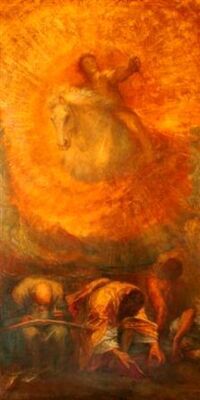
Many of Watts’s Symbolist works deal with the universal questions of life, creation, and genius. Progress was Watts’s exploration of the symbolic meaning of human advancement. A Nude male figure sits atop a white horse, clearly linked to the sculpture Physical Energy, as a symbol of human progress. Below him sit the non-progressive figures – an old man searches for knowledge in a book while beside him a man searches in the dirt for money. The third, known as the ‘sluggard’ sleeps, his arm blocking the light of progress from his eyes. A final man turns to the light, a symbol of how ordinary men could look to progress. The painting was an expression of Watts support for British colonialism, particularly in South Africa, and his racist view that the white British rule in colonies were a vehicle for progress, advancement, and betterment of non-white populations they subdued.
One of the subjects which preoccupied Watts in later life was the idea of human evolution and progress. This painting was his allegorical vision of what Watts felt was an apathetic attitude towards progress and advancement and a symbolic call to action. The central figure of Progress is represented by a bowman on a white charger, a motif repeated in the works Rider on a White Horse (c.1868-82) (where he represented one of the four horsemen of the apocalypse), and the sculpture Physical Energy. He bursts forth from a bright sunburst which radiates around him. The catalogue entry for its exhibition at the 1905 Watts exhibition explained the symbolic meaning of the rider as: ‘the rider on the white horse ‘conquering and to conquer’ has been used as the symbol of Progress’, indicating his view of advancement as being linked to thank of imperialism and colonial expansion [1].
Below him are four male figures who represent aspects of humanity, described as symbols of ‘non-progress’[2]. On the far left a bald man with long beard reads a book, oblivious to Progress due to his search for knowledge. Next to him a man in rich golden robes searches ‘grovelling in the dust ‘money grubbing’ as he called it that day’[3], a critique of materialism prevalent in several Watts works. A third man, barely visible in the lower right register of the work, obscures the light of progress from his eyes with his arm as he sleeps. These three figures act as symbols for the apathy of humanity to progress, concerned only with their own physical, mental and material pursuits. One lone figure turns toward the sunburst, a suggestion that man still possesses the ability to turn to the light of Progress that Watts believed in.
Watts strongly believed in English power as an agent of progress, writing: ‘we, the English people, are perhaps the agents of the great law – Movement, Progress, Evolution’ [4]. In his essay Our Race As Pioneers, Watts set out his views on English colonial expansion as a necessary means for human progress. Importantly, he argued his views of the English as an advanced and expansionist race who must colonise in order to advance humanity, drawing particular reference to the Boer War and what he saw a necessary intervention and colonial presence of the British in South Africa. Progress is an expression of these views, in which the white British colonialism is represented as a symbol of Progress. It is therefore possible to read the painting as an allegory for, and an argument in favour of, the Victorian view that colonial expansion was beneficial to indigenous non-white populations, as it brought ‘advancement’ to those regions. The colonial themes of the painting were understood at the time, with The Daily News reporting progress as ‘moving over the world to awaken Primitive Man to Agriculture, to Industry in other kinds, and supremely to Wisdom’[5].
Watts began his conception for the composition of progress from 1888, largely working on the work from 1902 after The Court of Death (COMWG.81, 1871-1902) was finished and moved to the Tate Gallery. He also completed a second smaller version, which was exhibited alongside the full version from the Watts Gallery Collection in the 1905 exhibitions at Edinburgh, Newcastle, and Manchester. The smaller version is now in the collection of York Art Gallery.
Footnotes:
[1] Royal Academy of Arts, Exhibition of the works by late George Frederic Watts, R.A. O.M. and the late Frederick Sandys… Winter Exhibition (London: William Clowes and Sons, 1905), p. 30.
[2] Mrs (Emilie) Russell Barrington, G.F. Watts: Reminisces (London: Macmillan, 1905), p.101.
[3] Mary Seton Watts, Catalogue of Subject Pictures by G. F. Watts O.M. R.A., Vol. I, c.1912, p.121.
[4] G. F. Watts, ‘Our Race As Pioneers’, published in Mary Seton Watts, The Annals of an Artists Life, Vol. III, (London: Macmillan and Co., 1912), p.278.
[5] Daily News, ‘Watts and Sargent Pictures, 1904’, quoted in Mark Bills & Barbara Bryant, G. F. Watts Victorian Visionary: Highlights from the Watts Gallery Collection (New Haven & London: Yale University Press, 2008), p. 274.
Text by Dr Nicole Cochrane
|
|
