


- Reproduction
- Número del objetoCOMWG.55
- Creador
- Título
Lady Augusta Holland
- Fechacirca 1844 - circa 1844
- Medium
- Dimensiones
- Painting height: 68.5 cm
Painting width: 56 cm
Frame height: 91 cm
Frame width: 81 cm - Descripción
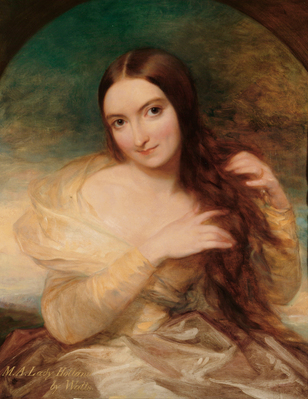
An early, private portrait that was never intended for public exhibition. Watts painted this portrait of Lady Mary Augusta Holland (1812–1889) during his time in Italy between 1843 and 1847. An opportune meeting in Florence saw the young artist invited to dine at the Casa Feroni, home to the diplomat Henry Edward Fox and his young wife. Days after their first meeting, Watts was invited to stay with the Hollands whilst he travelled through Italy. Invited for a few days, he stayed for a few years and quickly formed a close friendship with Lady Augusta. Depicting his aristocratic sitter in the privacy of her boudoir, with her eyes engaging directly with the viewer, whilst playing with her loose hair, this portrait would not have been deemed appropriate for public display at the time of its execution.
Lady Augusta Holland is private portrait and a key example of Watt’s early experiments in portraiture. In 1843 a 26-year-old Watts won a prize in the competition for the decoration of the Houses of Parliament. In September of that year he set off to study fresco painting in Italy. Yet, his professional endeavour into the Italian Renaissance technique became side-lined, in part due to his friendship with the Hollands. During his stay at the Casa Feroni, Watts became increasingly preoccupied with ‘easel paintings’ as he was introduced to aristocratic members of British high society whom he met through his new patrons.
Focussing on Lady Holland’s face, the paint in this portrait is smoothly and meticulously applied, as demonstrated in the rendering of her large eyes, and the subtle colouring of her cheeks and lips. The colour remains cool and restrained throughout the picture. Yet, as we move down the painting and the unravelling hair, the paint handling becomes looser as visible in the thinly applied, broad and brief brush strokes that depict the folds of the dress as they form in her lap. Although the background behind Lady Holland is also roughly rendered, it is recognisable from other portraits painted during his time in Florence, such as in Miss Marietta Lockhart (COMWGNC.10, 1845) [1].
The pose and setting demonstrate how Watts was emotionally close with Lady Holland. Although Lady Augusta Holland would not have been deemed suitable for public display, there are precedents for artists who were invited into the private realm of their female sitters and subsequently showing them in openly alluring poses [2]. This art historical tradition can be traced back to Titian, (an artist we know that Watts greatly admired), in works including Flora, c.1517. In Britain, a contemporary example of this type of private or ‘secret’ portrait included that of Queen Victoria, 1843 painted by Franz Xaver Winterhalter for Prince Albert’s 24th birthday.
Although Watts’s contribution is rare in the scheme of his oeuvre, ‘portraits of women combing through their hair in […] sensual and suggestive images’ would reappear in British art a generation later. [3] In his portrayal of mythical figures, Rossetti often used his mistress Fanny Cornforth as model. Examples of these paintings of young women, sat in their bedroom’s with exposed clavicle’s include Lady Lilith, 1867 and Aurelia (Fazio’s Mistress), 1863–1873. A third painting from this period entitled Joli Coeur, 1867, is one which we can compare with Watts’s Lady Augusta Holland more closely. In both portraits, a coquettish young woman, depicted in a half-length portrait, gazes directly out at the viewer. The hands of each woman are raised to her neck, with our focus firmly on what she is playing with; in the Watts portrait it is her hair, in the Rossetti it is her coral necklace. Rossetti even mirrors Watts’s inclusion of the gold lettered inscription; branding the painting with its title.
It is not known whether or not Rossetti would have been familiar with Lady Augusta Holland as it remained in her personal collection until her death in 1889. The Italian frame, ‘a gloriously Baroque confection that suits the image it surrounds’ is similar to other works from the Hollands’ collection [4]. It is far more elaborate than the frames which Watts would come to adopt for his later publicly exhibited portraits, as evident in the examples at both Watts Gallery and the National Portrait Gallery, London.
In Mary Watt’s catalogue which she compiled in 1915, four other portraits of Lady Holland, executed in the years he was in residence at her home, are documented [5]. Lady Holland on a Day-bed (COMWG.16, 1844) is another informal portrait which resides in the Watts Gallery collection today. These two portraits reveal his ability as an artist to establish a mutual trust and respect with his sitters, which is a trait he maintained throughout his career and became integral to his practice.
Explore:
Miss Marietta Lockhart [COMWGNC.10]
Lady August Hollard formerly known as Lady Holland on a Day-Bed [COMWG.16]
Footnotes:
[1] Barbara Bryant, G.F. Watts : portraits; fame & beauty in Victorian society (London: National Portrait Gallery, 2004), p.46.
[2] Barbara Bryant, G.F. Watts : portraits; fame & beauty in Victorian society (London: National Portrait Gallery, 2004), p.46.
[3] Barbara Bryant, G.F. Watts : portraits; fame & beauty in Victorian society (London: National Portrait Gallery, 2004), p.46.
[4] Barbara Bryant, G.F. Watts : portraits; fame & beauty in Victorian society (London: National Portrait Gallery, 2004), p.46.
[5] Mary Seton Watts, Catalogue of Portraits by G.F. Watts O.M. R.A., Vol.II, c.1915, pp.69-70.
Further Reading:
The Pre-Raphaelites, exhibition catalogue, (London: Tate Gallery in association with Allen Lane and Penguin Books, 1984)
Mark Bills and Barbara Bryant, G.F. Watts: Victorian Visionary (New Haven and London: Yale University Press in association with Watts Gallery, 2008).
Barbara Bryant, G.F. Watts: portraits; fame & beauty in Victorian society (London: National Portrait Gallery, 2004).
Barbara Bryant, G.F. Watts in Kensington: Little Holland House and Gallery (Compton, Surrey: Watts Gallery, 2009).
Caroline Dakers, The Holland Park circle: artists and Victorian society (New Haven: Yale University Press, 1999).
Victoria Franklin Gould, G.F. Watts: the last great Victorian (New Haven and London: Yale University Press, 2004).
The Earl of Ilchester, Chronicles of Holland House 1820–1900 (London: John Murray, 1937).
Jan Marsh, Pre-Raphaelite Women: Images of Femininity in Pre-Raphaelite Art (London: Guild Publishing, 1897).
Jan Marsh (ed.), Pre-Raphaelite sisters (London: National Portrait Gallery, 2019).
Andrea Rose, Pre-Raphaelite Portraits (Oxford: Oxford University Press, 1981)
Mary Seton Watts, George Frederic Watts: Annals of an Artist’s Life, vol. I (London: Macmillan and Co. Ltd., 1912).
Mary Seton Watts, Catalogue of Portraits by G.F. Watts O.M. R.A., Vol.II, c.1915, pp.69-70.
Text by Dr Stacey Clapperton
|
|
