


- Reproduction
- N° d'objetCOMWG.114
- Créateur
- Titre
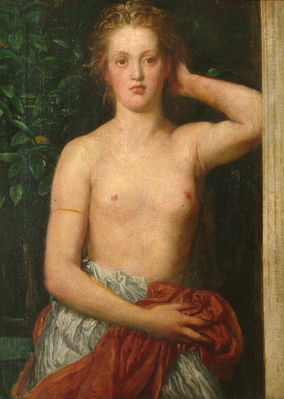
Rhodopis
- Datecirca 1868 - circa 1868
- Matériel
- Dimensions
- Painting height: 91.4 cm
Painting width: 71.1 cm
Frame height: 105 cm
Frame width: 85 cm - Description
This half-figure nude is a historical portrait of a Greek slave in Egypt who allegedly went on to become the wife of the King of Egypt, in some versions identified as Psammetichus. The story of Rhodopis is said to be the origin of the story of Cinderella. She was a Greek slave-girl. One day one of her sandals was stolen by an Eagle who flew with it to the Egyptian King. He was struck by an instant longing to see the beauty of the girl to whom the sandals belonged, and so ordered a search for her. After having found her she became his wife. The model for Rhodopis was Watts’s favourite model Mary Bartley. While there are various sources for the story of Rhodopis, an earlier preparatory drawing for Aesop and Rhodopis (COMWG2007.655) suggests that the ancient Greek historian Herodotus was the main source for Watts’s composition. In Herodotus’s version Rhodopis along with Aesop, the fabulist to whom Aesop’s Fables is attributed, were slaves of Ladmon of Samos. According to Herodotus (c. 484-425 BCE) she was brought to Egypt where she was freed by the brother of the poet Sappho (c. 630-570 BCE).
Rhodopis is a somewhat rare subject in art. However, the English painter Charles Landseer RA (1799-1879), brother of Sir Edwin Landseer, had contributed a painting titled Rhodopis, the Greek Cinderella in 1849 to the Royal Academy Exhibition [1]. Landseer had illustrated the story as it was told by the Roman author (175-235 AD) Ælian, in which Rhodopis’s sandal is stolen by an eagle who carries it all the way to Memphis and King Psammetichus, who upon seeing the beautiful shape of the sandal orders its owner to be found and marries her. Landseer’s painting illustrated more of the narrative, however, provided in a quote from Ælian which accompanied the painting. A critic in the Athenaeum noted that in ‘a very inartificial arrangement Mr. Landseer has brought in the several elements of the story; and in his principal figure he has well adhered to the spirit of his text’ [2]. In the Illustrated London News it was lauded as ‘better than anything’ Landseer had ‘done for some time past’ [3]. In 1862, the sculptor Charles Francis Fuller (1830-1875) had depicted the moment when the eagle steals the sleeping Rhodopis sandal in his sculpture Rhodope, also known as Rhodopis [4]. Sir E. J. Poynter, painter and President of the Royal Academy, exhibited a small picture entitled Rhodope at the Royal Academy in 1874 which was highly praised. Robert Fowler, The sculptor Harry Bates RA contributed a bronze head of Rhodope at the Grosvenor Exhibition in 1887, which was considered by one critic to be ‘one of the finest of modern bronzes’ [5].
It is also likely that Watts and his contemporaries found inspiration in William Morris’s retelling of the Story of Rhodope which was included in the third part of his epic poem The Earthly Paradise (1868-1869), thr first part of which was published in the same year as Watts’s painting is thought to have been painted. Watts went on to paint William Morris’s portrait in 1870 (NPG), and the dark green background bears a striking resemblance to that of the green foliage behind Rhodopis in this painting. In 1878, George Hamilton Barrable showed his Rhodope (Morris’s ‘Earthly Paradise’) at the Royal Academy. Henry Poole presented a marble statuette of Rhodope in 1909.
Watts’s half-length portrait gives little indication apart from its title that the woman is Rhodopis, the Greco-Egyptian Cinderella. The fascination with the Egyptian Cinderella grew throughout the nineteenth century, as seen in later illustrations and articles in The Graphic and exemplifies the Egyptomania of the time.
Footnotes:
[1] See The Exhibition of the Royal Academy of Arts. The Eighty-First (London: W. Clowes and Sons, 1849), p. 19.
[2] Anon. ‘Royal Academy’ in Athenaeum 1125 (1849), pp. 519-521, p. 521.
[3] Anon. ‘Exhibition of the Royal Academy of Arts, 1849’ in Illustrated London News 14 (May 26, 1849), pp. 345-351, p. 349. See also Anon. ‘Royal Academy’ in The Literary Gazette 1687 (May 19, 1849), pp. 377-377.
[4] See ‘Painting and Sculpture’ in The British Architect 3.64 (Mar 19, 1875), pp. 161-161.
[5] ‘The Grosvenor Exhibiton’ in The Athenaeum 3106 (May 7, 1887), pp. 612-614, p. 614.
Text by Dr Eva-Charlotta Mebius
|
|
