


- Reproduction
- N° d'objetCOMWG2007.954
- Créateur
- Titre
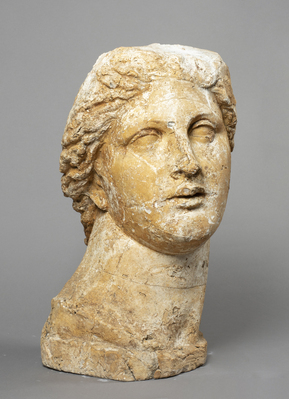
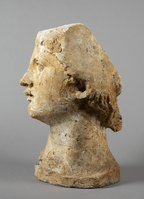
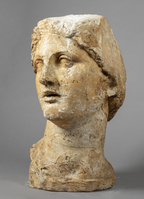
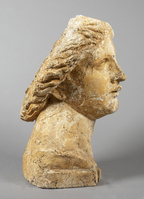
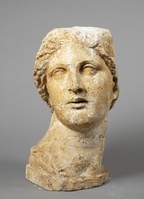
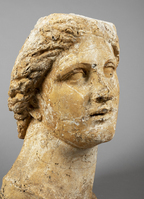
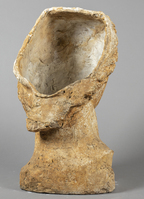
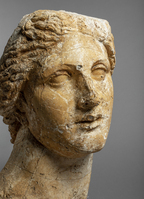
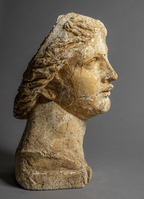
Plaster Study of Head of Aurora
- Date
- Matériel
- Dimensions
- Sculpture height: 52.5 cm
Sculpture width: 31 cm
Sculpture depth: 33 cm - Description
This head of Aurora was still in Watts’s London studio at New Little Holland House when he died in 1904. It can be seen in the watercolour by Thomas Matthews Rooke, painted as a gift to Mary after Signor’s death. Watts never exhibited Aurora publicly and partially destroyed one version of the design. Aurora was the goddess or personification of the dawn and the twin sister of the sun god Helios. Watts worked on his Aurora sculpture for decades, with Mary recording in her diary in 1893: ‘Signor down early. He had discovered that a candle helps him to see what his work wants in the sculpture studio. Fancy the little one there alone with his little candle in one hand, and his tool in the other, working out the great throat & breasts of his Dawn, her big form looming out of the darkness over his head.’
Watts was unsatisfied with his Aurora sculptural projects; he never exhibited them publicly and destroyed one version, while the other (COMWG2007.957) is preserved at the Watts Gallery—Artist’s Village. This head is closely related to the full figure at the Watts Gallery. It is fragmentary, possibly damaged, and has been treated with a surface coating, possibly shellac. This may be a remnant of the destroyed sculpture or a stand-alone study for the extant plaster. The over-life-size head shows the characteristic schematising of Watts’ monumental and allegorical sculptural practice, in contrast to the more naturalistic, if stylised work on figures like the effigy of Bishop Lonsdale and even Clytie [1]. The facial features here respond to the heads of the Monte Cavallo Dioscuri, a pair of colossal Roman sculptures on the Quirinal Hill in Rome for which Watts had formed a deep fondness during the 1840s [3], and which had been the model for Richard Westmacott’s memorial to the Duke of Wellington in Hyde Park. [2]
Watts seems to have struggled to balance his interest in an archaising, highly stylised effect following what he understood to be Pheidian examples, and contemporary expectations for an exacting anatomical accuracy. Mary recorded:
But something he was trying for eluded him, and feeling unhappy he cut the figure to pieces. Talking of this at Limnerslease the following spring he deeply regretted it: ‘I was a fool to change it, I cannot think what I was about,’ were his words. ‘I thought it was wrong, but if it looked right what did it matter? We think now-a-days that we must get our work to be mechanically exact, but that has nothing to do with it; the quality of exactness is quite another element [3].
References to Watts’s work on at least one version of Aurora appear in letters to Charles Rickards in 1879, when Watts wanted to show what he had to Rickard and suggested putting it into marble [4]. He was still working on a version of Dawn at least as late as 1893, when Mary recorded in her diary for August 23:
Signor down early. He had discovered that a candle helps him to see what his work wants in the sculpture studio. Fancy the little one there alone with his little candle in one hand, and his tool in the other, working out the great throat & breasts of his Dawn, her big form looming out of the darkness over his head [5].
A version was still in the studio at the time of his death; Mary wrote of two vans coming to collect the busts and sculptures, and that ‘When I saw the unfinished Dawn carried out I could not keep back my tears & had to go away. He was so full of hope when he last worked upon it, but the better Dawn came to him first.’ [6] The head is visible on a shelf at the centre right of Thomas Matthews Rooke’s watercolour of the New Little Holland House studio painted as a gift for Mary after Watts’s death.
Explore:
Two Pencil Studies of a Standing Female Nude (COMWG2007.412)
Three Pencil Studies of a Standing Female Nude (COMWG2007.411b)
Two Pencil Studies of a Standing Female Nude (possibly study for 'Dawn') (COMWG2007.413a)
Pencil and Ink Study of a Standing Female Nude (possibly Study for 'Dawn') (COMWG2007.414a)
Two Pencil and Ink Studies of a Standing Female Nude (possibly Study for 'Dawn') (COMWG2007.414b)
Pencil and Ink Study of a Standing Female Nude (possibly Study for 'Dawn') (COMWG2007.415a)
Pencil and Ink Study of a Standing Female Nude (possibly Study for 'Dawn') (COMWG2007.415b)
Four Rough Pencil Figure Studies (COMWG2007.526b)
A Pen and Ink Study of a Standing Female Nude (COMWG2007.531a)
Footnotes:
[1] The finished work is in Lichfield Cathedral, while Watts Gallery has the plaster maquette (COMWG.460); several versions of Clytieare held by the Watts Gallery, including a bronze, (COMWG2008.152).
[2] G. F. Watts to Georgiana Duff Gordon, 15 February 1847, National Portrait Gallery Archives GFW1/14/50, Marie F. Busco, ‘The “Achilles” in Hyde Park,’ The Burlington Magazine, vol. 30, no. 1029 (Dec., 1988) pp 920-4.
[3] Mary Seton Watts, George Frederic Watts: the Annals of an Artist’s Life, vol. 2 (London: Macmillan and Co., Ltd, 1912), pp. 314-5.
[4] G. F. Watts to Charles H. Rickards, 19 August 1879, National Portrait Gallery Archives GFW1/3/75.
[5] Desna Greenhow, ed., The Diary of Mary Watts 1887-1904 (London: Lund Humphries, 2016), p. 142.
[6] Desna Greenhow, ed., The Diary of Mary Watts 1887-1904 (London: Lund Humphries, 2016), p. 241.
Further Reading:
Stephanie Brown, ‘Indefinite Expansion: Watts and the Physicality of Sculpture,’ in Representations of G.F. Watts: Art Making in Victorian Culture, ed. Colin Trodd and Stephanie Brown (Farnham: Ashgate, 2004), pp. 83-106.
R.E. Gutch, ‘Watts’s Sculpture,’ The Burlington Magazine Vol. 110, No. 789 (Dec., 1968), pp. 693-99.
Elizabeth Prettejohn, ‘Between Homer and Ovid: Metamorphoses of the ‘Grand Style’ in G. F. Watts,’ in Representations of G.F. Watts: Art Making in Victorian Culture, ed. Colin Trodd and Stephanie Brown (Farnham: Ashgate, 2004), pp. 49-64.
Text by Dr Melissa Gustin
|
|


