


- Reproduction
- N° d'objetCOMWG.22
- Créateur
- Titre
Genius of Greek Poetry
- Date1857 - 1878
- Matériel
- Dimensions
- Painting height: 66 cm
Painting width: 53.3 cm
Frame height: 100 cm
Frame width: 86 cm - Description
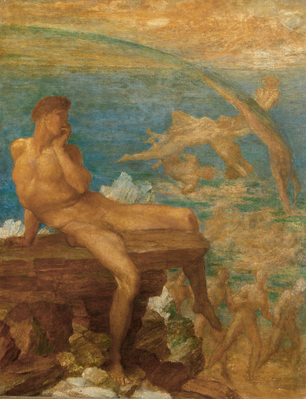
This symbolist painting reflects Watts’s lifelong interest in ancient Greece. It presents a visual metaphor for the relationship between art, nature, and poetry. The Genius, or spirit, of Greek poetry, is depicted as a reclining nude male, inspired by the figures of the Parthenon. From his rocky seat he gazes out to a seascape full of nude spirits who move among the clouds and waves. Watts was inspired by his travels to Greece and Turkey in 1856 with the archaeologist Sir Charles Newton. The warm vivid colours were inspired by his memories of the landscape of the Mediterranean. In 1884 The Genius of Greek Poetry was among those sent by Watts to his retrospective show at the Metropolitan Museum of Art in New York. It was the first solo exhibition by a living artist at the museum. The catalogue notes a companion picture, titled ‘The Genius of Northern Poetry’, which was never completed or does not survive.
The Genius of Greek Poetry is perhaps one of Watts’s most overtly symbolist works, expressing not a singular narrative or place, but rather an expression of his experience of, and reverence for, ancient Greece and its ruins. The imaginative composition depicts an idealised nude male seated atop of a rocky outcropping. In the background is an imaginative seascape of vivid blue sea and rich oranges of the sky and clouds. Undefined spirits swoop and fly through the sky and cavort amongst the surf.
Watts visited Greece first in 1856, accompanying the archaeologist Charles Newton to visit the ruins of Halicarnassus and again in the 1880s, after Genius of Greek Poetry was finished, for his honeymoon with Mary Seton Watts. Ancient Greece fascinated Watts from a young age, with Mary recording how ‘his imaginative mind could roam the windy plains of Troy, ot climb the heights of Olympus. Moving through the dim light of the London atmosphere, in his dull little room he saw, ‘the bright eyed Athene in the midst of the holy aegis’ [1]. His experiences of Greece and the Mediterranean, particularly the atmosphere created vivid colours of the landscape and the ruins of antiquity, had a profound effect on Watts and his work, calling it a ‘constant communion with such rich loveliness’ [2]. His experiences of Greece would provide artistic inspiration for a number of paintings, including the landscape studies of Salamis (COMWG.251, c. 1887) and views of the Island of Cos.
The symbolic ambiguity of the painting caused some commentators to question its meaning, with Marion Spielmann (1858-1948) noting in his 1886 catalogue of Watts’s work that Genius of Greek Poetry and Watts explicitly symbolic works ‘are not sufficiently and immediately intelligible’ [3]. Barrington’s catalogue entry for the painting in 1884 expresses the harmony of landscape and artistic expression, writing:
The intention of the artist in painting this picture has been to endeavour to render the significance, the local tone, and especially the anthropomorphic character of the Genius of Greek Poetry. The prominence humanity held in the Greek mind, the association of the effects of nature, and the entire conditions of the world with humanity being so strong that all effects and moods of nature weave themselves in his imagination into semi-human existences; the winds and the currents, the hours of the day, the earth, sea and air, all natural phenomena he invests in human forms, attributes, and moods [4].
The composition, particularly the relationship between the Genius figure and the undefined spirits was once which occurs in several works by Watts. The figure of Genius has traditionally been described as inspired by the reclining ancient sculptures of Ilissos and Dionysus of the Parthenon, due to the sculptural nature of the composition [5]. However, the musculature and positioning more closely aligns to Michelangelo’s twisting male nudes of the Sistine Chapel and allegorical drawing The Dream (Il Sogno). The figure was used in his mural painting Achilles and Briseis (COMWG.94, 1858-1860) at Bowood house, completed concurrently with Genius of Greek Poetry, representing the Greek hero Achilles in a moment of reflection and indecision. Similarly, the motif of linked and frolicking spirits was repeated in works Chaos (COMWG.143, 1875-1882) and Prometheus (COMWG.28, 1904) where they are understood to represent the passage of time and the connections between the ancient past and the present.
Watts worked at the composition for Genius of Greek Poetry for two decades, from the late 1850s to around 1878 and completing several versions, each with subtle variations in colour, style, and content. One noticeable variation is the approach to modesty. The Watts Collection version presents Genius as fully nude, the outline of genitalia visible, but undefined. The version held at the Fogg Art Museum is covered in a translucent white sheet, reminiscent of the Achilles and Briseis (COMWG.94, 1858-1860) mural. The Harris Museum and Art Gallery version, likely the most complete or final version of the composition, the draped fabric is replaced by a trailing vine. Watts also experimented with the positioning and composition of the spirit figures
According to Mrs Barrington the painting had a sister composition, titled ‘The Genius of Northern Poetry’, which was ‘darker, more mysterious, less human in attributes’ [6]. No version of this painting survives; it was either never realised or lost. Together the two paintings likely would have expressed a contrast in the light of the Mediterranean south and the darkness of the north, the concrete landscape and the abstract, and the monotheism of the nineteenth century with the pantheism of the ancient past.
The paintings were highly exhibited, with versions exhibited in the Watts’s retrospectives at Grosvenor Gallery in 1881 and the Metropolitan Museum of Art in 1885. One version of the work was acquired by the Harris Museum and Art Gallery in Preston in 1907. Another version was sold by Mary Seton Watts, through the New York art dealer Martin Birnbaum (1878-1970), to the American art collector Grenville Lindall Winthrop (1864-1943) in 1928. He went on to donate his collection to the Fogg Art Museum in 1943. The Watts Collection also includes a bronze study for the figure of Genius (COMWG.452, 1904).
Footnotes:
[1] Mary Seton Watts, The Annals of an Artists Life, Vol. I, (London: Macmillan and Co., 1912), p.15.
[2] Mary Seton Watts, The Annals of an Artists Life, Vol. III, (London: Macmillan and Co., 1912), p.51.
[3] Marion Harry Spielmann, ‘The Works of Mr George F. Watts, R.A., with a complete catalogue of his Pictures’, Pall Mall Gazette, Extra Numbers, 22 (1886), p.10.
[4] Mrs (Emilie) Russell Barrington, Catalogue of Paintings by G.F. Watts, R.A., of London, on exhibition at the Metropolitan Museum of Art New York (New York, 1885), p. 20.
[5] Andrew Wilton & Robert Upstone (ed.), The Age of Rossetti, Burne-Jones and Watts: Symbolism in Britain 1860-1910, (London: Tate Gallery Publishing, 1997), p.206.
[6] Mrs (Emilie) Russell Barrington, G.F. Watts: Reminisces (London, 1905), pp.135-136.
Further Reading:
Mark Bills & Barbara Bryant, G. F. Watts: Victorian Visionary (New Haven & London: Yale University Press, 2008).
C. Trodd, ‘To intensify the sense of teeming life’: Watts and the twilight of transcendence’ in Trodd & Brown, Representations of G. F. Watts: Art Making in Victorian Culture (Ashgate: Aldershot, 2004).
S. Wolohojian, ed., A private passion: 19th-century paintings and drawings from the Grenville L. Winthop Collection (Massachusetts: Harvard University, 2003).
Text by Dr Nicole Cochrane
|
|
