


- Reproduction
- N° d'objetCOMWG.43
- Créateur
- Titre
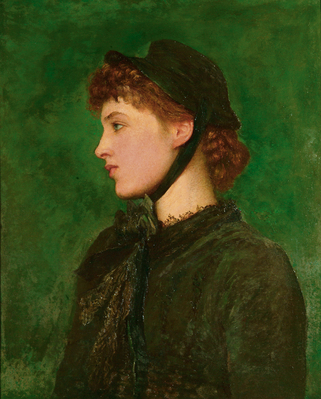
Lillie Langtry also known as The Dean's Daughter
- Dateexact 1880 - exact 1880
- Matériel
- Dimensions
- Painting height: 66 cm
Painting width: 53.3 cm
Frame height: 96 cm
Frame width: 83 cm - Description
A famed portrait of the actress and great society beauty. Born in Jersey Emile Le Breton (1853–1929) came to be known by the moniker Lillie due to paleness of her complexion and in tribute to the native flower of her home. On moving to London in 1876, Lillie quickly gained a reputation as one of the great society beauties of the day and was painted by leading portraitists including John Everett Millais, Sir Edward Poynter and Watts. In this striking portrait, which was debuted at the Royal Academy in 1880, Watts positions Langtry in full profile. The complexion of her pale skin appears luminous and her delicate features highlight as she is set against a bright and bold green background.
As a celebrity of the day, Langtry recalled in her autobiography how: ‘The photographers, one and all, besought me to sit. Presently, my portraits were in every shop-window, with trying results, for they made the public so familiar with my features’[1]. Although she enjoyed celebrity status through her acting career, within three years of moving to London with her husband Edward, Langtry became the object of society gossip as rumours spread that she was the mistress to Queen Victoria’s heir, Edward Albert Prince of Wales and enjoyed relationships with Prince Louis of Battenberg and the Prime Minister William Ewart Gladstone [2].
Shortly after arriving in London in 1876, and before any societal scandal took hold, Langtry was approached by the day’s great portrait painters for sittings. It was those with John Everett Millais, Sir Edward Poynter and Watts that she recalled being the ‘most interesting’ [3].
Millais was the first to paint her portrait in 1878. Standing in three-quarter profile and dressed in a plain black dress with white lace frilling to the sleeves and chest, Lilly holds a scarlet coloured Jersey lily in left hand. Entitled A Jersey Lily, the painting was so well received when it was exhibited at the Royal Academy that summer that a policeman was assigned to control the crowds. In the same summer exhibition, Sir Edward Poynter contributed his portrait of the Mrs Langtry. Sat in a red armchair and wearing an embellished golden gown, Langtry testified that ‘Sir Edward did not catch my colouring so accurately […] but, nevertheless, it is a fine portrait’, which the artist later gifted to his sitter [4].
Watts invited Langtry to sit for him in 1880 and she detailed how on her arrival he ‘ruthlessly tore the opulent ostrich feather which [she] regarded at that time as the glory of [her] head gear’ [5]. Initially displeased at being painted in the plain outdoor clothing that she had arrived in, Langtry later admitted that Watts had been correct in his ‘arbitrary ideas, for the portrait has not dated, and might have been painted yesterday or to-morrow’ [6].
Compositionally, the portrait is fairly simple. Standing in full profile, Langtry is set against a bold, green background. Applied in a scumbling and uneven design, the background colour is not flat, and is believed to have indicated ‘roses and leaves’ [7]. In his colour choice, Watts demonstrated that ‘green makes flesh not only ruddier, but more delicate, and helps to reveal and emphasise all the tones and modelling, and more subtle qualities in colour’ [8]. The rouge of her lips, the crisp pale blue of her eyes and the glow of blush in her cheeks has been described as ‘one of the most delicate passages in any of his portraits’ [9]. This bold green background featured in the portrait of Euterpe Ionides, 1881, now in the V&A collection.
In choosing to reduce and eliminate any embellishments of dress, ornament or props from his portrait, Watts directs the viewer’s attention to Langtry’s face. He allowed her beauty and his skill in portraying it, to speak for itself. We do not know what she is looking at and her expression gives nothing away as to her mood or attitude. The viewer is left to ponder that for themselves.
Footnotes:
[1] Lillie Langtry, The Days I Knew (London: Hutchinson & Co., 1925), p.44.
[2] Theo Aronson, 'Langtry, Lillie [née Emilie Charlotte Le Breton]’, Oxford Dictionary of National Biography, (24 May 2008).
[3] Lillie Langtry, The Days I Knew (London: Hutchinson & Co., 1925), p.53.
[4] Lillie Langtry, The Days I Knew (London: Hutchinson & Co., 1925), p.57.
[5] Lillie Langtry, The Days I Knew (London: Hutchinson & Co., 1925), p.58.
[6] Lillie Langtry, The Days I Knew (London: Hutchinson & Co., 1925), p.58.
[7] M.H. Spielmann, G.F. Watts, R.A., O.M., as a Great Painter of Portraits: A Lecture, delivered in the Memorial Hall Manchester, 7th June 1905 (London, Sherratt & Hughes, 1905), p.47.
[8] M.H. Spielmann, G.F. Watts, R.A., O.M., as a Great Painter of Portraits: A Lecture, delivered in the Memorial Hall Manchester, 7th June 1905 (London, Sherratt & Hughes, 1905), p.48.
[9] Marks Bills and Barbara Bryant, G.F. Watts: Victorian Visionary (New Haven and London: Yale University Press in association with Watts Gallery Compton, 2008), p.216.
Further Reading:
Theo Aronson, 'Langtry, Lillie [née Emilie Charlotte Le Breton]’, Oxford Dictionary of National Biography, (24 May 2008).
Marks Bills and Barbara Bryant, G.F. Watts: Victorian Visionary (New Haven and London: Yale University Press in association with Watts Gallery Compton, 2008).
Barbara Bryant, G.F. Watts : portraits; fame & beauty in Victorian society (London: National Portrait Gallery, 2004).
Victoria Franklin Gould, G.F. Watts: the last great Victorian (New Haven and London: Yale University Press, 2004).
Lillie Langtry, The Days I Knew (London: Hutchinson & Co., 1925).
M.H. Spielmann, G.F. Watts, R.A., O.M., as a Great Painter of Portraits: A Lecture, delivered in the Memorial Hall Manchester, 7th June 1905 (London, Sherratt & Hughes, 1905).
Mary Seton Watts, George Frederic Watts: Annals of an Artist’s Life, vol. II (London: Macmillan and Co. Ltd., 1912).
Text by Dr Stacey Clapperton
|
|
