


- Reproduction
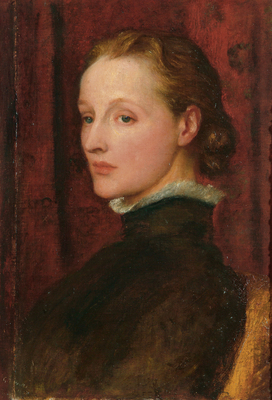
- N° d'objetCOMWG.7
- Créateur
- Titre
Mrs G. F. Watts
- Dateexact 1887 - exact 1887
- Matériel
- Dimensions
- Painting height: 48.3 cm
Painting width: 35.6 cm - Description
This rare portrait of the artist’s wife was painted on their honeymoon in 1887. George Frederic Watts married artist Mary Fraser Tytler (1849–1938) on 20 November 1886, after first meeting in 1870. This three-quarter, bust length portrait was painted because Watts’s ‘hand was wearied by idleness’ during their travels through Constantinople. The portrait was painted on a single canvas alongside another view of Mary from the back. The two portraits were cut and framed separately at an unknown date.
A sympathetic portrait of his new wife. Aged 37 when this portrait was painted, Mary Seton Watts is seen wearing a plain black dress with a narrow white frill at the neckline. Her auburn hair is loosely tied behind her in a low bun revealing her high forehead. The complexion of her skin is fair and delicate and her fine features are punctuated by her piercing blue eyes. Presented in three-quarter profile, Mary seats in front of a deep red curtain which features brief and vaguely executed decoration. Her gaze and expression are simple, as if captured in a contemplative mood.
On 26 April 1870, Mary wrote in her diary that whilst staying a hotel in Pera, Constantinople, Watts began because his hand was wearied by idleness, a sketch in oil, of me. Painted straight off, in four colours, on single prime canvas with white, light red, burnt and raw umber, a lovely flesh colour’ [1]. It is possible that the restricted use of colour was due to the limited materials available whilst the couple were travelling. This may also be the reason why Watts originally painted two portraits of Mary on a single canvas.
At an unknown date, the two portraits were separated and reframed. They were reunited in 1946 when George and Mary’s adopted daughter Lilian Chapman presented the back-view study to the Watts Gallery [2]. Today, the two works now hang next to each other in the Studios at Watts Gallery.
As an original double portrait, this work belongs to a series of works including Georgina Treherne (COMWGNC.19, 1856-58) and Mary ‘Long Mary’ Bartley (COMWG.180, 1860) which both include two head studies of a single sitter, on a single canvas. Compositionally, the portrait of his wife is closer to that of Mary ‘Long Mary’ Bartley as these two works feature simple and roughly executed backgrounds, using a single colour, with little attempt made to combine the two portraits in a unified space.
Writing to art school students, Watts outlined his method of observing the head of a model from a variety of positions: ‘If I had a school, I should make my pupils draw from the model a head in full face, and then without the model, and from knowledge alone, they should make a drawing of the three-quarter face’ [3]. Watts’s double portraits are visual records of this exercise and demonstrate his interest in sculptural forms. By representing the same head from various viewpoints, he was able to produce a study of their three dimensionalities on a two-dimensional surface.
First exhibited at the Whitechapel Gallery in 1892, this portrait then featured at the New Gallery in 1897 and the memorial exhibitions in London, Manchester, Newcastle and Dublin in 1905-1906. Throughout their 18-year marriage, Watts is known to have only painted his wife three times, all during their honeymoon. In addition to the two portraits mentioned here, he painted another head study of Mary, viewed from the back, wearing a large summer hat.
Explore:
Georgina Treherne [COMWGNC.19]
Double Portrait of Long Mary [COMWG.180]
Mrs. G.F. Watts [COMWG.1]
Mrs G.F. Watts in a Straw Hat [COMWGNC.15]
Footnotes:
[1] Desna Greenhow ed., The Diary of Mary Watts: 1887-1904 (London: Lund Humphries in association with Watts Gallery, 2016), p.28
[2] Marks Bills and Barbara Bryant, G.F. Watts: Victorian Visionary (New Haven and London: Yale University Press in association with Watts Gallery Compton, 2008), p.236.
[3] Mary Watts, George Frederic Watts Volume 3 (London: Macmillan and Co., 1918), p.18
Further Reading:
Marks Bills and Barbara Bryant, G.F. Watts: Victorian Visionary (New Haven and London: Yale University Press in association with Watts Gallery Compton, 2008).
Wilfred Blunt, England’s Michelangelo (London: Hamish Hamilton Ltd., 1975).
Victoria Franklin Gould, G.F. Watts: the last great Victorian (New Haven and London: Yale University Press, 2004).
Desna Greenhow ed., The Diary of Mary Watts: 1887-1904 (London: Lund Humphries in association with Watts Gallery, 2016).
M.H. Spielmann, G.F. Watts, R.A., O.M., as a Great Painter of Portraits: A Lecture, delivered in the Memorial Hall Manchester, 7th June 1905 (London, Sherratt & Hughes, 1905).
Mary Seton Watts, George Frederic Watts: Annals of an Artist’s Life, vol. II (London: Macmillan and Co. Ltd., 1912).
Mary Seton Watts, Catalogue of Portraits by G.F. Watts O.M. R.A., Vol. II, c.1915.
Text by Dr Stacey Clapperton
|
|
