


- Reproduction
- Numero oggettoCOMWG.18
- Creatore
- Titolo
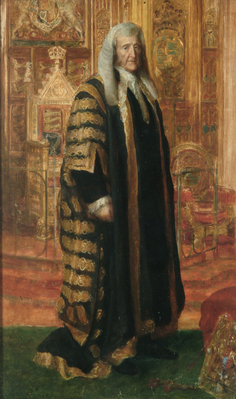
Lord Campbell
- Dataexact 1860 - exact 1860
- Materiale
- Dimensioni
- Painting height: 63.5 cm
Painting width: 38 cm - Descrizione
An ambitious oil study of a popular Lord Chancellor pictured in his 80th year. John Campbell had enjoyed a successful career as a lawyer after being called to the bar at the age of 27. In middle age he entered the political career before rising to the rank of Lord High Chancellor in 1859, a position which he held for two years until his death at the age of 81, in June 1861. Within Watt’s career, this portrait remains a rare example of a full-length male portrait and one in which the sitter is dressed in full ceremonial attire, in an equally elaborate setting.
An ambitious oil study of an ambitious and successful Lord Chancellor. Born in Fife, Scotland, John Campbell first arrived in London aged 18. Three years later, he entered Lincoln’s Inn as a student and was called to the bar aged 27. However, it wasn’t until his late 40s that Campbell began to develop political aspirations and subsequently stood as a moderate Whig in opposition to the Tory party, in the borough of Stafford and later the town of Dudley. In his politics, he favoured the connection of the church and state and became associated with new legislation including the Inheritance Act 1833, the Wills Act 1837 and the Judgements Act 1838. After becoming Chancellor of the Duchy of Lancaster in 1846, and Chief Justice in 1850, Campbell was appointed Lord High Chancellor, one of the highest-ranking offices in Great Britain in June 1859. He held the position for two years until his death at the age of 81, in June 1861 [1].
In this full-length oil study, Lord Campbell is wearing his Lord Chancellor robes consisting of black tailcoat, waistcoat and breeches, white shirt, black silk stockings and buckled patent court shoes. Over this is a black, silk damask robe of state with a long train which is trimmed with gold and lace frogging. On his head he wears a full-bottomed wig which signifies his legal background.
He is positioned in the House of Lords, in the Palace of Westminster. Behind him is the monarch’s throne, which is visible as he walks to take his seat on the Woolsack, included in the bottom right hand corner of the picture the seat of the Lord Speaker, in the House of Lords [2]. In the life sized finished portrait, which now belongs to a private collection, the extensive gilt framework behind him is more precisely rendered, and a ceremonial mace is depicted resting on the woolsack.
In order to paint the elaborate setting of the House of Lords and to achieve accuracy in detailing the paraphernalia of the historic location, Watts is believed to have written to parliament in September 1860 to seek special permission to paint the Lord Chancellor in situ [3]. This decision would have been usual for the artist, who preferred to paint his sitters in the comfort of his own studio.
Painted on panel, the reverse shows that it is bevelled on three sides. This suggests that a larger panel was cut down in order to provide the support for this detailed oil study. Painting the portrait had begun by March 1860 as Watts wrote to his friend George Cavendish Bentinck to say that painting had commenced but the Chancellor had just ‘lost his wife’ earlier that month [4].
In the context of Watts’s career, the portrait is rare in that it is a full-length male portrait. The artist frequently expressed how he loathed modern dress and so painting Campbell in his ceremonial robes seems to have been a compromise. Similarities can be drawn between this portrait and that of Lord Lyndhurst. Although formally different, the portraits were painted two years apart. Both men had held the position of Lord Chancellor and Watts painted them in old age, wearing official robes.
In Campbell’s face a reflective expression can be detected, as if the man if reminiscing about his current position and lengthy career. One critic remarked that Watts succeeded in achieving the ‘refined intellect, self-restraint […] and the uprightness of the man […] with unerring truth and understanding’ [5].
Explore:
Lord Lyndhurst [COMWG 50]
Prince of Wales [COMWG 138]
Footnotes:
[1] Gareth H. Jones and Vivienne Jones, ‘Campbell, John, first Baron Campbell of St Andrews’, Oxford Dictionary of National Biography. Jan 2008.
[2] M.H. Spielmann, G.F. Watts, R.A., O.M., as a Great Painter of Portraits: A Lecture, delivered in the Memorial Hall Manchester, 7th June 1905 (London, Sherratt & Hughes, 1905), p.32.
[3] Barbara Bryant, G.F. Watts: portraits; fame & beauty in Victorian society (London: National Portrait Gallery, 2004), p.114.
[4] Mary Seton Watts, Catalogue of Portraits by G.F. Watts O.M. R.A., Vol. II, c.1915, p.28.
[5] M.H. Spielmann, G.F. Watts, R.A., O.M., as a Great Painter of Portraits: A Lecture, delivered in the Memorial Hall Manchester, 7th June 1905 (London, Sherratt & Hughes, 1905), p.32.
Further Reading:
Barbara Bryant, G.F. Watts : portraits; fame & beauty in Victorian society (London: National Portrait Gallery, 2004).
Gareth H. Jones and Vivienne Jones, ‘Campbell, John, first Baron Campbell of St Andrews’, Oxford Dictionary of National Biography, Jan 2008.
M.H. Spielmann, G.F. Watts, R.A., O.M., as a Great Painter of Portraits: A Lecture, delivered in the Memorial Hall Manchester, 7th June 1905 (London, Sherratt & Hughes, 1905).
Mary Seton Watts, Catalogue of Portraits by G.F. Watts O.M. R.A., Vol. II, c.1915.
Text by Dr Stacey Clapperton
|
|
