


- Reproduction
- Numero oggettoCOMWGNC.1
- Creatore
- Titolo
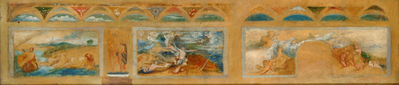
Study for the Carlton House Terrace Frescoes
- Datacirca 1854
- Materiale
- Dimensioni
- Painting height: 61 cm
Painting width: 14 cm - Descrizione
This long and narrow canvas holds tiny oil studies for a fresco cycle that filled an entire room. Watts painted a series of allegorical scenes in 7 Carlton House Terrace showing the classical elements, Earth, Air, Fire, and Water. It also had scenes of Wind and of Apollo and Diana, which is now owned by the Monarchy of the United Kingdom and displayed at the Watts Gallery. Watts painted them in 1854, but they were covered up by the end of the century. They were only rediscovered when the house they were in housed the German embassy ahead of World War 2. The little studies here may have been used for Watts to show his patrons, Lord and Lady Somers-Cocks. Other drawings and studies in the Watts Gallery would have shown more detail of the pictures but this gives a sense of the colour scheme.
Watts was a leading figure in the English fresco revival of the 1850s, although many of his frescoes aged badly or were disregarded. This oil sketch shows rough preparatory studies for the fresco series at 7 Carlton House Terrace, the London home of Watts’ friend Lady Virginia Somers-Cocks, Countess Somers (née Pattle). Several of these frescoes are now held in Malvern College, Worcestershire, having been removed from the walls of 7 Carlton House Terrace after 1973 and displayed at Eastnor Castle in Herefordshire by relatives of the Somers family from 1976 until 1988 [1]. Watts Gallery holds the massive section of fresco showing Apollo and Diana on deposit from the Crown Estate.
This long, narrow canvas shows five of the major subjects from what is known as The Elements fresco cycle, although the finished works were broken up slightly differently. From left to right, the study shows Arion and the dolphin, Apollo and Diana, the Anemoi or Four Winds, the Battle of Gods and Giants or Titans and Vulcan at his Forge [2]. A decorative scheme of false lunettes above the fresco seems to not have materialised at the house, and the two right-hand scenes of the Gigantomachy and Vulcan, here shown spanning an arch, were broken into discrete panels. Watts Gallery holds a red chalk drawing for the Gigantomachy (COMWG2006.56, 1854-1855). The long frescoes showing Earth in Carleton House Terrace are not included on this study.
The stories representing the elements are derived from Greek mythology, but often via Roman poetry. Arion, a seventh-century BCE Greek poet sometimes credited with inventing the dithyramb, a poetic format used in celebrating Dionysus (the Greek god of wine), represents Water. None of his poems survive and the only reference to his life comes from Herodotus, who made up a lot of his material. Herodotus tells of Arion’s misadventure at sea, threatened by sailors, who coveted his treasure after a successful tour of Greece; Arion threw himself into the sea and was saved by a dolphin [3]. In the finished fresco, Watts also included figures quoting Raphael from the Villa Farnesina in Rome, although these aren’t fully visible in this sketch. Watts Gallery also holds an early pen and ink study (COMWG2007.496) for this composition.
Although Apollo and Diana are best known as the twin Greek gods of the Sun and Moon, for Watts they function as ‘Two figures symbolic of the antagonistic forces, Attraction and Repulsion’ [4]. This is not a typical use of the Olympian twins but may derive from their roles as the sun and moon, or from their opposing characteristics on Olympus. Apollo was a god of civilisation, learning, and poetry, while Diana (in Greek, Artemis) was the goddess of the hunt, the wilderness, animals, and young girls.
Confusingly there are two scenes which represent air or wind: the Anemoi, who were the four winds of the earth, and the Gigantomachy. It might be that Watts saw the Gods versus the Giants as the triumph of the higher air, of heavenly beings, over the more monstrous and earthy figures, while the Anemoi symbolised wind as the actual breathable blowing air. The figure at the bottom left of this panel is Aulus, the keeper of the winds, while the four swirling bodies in drapery at the centre of the panel are the winds themselves. White puffs of paint stand in for clouds blowing around the pink nude winds.
The Gigantomachy is barely sketched out, recognisable only from the falling figure of giants at the bottom of the panel; this represents Air. On the opposite side of the arch is Vulcan at his forge, the god for whom volcanoes are named. Vulcan made armour and weapons for the gods in his fiery workshop and therefore represents Fire. Watts’ design for Vulcan would be revised and refined into the painting The Genius of Greek Poetry (COMWG.22, 1857-1858) and the figure of Achilles in the Bowood House fresco (COMWG.94, 1858-1860). Similarly, a plaster study of a seated bearded man (COMWG2007.929), may represent a later return to this idea of the crafting, labouring god, married to Venus (the goddess of love and beauty), reminiscent of Watts’ disastrous marriage to Ellen Terry in 1864.
Footnotes:
[1] Nicholas Tromans, ‘“The Elements”: A Fresco Cycle by George Frederic Watts,’ in Tributes to Jean Michel Massing, ed. Mark Stocker and Phillip Lindley (Turnhout: Brepols Publishers, 2016) pp. 313-4.
[2] Visually the two battles are nearly impossible to distinguish without textual evidence; both show the Greek gods battling and defeating demi-gods or superhumans in the earliest mythological ages.
[3] William Smith, New Classical Dictionary of Biography, Mythology and Geology (London: John Murray, 1850) p. 79; Herodotus, trans. Henry Cary, Herodotus; a new and literal version from the text of Baehr, with a geographical and general index by Henry Cary (New York: Harper & Brothers Publishers, 1876), pp. 9-10.
[4] Mary Seton Watts, George Frederic Watts: the Annals of an Artist’s Life, vol. 1 (London: Macmillan and Co., Ltd, 1912), p. 102.
Text by Dr Melissa Gustin
|
|
