


- Reproduction
- Numero oggettoCOMWGNC.13
- Creatore
- Titolo
Blondel
- Dataexact 1841 - exact 1841
- Materiale
- Dimensioni
- Painting height: 29.7 cm
Painting width: 24.7 cm - Descrizione
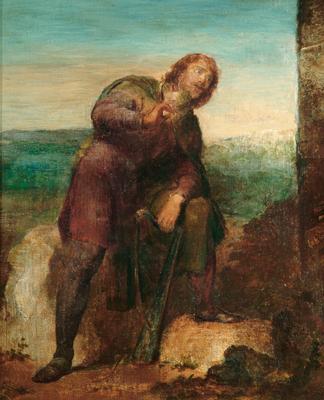
This is a very early painting by Watts of the legend of King Richard I’s famed favourite minstrel Blondel who rescued the king when the latter was imprisoned in the Castle of Dürnstein in Austria on his way back from Jerusalem at the end of the Third Crusade (1189-1192). As the legend goes, when King Richard I was imprisoned his favourite troubadour set out to find him by singing outside of castles where he might be held prisoner. When he came to the Castle of Dürnstein, Blondel began to sing a melody that the King and Blondel had written together, and the King responded in song. Hence, Watts has depicted the moment when Blondel listens for or hears the King’s reply. His happy expression suggests that the castle wall on his left is the one in which Richard I was held captive.
In the nineteenth century, many artists and writers were drawn to the legend of Blondel. For example, a young Charlotte Brontë wrote a poem Richard Coeur de Lion and Blondel when she was 17. Blondel was also an important character in Sir Walter Scott’s novel The Talisman (1825). The novels of Sir Walter Scott were, according to Mary Watts, one of G. F. Watts’s earliest sources of inspiration. She wrote:
knights and cavaliers often supplied subjects for his pencil, and with the Greek heroes inspired his earliest compositions. These novels inspired him then, and throughout life, and were’ together with the novels of Jane Austen ‘the books that he turned to most often when tired or unwell [1].
Watts’s depiction is a pretty traditional historical rendering. He painted two versions of Blondel, one of which was met with acclaim when it was exhibited at the Royal Institution, Manchester in 1842 It was considered to be a ‘well-drawn figure, coloured with much skill, and made to tell the story with no inconsiderable tact’ [2]. The year after it was praised at the British Institution too. ‘Blondel has sung his part of the famous “Trobadour,” and is now listening to Richard. The incident is well described, and the drawing accurate and forcible’, the reviewer wrote [3]. The famous Victorian painter Charles Allen Duval contributed a similar composition to an exhibition at Westminster Hall in 1847 [4]. When Henry William Pickersgill showed his Blondel in search of his master, Richard Coeur de Lion at the Royal Academy in 1862 interest Richard I’s extraction seemed to have waned [5]. It was described as ‘foolish and empty in the extreme’ [6]. Others who were inspired by the legend took more liberties with the subject matter, such as Eleanor Anne Porden (1795-1825) in her medievalist epic Coeur de Lion (1822) in which she reimagined Richard I’s rescuer to be his wife Berengaria of Navarre [7].
Footnotes:
[1] Mary Watts, George Frederic Watts Vol I (London: Macmillan, 1912), p 15.
[2] Anon. ‘The Provincial Exhibitions’ in The Art-Union 4.45 (Oct 1842), pp. 232-236, p. 233.
[3] Anon. ‘The British Institution’ in The Art-Union 50 (Mar 1843), pp. 64-70, p. 69.
[4] Anon. ‘The Exhibition at Westminster Hall, Under the Auspices of Her Majesty’s Commissioners on the Fine Arts’ in The Art-Union (Aug 1847), pp. 265-272. Watts was also represented at this exhibition with Echo (1844-46) and was awarded the premium for ‘Alfred inciting the Saxons to prevent the Landing of the Danes by encountering them at Sea’.
[5] See The Exhibition of the Royal Academy of Arts. The ninety-fourth. (London: William Clowes and Sons, 1862), p. 7.
[6] Anon. ‘The Royal Academy’ in the Saturday Review 13.343 (May 24, 1862), pp. 592-594, p. 593.
[7] For a discussion of the excavation of Britain’s chivalric past and problems associated with it see Adeline Johns-Putra ‘Eleanor Anne Porden’s Coeur De Lion (1822): History, Epic, and Romance’ in Women’s Writing 19.3, pp. 351-371.
Text by Dr Eva-Charlotta Mebius
|
|
