


- Reproduction
- Numero oggettoCOMWG.44
- Creatore
- Titolo
Prodigal Son
- Datanot before 1872 - not after 1873
- Materiale
- Dimensioni
- Painting height: 61 cm
Painting width: 50.8 cm
Frame height: 90 cm
Frame width: 80 cm - Descrizione
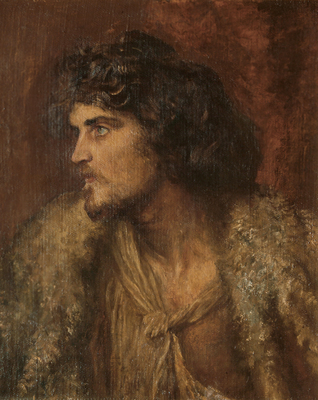
The Prodigal Son was a popular them in the art of this period. In the year of 1869, the Royal Academy saw three of Watts’s contemporaries attempt the Biblical theme in the work of the Paul Falconer Poole (1807-1879), Edward Poynter’s (1836-1919) The Prodigal’s Return (1869), and William Gale’s (1823-1909) The Return of the Prodigal. Every other year throughout the nineteenth century a painting or sculpture that took inspiration from the Parable of the Prodigal Son was shown at the Royal Academy. This work, a head study, differs from another work by Watts on this subject (COMWG.192). Although they both focus on depicting the son from the parable in Luke 15:11-32 who returns home intending to be accepted back as a servant the figure in this work looks less worn and is wearing what looks like a sheepskin coat over the same tunic in the other work which shows this figure in a landscape.
Scholars of nineteenth-century art speculate that an Italian model Angelo Colarossi served as the model for this work. Bills observes that Colarossi modelled for other late nineteenth-century artists including Leighton, Burne-Jones, Alma-Tadema as well as Simeon Solomon and may have also modelled as the muscles for Watts’s sculpture Clytie (COMWG2008.152, 1865-1869) [1]. Ford notes that Colarossi likely served as a model for other works by Watts including Genaro - A Venetian Nobleman (1864), Samson (COMWG75, 1871) and Angel Removing the Curse of Cain (COMWG.66, 1885-1886) [2]. Solidifying this idea that Colarossi modelled for a large number of artists during this period Ford including John Singer Sargent and Jean-Léon Gérôme in Paris while noting that Colarossi was among the most famous artists’ models in London at the time and even listed his occupation as model in the 1881census [3].
Differing from Watts’s other painting called The Prodigal Son (COMWG.192, 1872-1873), both painted around the same time, this work features a close up of the subject’s head and shoulders rather than showing the figure’s full body with a landscape background. Critics of Watts noted another difference between this work and Watts’s other painting titled The Prodigal Son. Phythian compares the expression of the figures in both of these works. He argues that the figure in the other work looks bitter and “perishing with hunger” while this painting shows the prodigal son as “looking sadly, hopelessly, towards home” [4].
However, Bills differs with this interpretation. He describes the figure in the other work as passive while the colours in this work are subdued and warm while the face shows strength and determination [5]. He expands on this later when he states, “there is a restlessness in this painting shown in the straining neck suggesting an epiphany” [5]. Therefore, differing from Phythian Watts, Bills contends this figure has come to a realization and possibly made a decision about his next steps which may including returning home.
Footnotes:
[1] Mark Bills, “43. The Prodigal, 1872-3,” G.F. Watts Victorian Visionary (ed. Mark Bills and Barbara Bryant), page 186.
[2] Colin Ford, “’Mountain Nymph’ and ‘Damned Villain’ Posing for Julia Margaret Cameron,” History of Photography 27 (1), page 60.
[3] Colin Ford, “’Mountain Nymph’ and ‘Damned Villain’ Posing for Julia Margaret Cameron,” History of Photography 27 (1), pages 61-63.
[4] John Ernest Phythian, George Frederick Watts, pages 109-110.
[5] Mark Bills, “43. The Prodigal, 1872-3,” G.F. Watts Victorian Visionary (ed. Mark Bills and Barbara Bryant), page 186.
Text by Dr Eva-Charlotta Mebius
|
|
