


- Reproduction
- Numero oggettoCOMWG.5
- Creatore
- Titolo
Thomas Hughes
- Datacirca not before 1870 - circa not after 1880
- Materiale
- Dimensioni
- Painting height: 66 cm
Painting width: 48.3 cm
Frame height: 98 cm
Frame width: 81 cm - Descrizione
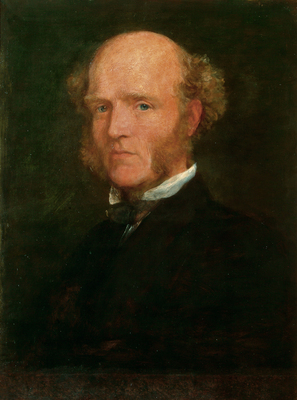
This portrait of Thomas Hughes (1822–1896) the MP, social reformer and author of the bestselling children’s book 'Tom Brown’s School Days' is painted in the style of a ‘Hall of Fame’ portrait. In three quarter profile, sat against a nondescript background and wearing dark, plain clothing, the focus of this portrait is on the sitter’s face. Although the hair is depicted in light and feathery brushstrokes, the face is overworked in thickly applied paint. On completion, Watts was considered to be so ‘dissatisfied’ with the work that he painted over it in a wash of burnt sienna. The wash was only removed after Watts’s death.
Remembered today as the author of the best-selling children’s book Tom Brown’s School Days, Thomas Hughes (1822–1896) was also an MP and committed social reformer. A young Hughes began his education at the world-famous Rugby School, which later became the setting for his semi-autobiographical book. Although he excelled at sports, in particular cricket and rowing, Hughes never quite achieved academic success. Nevertheless, he enrolled at Oriel College, Oxford in 1842. During his early legal career, he became involved with F.D. Maurice’s Christian socialism movement which resulted in the founding of the Working Men’s College in 1854 and the Working Men’s Club and Institute Union in 1862. As a committed social reformer throughout his life, Hughes was elected as Liberal MP for Lambeth in 1865 and became a key figure in the history of British trade unionism [1].
It is unknown when Watts first came into contact with Hughes, although he was familiar with his family. Hughes had seven siblings, with six brothers and a sister. Jane ‘Jeanie’ Hughes is known today for becoming Britain’s first female civil servant as the Inspector of Workhouses and Pauper Schools [2]. She married the lawyer Nassau John Senior in 1848. Mixing in the same social circles as Little Holland House, by the mid-1850s, Jeanie had become one of Watts’s confidants and he painted her in his much celebrated portrait Jane 'Jeanie' Elizabeth Hughes, Mrs Nassau John Senior, which marked his return to the Royal Academy Summer Exhibition season in 1858 [3].
In that same year, Watts painted a portrait of the mother, Margaret Elizabeth Hughes, nee Wilkinson, in a sixteenth-century Flemish inspired painting, which he gifted to Jeanie. However, it wasn’t until the following decade that Watts turned his attention to Thomas Hughes.
In a letter from the summer of 1868, the final year of Hughes’ stretch as an MP, he wrote to Watts to offer himself for a sitting between the hours of 11.30am and 1:30pm and offered to send a photograph of himself as a substitute [4]. In Mary’s initial catalogue of the artist’s work, there is no date included as to when the portrait of Hughes was completed. Her annotations do claim that on competition Watts was left ‘dissatisfied’ and so ‘obliterated the features with a wash of burnt sienna. After his death, the wash was removed by sponging with rain water, and the features were made visible’ [5].
Sitting in three-quarter profile with his blue eyes gazing out at the viewer, the flesh tones of Hughes’ skin appear thickly painted to the extent of that they have been overworked. This is particularly evident in the application of paint on the forehead, brows, ridge of the nose and cheeks. In contrast, the hair has been established using light and feathery brush strokes.
Painted against a nondescript background and wearing a plain, dark overcoat with only a white shirt collar and necktie visible, the format of this three-quarter length portrait follows Watts’s ‘Hall of Fame’ works. As a prominent figure in Victorian society, both in terms of his literary success and work as a social reformer, Hughes would have seemed a likely candidate to join the esteemed company of the other ‘Hall of Fame’ figures. However, after Hughes’ death in 1896 and Watts’s in 1904, this portrait never entered the National Portrait Gallery, London collection and remained part of the original Limnerslease collection.
Footnotes:
[1] Charlotte Mitchell ‘Hughes, Thomas (1822–1896)’, Oxford Dictionary of National Biography, Oxford University Press, Sept 2004; online edition, May 2006.
[2] Barbara Bryant, G.F. Watts: portraits; fame & beauty in Victorian society (London: National Portrait Gallery, 2004), p.106.
[3] Barbara Bryant, G.F. Watts: portraits; fame & beauty in Victorian society (London: National Portrait Gallery, 2004), p.104.
[4] Letter from Thomas Hughes to G.F. Watts, 13 August 1868, Watts Correspondence, Heinz Archive, National Portrait Gallery, GFW/1/15.
[5] Mary Seton Watts, Catalogue of Portraits by G.F. Watts O.M. R.A., Vol. II, c.1915, p.71.
Further Reading:
Barbara Bryant, G.F. Watts: portraits; fame & beauty in Victorian society (London: National Portrait Gallery, 2004).
Charlotte Mitchell ‘Hughes, Thomas (1822–1896)’, Oxford Dictionary of National Biography, Oxford University Press, Sept 2004; online edition, May 2006.
Leonee and Richard Ormond, G.F. Watts: The Hall of Fame: Portraits of his Famous Contemporaries (Compton: Watts Gallery, 2012).
Watts Correspondence, Heinz Archive, National Portrait Gallery, GFW/1/15.
Mary Seton Watts, Catalogue of Portraits by G.F. Watts O.M. R.A., Vol. II, c.1915.
Text by Dr Stacey Clapperton
|
|
