


- Reproduction
- [nb-NO]Object number[nb-NO]COMWG.109
- [nb-NO]Creator[nb-NO]
- [nb-NO]Title[nb-NO]
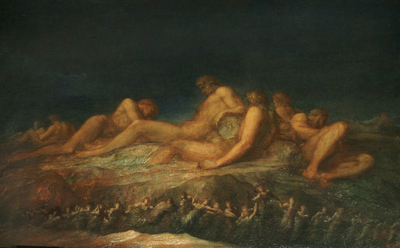
The Titans
- [nb-NO]Date[nb-NO]from 1848 - to 1875
- [nb-NO]Material[nb-NO]
- [nb-NO]Dimensions[nb-NO]
- Painting height: 71.1 cm
Painting width: 111.8 cm
Frame height: 102 cm
Frame width: 143 cm - [nb-NO]Description[nb-NO]
Both a colour study for Chaos and a finished picture, The Titans shows sleeping giants and tiny dancing figures. In Watts’ House of Life project, the giants represented mountains and the ‘non-effect of time on them’, while the dancing figures represented ‘centuries and cycles’ of humanity. The name Titans recalls Greek mythological characters from the early days of creation. The Titans were the children of the Earth and the Sky. Some of the Titans fought the gods for dominance over the universe and were defeated. Others, like Prometheus (whom Watts painted separately) tried to help humanity. Watts used the term generically, suggesting only giant and ancient figures rather than specific characters. Text by Dr Melissa Gustin
This is a study for a small part of Watts’s magnificent sublime image of the chaos of an emerging cosmos in Chaos (c. 1875-82, Tate). This painting in oil on panel is thought to be the very first sketch of this subject. According to Mary Watts it was one of Watts’s most treasured paintings and rested ‘unframed upon the dresser of Mr. Watts’s studio until his death in 1904’ [1]. According to Mary, he ‘set a value’ upon this small panel ‘above almost any other work of his own hand’ [2].
It is certainly a work which exhibits the curious originality of Watts’s imagination, and when one version of his giantology was exhibited at the New Gallery in 1897 the ‘superb’ composition was thought to sum up ‘the whole of Mr. Watts’ symbolic art’ [3]. The critic M. H. Spielmann concurred in the Magazine of Art, in which he wrote that the ‘fine’ picture ‘exhibits, perhaps better than any other, the monumental character of the artist’s conception, while the forms obviously recall his study of the Elgin marbles’ [4].
There is no evidence of to what extent G. F. Watts was familiar with the work of his predecessor William Blake (1757-1827). Yet it should be noted that while Blake died in obscurity his work became more and more familiar with audiences following the publication of Gilchrist’s Life of William Blake (1863) and the Blake Exhibition at the Burlington Club in 1876. Following the exhibition, in 1877, a facsimile edition of Jerusalem the Emanation of the Giant Albion was published and an edition of etchings from his works by William Bell Scott was published in 1878 [5].
Many of Watts’s paintings exhibit a Blakean affinity, and perhaps none the more so than Watts’s giantology of creation Chaos (COMWG.143, 1875-1882). While this can be explained by their common influence of Michelangelo, it can also be explained by their knowledge of Britain’s giants in particular and the importance of giants within creation myths more generally [6]. The similarities between their respective artistic outputs was not lost on Watts’s contemporaries, who thought that some of Watts’s groups of figures ‘recall William Blake’ [7].
Apart from its interesting mythology, Watts’s painting also exemplifies his strength as a colourist, of which critics grew more and more appreciative throughout the nineteenth century and beyond. While the panel was never exhibited, Mary Watts revealed that the German-born British painter Sir Hubert von Herkomer R.A. once borrowed it ‘for several months as an example of colour to set before his students’ at the Herkomer School of Art at Bushey [8]. It exemplifies the what G. K. Chesterton called Watts’s
spiritual and symbolic history of colours... [in] the mess on his palette. [One] would see giants and the sea and cold primeval dawns and brown earth-men and red earth-women lying in the heaps of greens and whites and reds, like forces in chaos before the first-day of creation [9].
Footnotes:
[1] Mary Watts, Catalogue of Works by G.F. Watts, p. 24.
[2] Ibid., p. 25.
[3] Anon. ‘Mr. G. F. Watts at the New Gallery’ in Art Journal (Feb 1897), pp. 62-62, p. 62 The review was accompanied by a photograph of the painting by Frederick Hollyer (COMWG2010.1.387). See also Anon. ‘G. F. Watts at the New Gallery’ in Artist 19 (Feb 1897), pp. 57-58.
[4] M. H. Spielmann, ‘Mr. George Frederick Watts, R. A.’ in The Magazine of Art (Jan 1897), pp. 201-210, p. 210. Some, like the architect and critic Henry Heathcote Statham (1839-1924), were less convinced by the ‘unintelligible’ moral symbolism of Watts’s Chaos and other canvases that appeared to be not pictures but ‘good-boy puzzles for Sundays’. See H. Heathcote Statham, ‘Leighton and Watts: Two Ideals in Art’ in Fortnightly Review 61.362 (Feb 1897), pp. 303-310, p. 310.
[5] See William Michael Rossetti’s review, ‘William Blake’ in The Academy 303 (Feb 23, 1878), pp. 174-175 and Henry G. Hewlett, ‘Imperfect Genius: William Blake’ in The Contemporary Review 28 (Oct 1876), pp. 756-784.
[6] Peter Connor, ‘Giants’ in Gods, Goddesses, and Mythology Vol 4 Druids-Gilgamesh, Epic of. (New York: Marshall Cavendish, 2005), pp. 563-570.
[7] Anon. ‘G. F. Watts at Burlington House’ in The Athenaeum 4031 (Jan 28, 1905), pp. 119-120, p. 119. See also for example Esther Wood, ‘Sixty Years a Painter’ in The Leisure Hour (Nov 1897), pp. 17-20, and Anon. ‘ART. IX.-1. The National Gallery of British Art’ in The Quarterly Review 187.373 (Jan 1898), pp. 209-233.
[8] Mary Watts, Catalogue of Works by G.F. Watts, p. 25.
[9] G. K. Chesterton, G. F. Watts (Chicago: Rand McNally, 1904), p. 59.
Text by Dr Eva-Charlotta Mebius
|
|
