


- Reproduction
- [nb-NO]Object number[nb-NO]COMWG.352
- [nb-NO]Creator[nb-NO]
- [nb-NO]Title[nb-NO]
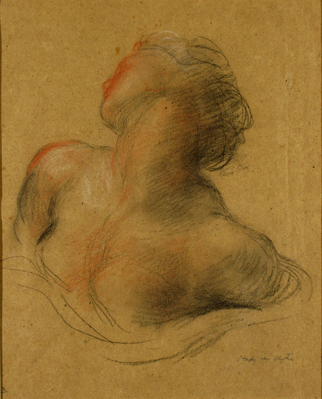
Chalk Study for 'Clytie'
- [nb-NO]Date[nb-NO]circa not before 1860 - circa not after 1869
- [nb-NO]Material[nb-NO]
- [nb-NO]Dimensions[nb-NO]
- drawing height: 38.7 cm
drawing width: 29.5 cm
mount height: 51.4 cm
mount width: 41.4 cm - [nb-NO]Description[nb-NO]
This chalk drawing, in black, red, and white on textured paper, may represent a middle point between Watts’s bust of Clytie and the oil painting of the same subject and composition. It shows a view of the statue in which the face is almost completely hidden. Only a very tiny hint of the tip of the nose can be seen above the line of the cheekbone. This ‘lost profile’ draws the focus away from the face, which is what draws human attention first, towards the rest of the body. Watts used this to emphasise the violent twisting and straining of Clytie’s body back over her shoulder, to see the setting sun. Clytie has begun to transform into a flower that follows the sun across the sky, after the sun-god rejected her love.
It is difficult to ascertain the working order of Watts’s group of Clytie works, particularly between the finished sculpture, oil painting, and this chalk drawing. This drawing, in black, red, and white chalk on textured brown paper seems to be a preparatory work (COMWG2007.328, 1854-1855) along the lines of his drawings in the same media for 7 Carlton House Terrace showing Arthur Prinsep at Watts Gallery and at the National Gallery of Art, Edinburgh [1]. However, the date of the painting is uncertain, and the sculpture is generally given a date range of between five and ten years, so it is unclear where the relative parts fall. It is likely that a sheet of very early sketches at the Watts Gallery, probably taken from a sketchbook, are some of the earliest gestures towards Clytie, because some drawings (COMWG2007.398) show the pose in reverse. In the chalk drawing, the termination of the arms and torso is described with quick, indeterminate lines that suggest but do not depict drapery, where on the sculpture the lower edge of the bust is disguised in large, heavy leaves and the painting simply is cut off at the bottom edge of the canvas.
However, it may well be that the sculpture design, possibly incomplete but substantially worked out, was the model for the present drawing, which in turn preceded the painting. The profil perdu, or lost profile, which is a notable feature of the drawing and painting, can be matched to a specific view of the bust (COMWG2008.152). Watts used the profil perdu in numerous works, from Satan (1847-8) to a portrait of Mary seen from behind; John Ruskin commented about Satan that ‘He has his cheek-bone alright,’ drawing attention to the barely visible sliver of face [2]. The bust does demonstrate the profil perdu but the twisting design of the sculpture invites circumambulation, or taking it in from multiple angles, many of which do provide a clear view of either the profile or the whole face. It stands to reason that rather than sculpting to match the very faint hint of profile in the drawing, the drawing and then the painting were taken from the sculpture, either from the marble or a plaster cast which would provide a better variation in light and dark in relation to human skin than the dark patinated bronze.
The drawing, painting, and sculpture all show the figura serpentinata, a term coined by the sixteenth-century Milanese theorist and artist Giovan Paolo Lomazzo [3]. Lene Østermark-Johansen defines this as ‘the turning of the body on its own axis,’ and it is a defining characteristic of later Renaissance and Mannerist painting [4]. Algernon Swinburne, whom Watts painted in 1867, wrote of the bust version of Watts’s Clytie at exhibition in 1868 that it was ‘Not imitative, not even assimilative of Michel Angelo’s manner, it yet by some vague and ineffable quality brings to mind his work rather than any Greek sculptor’s. There is the same intense and fiery sentiment, the same grandeur of device, the same mystery of tragedy […]’ [5]. Swinburne connected Watts’s twisting figure to the figura serpentinata in Michelangelo’s drawings he had seen several years earlier at the Uffizi in Florence [6]. Watts, who had spent the better part of four years in Florence and who considered Michelangelo one of the greatest artists in history, may well have seen the same drawings. Although Watts’s drawing of Clytie could never be mistaken for one of Michelangelo’s red chalks studies of serpent-like women, the two artists shared an interest in an elongated and torqued neck round which the rest of the body spirals.
Explore:
Clytie (COMWG2007.126)
Clytie (COMWG2007.177)
Bust of Clytie (COMWG2007.1075)
Footnotes:
[1] National Galleries Scotland, inv. D 5023.46
[2] John Ruskin to Watts, c. 1850, in The Letters of John Ruskin 1827-1889, vol. 1, ed. E.T. Cook and Alexander Wedderburn (London: George Allen, 1909) p. 112.
[3] Lene Østermark-Johansen, ‘Serpentine Rivers and Serpentine Thought: Flux and Movement in Walter Pater's Leonardo Essay,’ Victorian Literature and Culture , 2002, Vol. 30, No. 2 (2002), p. 457.
[4] Lene Østermark-Johansen, ‘Serpentine Rivers and Serpentine Thought: Flux and Movement in Walter Pater's Leonardo Essay,’ Victorian Literature and Culture , 2002, Vol. 30, No. 2 (2002), p. 457; Algernon Charles Swinburne, ‘Notes on Designs of the Old Masters at Florence,’ Fortnightly Review, July 1868, republished in Algernon Charles Swinburne, Essays and Studies (London: Chatto & Windus, 1875), pp. 314-57.
[5] Algernon Charles Swinburne, Notes on the Royal Academy Exhibition, 1868, part 2 (London: John Camden Hotten, 1868), pp. 35-6.
[6] Lene Østermark-Johansen, ‘Swinburne's Serpentine Delights: The Aesthetic Critic and the Old Master Drawings in Florence,’ Nineteenth Century Contexts, vol. 24 (1), pp. 49–72; Stefano Evangelista, ‘Swinburne’s Galleries,’ The Yearbook of English Studies Vol. 40, No. ½ (2010) pp. 160-79.
Further Reading:
R.E. Gutch, ‘Watts’s Sculpture,’ The Burlington Magazine Vol. 110, No. 789 (Dec., 1968), pp. 693-99.
Gordon S. Haight, ‘George Eliot and Watts’s Clytie,’ The Yale University Library Gazette, Vol. 56, No. 3/4 (April 1982), pp. 65-9.
Lene Østermark-Johansen, ‘Serpentine Rivers and Serpentine Thought: Flux and Movement in Walter Pater's Leonardo Essay,’ Victorian Literature and Culture , 2002, Vol. 30, No. 2 (2002), pp. 455-482.
Charles Ricketts, ‘Watts at Burlington House,’ The Burlington Magazine for Connoisseurs, Vol. 6, No. 23 (Feb., 1905), pp. 346-350.
William Michael Rossetti and Algernon Charles Swinburne, Notes on the Royal Academy Exhibition, 1868, (London: John Camden Hotten, 1868).
Text by Dr Melissa Gustin
|
|
