


- Reproduction
- [nb-NO]Object number[nb-NO]COMWG.180
- [nb-NO]Creator[nb-NO]
- [nb-NO]Title[nb-NO]
Double Portrait of Long Mary
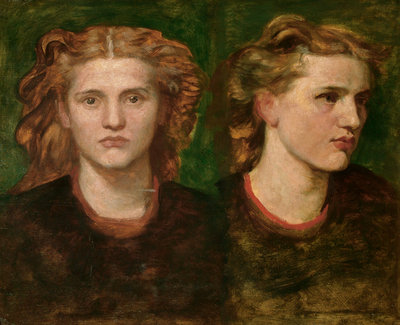
Double Portrait of Long Mary; a double bust-length female portrait of Watts's model.
- [nb-NO]Date[nb-NO]circa not before 1860 - circa not after 1860
- [nb-NO]Material[nb-NO]
- [nb-NO]Dimensions[nb-NO]
- Painting height: 53.3 cm
Painting width: 66 cm
Frame height: 86 cm
Frame width: 97 cm - [nb-NO]Description[nb-NO]
An informal study of Watts’s favourite model. Watts came to affectionately nickname Mary Bartley, the housemaid at Little Holland House, ‘Long Mary’ due to her long limbs and statuesque proportions. First sitting for Watts in 1860, after he had sought permission from Sara Prinsep, Bartley became the subject for numerous life-drawing studies and was used as a model for future paintings and sculpture. In this double portrait, Bartley is presented in a full-frontal pose (left) and a three-quarter pose (right). The study, which presents Bartley ‘in the round’ remained in Watt’s studio collection and would have been used as a reference for other works.
If I had a school, I should make my pupils draw from the model a head in full face, and then without the model, and from knowledge alone, they should make a drawing of the three-quarter face [1].
In his notes to art school students, Watts outlines his method of observing and recording the likeness of a model; which is visualised in this double portrait of Mary ‘Long Mary’ Bartley.
Bartley, who worked as a housemaid at Little Holland House was not a professional model and was only allowed to sit for Watts after he sought permission from her mistress Sara Prinsep. Watts then went on to explain how she ‘might serve art should she consent to sit to him for the nude’[2]. Using non-professional models was not a rarity for Victorian artists and it was possible for them to sit for more than one artist and seek out professional status. Dante Gabriel Rossetti, for one, is credited with ‘discovering’ the housemaid Fanny Cornforth who would become a favourite model of his [3]. Bartley however, only sat for Watts and little is known about her life after Little Holland House.
Although her physical characteristics are evident in many of Watts’s life drawing studies on paper, this is the only painted portrait of Bartley that exists. Her large almond shaped eyes, wide nose, plump bowed lip and thick neck informed the female figures that featured in subject paintings from the late 1860s including: A Fair Saxon (COMWG.91, 1868-70), Rhodopis (COMWG.114,1868), Thetis (COMWG.42, 1870-1886), and Olympus on Ida (COMWG30, 1885). Bartley was also used as one of the models for his much-celebrated sculptural bust Clytie (COMWG2008.152, 1860-69).
In this portrait Bartley is captured in a full-frontal pose and a three-quarter profile viewpoint, although it is unknown whether Watts kept to his own outline of drawing the head on the right-hand side of the canvas from memory. In the painting, attention has been paid to the head, face and hair, which has been brushed back to fully expose the features of the face. The background and Bartley’s clothing appear as flat masses of colour, which demonstrates their irrelevance to this study of the human head from multiple angles.
Although the double portraits that Watts created remained in his personal collection, and preserved as studies to reference, this portrait is unlike the others. In the earlier portrait of Georgina Treherne, (COMWGNC.19, 1856-58), the two heads depicted from different angles are presented in a unified space, where Georgina is seen reclining on a daybed. The double portrait of Mrs G.F. Watts (COMWG.1 and COMWG.7, 1887) was split into two single works and shows Mary from a three-quarter angle and from behind. Like Double Portrait of Long Mary, the portraits of Mrs G.F. Watts are presented against a roughly executed, plain background.
Using a single canvas for multiple studies is a practice Watts continued with throughout his career. Not unique to Watts’s practice however, there is art historical precedence for presenting various viewpoints of the same figure on a single canvas, such as Van Dyck’s Charles I in three positions, c.1635 and Philippe de Champaigne’s, Triple Portrait of Cardinal de Richelieu, c.1642. There is also evidence that Watts executed multiple landscape compositions on a single canvas and so this type of experimentation was not limited to figurative works.
Double Portrait of Long Mary was never finished to a high degree or exhibited publicly, and remained as a modestly simple, private portrait which would inform Watts’s art for many years after.
Explore:
Georgia Treherne [COMWG NC 19]
Mrs. G.F. Watts. [COMWG 7]
Mrs. G.F. Watts [COMWG 1]
A Fair Saxon [COMWG 91]
Rhodopis [COMWG 114]
Thetis [COMWG 42]
Olympus on Ida [COMWG 30]
Clytie [COMWG 2007.1075]
Footnotes:
[1] Mary Seton Watts, ed., George Frederic Watts: Annals of an Artist’s Life: Writings on Art, vol. III (London: Macmillan and Co. Ltd., 1912), p.18.
[2] Mary Seton Watts, Catalogue of Portraits by G.F. Watts O.M. R.A., Vol. I, c.1915, p.53.
[3] Marks Bills and Barbara Bryant, G.F. Watts: Victorian Visionary (New Haven and London: Yale University Press in association with Watts Gallery Compton, 2008), p.148.
Further Reading:
Marks Bills and Barbara Bryant, G.F. Watts: Victorian Visionary (New Haven and London: Yale University Press in association with Watts Gallery Compton, 2008).
Victoria Franklin Gould, G.F. Watts: the last great Victorian (New Haven and London: Yale University Press, 2004).
Chloe Ward, The Drawings of G.F. Watts (London: Watts Gallery in association with Philip Wilson Publishers, 2016)
Mary Seton Watts, George Frederic Watts: Annals of an Artist’s Life, vol. II (London: Macmillan and Co. Ltd., 1912).
Mary Seton Watts, ed., George Frederic Watts: Annals of an Artist’s Life: Writings on Art, vol. III (London: Macmillan and Co. Ltd., 1912).
Mary Seton Watts, Catalogue of Portraits by G.F. Watts O.M. R.A., Vol. I, c.1915.
Text by Dr Stacey Clapperton
|
|
