


- Reproduction
- [nb-NO]Object number[nb-NO]COMWGNC.21
- [nb-NO]Creator[nb-NO]
- [nb-NO]Title[nb-NO]
Uldra
- [nb-NO]Date[nb-NO]exact 1884 - exact 1884
- [nb-NO]Material[nb-NO]
- [nb-NO]Dimensions[nb-NO]
- Painting height: 66 cm
Painting width: 53.3 cm
Frame height: 95 cm
Frame width: 83 cm - [nb-NO]Description[nb-NO]
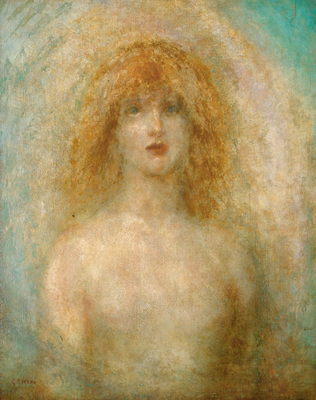
This harmless looking blond woman is Watts’s interpretation of the Scandinavian myth of the Huldra or Hulder. These were forest spirits who could be either helpful or spiteful. They were not actually spirits of the rainbow or waterfalls, although one Norwegian waterfall may have had a local Huldra myth. Watts describes his Uldra as the spirit of the rainbow seen through waterfall mists. The catalogue for Watts’s solo exhibition at the Metropolitan Museum of Art in 1884 described it as ‘the best example of an atmospheric effect in a figure-picture among Mr. Watts' works.’ Watts used pale tones of yellow, blue and pink to create a hazy, golden effect, which Watts described as a ‘a certain opalescent quality.’ The half-length figure dissolves against the background, like a spirit seen through a spray of mist.
Watts seems to have invented ‘Uldra’ as a character, merging several broad mythological tropes into a single figure without an apparent textual precedent. It is likely that he took the name ‘Huldra,’ a type of Scandinavian spirit and invented his ‘spirit of the rainbow.’ The huldra or hulder (names for the same group of folkloric figures) were forest dwellers, who often looked after the fires of charcoal burners in return for food, rather than water creatures. Scandinavian folklore does have numerous water spirits but no specific spirit of the rainbow seen through the mists of waterfalls. Rather, Watts may have merged the more widely known type of the undine or Ondine, and the evocative Northern European name to give character to his painting. Watts also painted Undine (COMWG.62, 1835, 1870), held at the Watts Gallery, but the pictures do not seem to be a pair. The colour and paint handling of Uldra instead seem to relate to the two paintings called Olympus on Ida (COMWG.30, 1885), which depict the three Olympian goddesses Athena, Aphrodite, and Hera.
Alongside the final version Olympus on Ida, now in the Art Gallery of South Wales, Australia, Uldra was one of Watts’s pieces where he moved from a more sombre colour palette to experiment in a drier oil medium and lighter colours [1]. As Barbara Bryant has noted, they were ‘overtly Symbolist exercises with ethereal figures in a cloud-like setting.’ These ‘epitomised a visionary quality that became uniquely identified with Watts’s work’ [2].
The work was one of Watts’s favourite exhibition pieces, and was sent to the Metropolitan Museum of Art solo exhibition in 1884, the Paris Exhibition Universelle in 1889, and four of the memorial exhibitions according to Mary Watts’s catalogue of her husband’s work [3]. She also noted a second copy, a few inches smaller, said to be painted in 1882. The painting remained in Mary’s hands after Watts’s death but was sold by their ward Lillian Chapman after Mary’s death. It was eventually re-purchased by the Watts Gallery with the support of the Art Fund in 1995 [4].
The model for the three-quarter length picture has been suggested as Dorothy Dene, an actress most famous as Frederic Leighton’s favourite model. It was suggested that Watts never used a live model, but Mary clarified that it was more accurate to say he avoided using specific models for his symbolic or mythological paintings. Instead he largely took inspiration from the drawings he had made in the 1860s of Mary Bartley, known as Long Mary (COMWG.180, 1860) [5]. This work, although dating from the 1880s, has a pose reminiscent of an earlier group of work including The Wife of Plutus (or Pluto), The Wife of Pygmalion (COMWG2007.813, 1868), and A Study with Peacock Feathers [6].
Footnotes:
[1] Art Gallery of South Wales, inv. 20146P17
[2] Barbara Bryant, ‘Invention and Reinvention: The Art and Life of G.F. Watts,’ in G.F. Watts: Victorian Visionary, ed. Mark Bills and Barbara Bryant (New Haven: Yale University Press, 2008) p. 43.
[3] Mary Seton Watts, Catalogue of Subject Pictures by G.F. Watts O.M. R.A., v. I, c. 1912, p. 151.
[4] Art Fund, ‘Art We’ve Helped Buy: Uldra,’ 1995
[5] Mary Seton Watts, George Frederic Watts: the Annals of an Artist’s Life, vol. 2 (London: Macmillan and Co., Ltd, 1912), p. 44.
[6] Walker Art Gallery, WAG 2135; Buscot Park, no. 90; sold at Christies, London, The Joe Setton Collection: From Pre-Raphaelites to last Romantics, 10 December 2020, Lot 6.
Text by Dr Melissa Gustin
|
|
