


- Reproduction
- [nb-NO]Object number[nb-NO]COMWG.65
- [nb-NO]Creator[nb-NO]
- [nb-NO]Title[nb-NO]
Miss Mildmay
- [nb-NO]Date[nb-NO]not before 1855 - not after 1856
- [nb-NO]Material[nb-NO]
- [nb-NO]Dimensions[nb-NO]
- Painting height: 55.9 cm
Painting width: 45.7 cm
Frame height: 67 cm
Frame width: 57.5 cm - [nb-NO]Description[nb-NO]
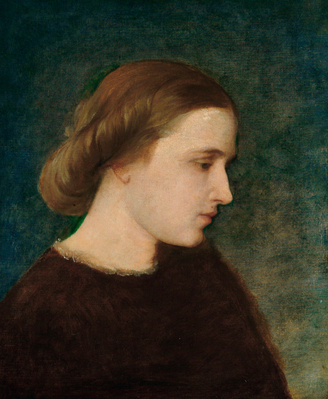
An early portrait that quietly celebrates young female beauty. Through family connections, Miss Geraldine Mildmay (1832–1912) was well acquainted with literary figures including Thomas Carlyle, Henry Taylor and Alfred Tennyson: all men which Watts also admired. Simple and understated, this portrait is an early example of Watts’s reliance on blue background for his female portraits. The combination of deep brown dress and the glowing blue of the background, evoking a sky, Mildmay’s porcelain skin and delicate features are highlighted.
It is not known why Watts chose to paint Miss Geraldine Mildmay in the winter of 1855-56. Her father, George St John-Mildmay (1792-1851), the third son of the third baronet of Farley, was a captain in the Royal Navy. Through family connections, Geraldine and her mother belonged to the literary and intellectual ‘Ashburton set’ [1]. It was through the Ashburton’s that she came to be acquainted with Thomas Carlyle, Henry Taylor and Alfred Tennyson, who Watts was also well acquainted with and went on to paint their portraits [2]. Geraldine’s upper-class lifestyle was maintained when she married Alfred Buckley Esq., of New Hall, Wiltshire, two years after this portrait was painted [3].
Aged 23, this portrait was painted during Watts’s short stay in Paris during the winter of 1855-56 with his friends the Hollands. Staying in the city for ten months, Watts established a studio at 10 Rue des Saint Pères where he is known to have painted the French statesman Adolphe Thiers, Prince Jerome Buonaparte and Princess Dorothea Lieven [4]. Whereas these were formal, three-quarter length and highly detailed grand portraits in the neoclassical manner of the French portrait painter painter Jean Auguste Dominique Ingres (1780–1867), Miss Geraldine Mildmay marked a departure for Watts [5].
It is a simple, understated portrait painted on a fine, plain weave canvas. Although seemingly unfinished, certain areas show diligence and delicacy such as the fine brushstrokes which show the curl of the hair and in the colouring of the lips. There are also odd and incomplete passages of paint. The lower half of the exposed ear for example has been briefly outlined with no modelling. The passage of flat colour under her chin and where the clothing meets Mildmay’s neck has also been left incomplete with no sense of form or depth of space attempted. At the nape of the neck and to her profile there is also a strong outline in a solid green pigment compared with the rest of the background colour. Watts may have wished to strengthen the profile after experimenting with the placement of the head itself.
In terms of composition and colour palette, this portrait of Miss Mildmay is strikingly similar to a portrait he painted ten years later of Miss Eliza Ogilvy, in the Ashmolean Museum of Art and Archaeology collection. Both sitters are viewed from the same angle with their hair swept up in the same style. Both wear thick brown overcoats with little embellishment and are set against a deep blue background evoking a skyline or a vast seascape. Indeed, blue backgrounds were a common feature in Watts’s early portraits, and in particular in his portraits of women. Further examples in the collection include: Miss Marietta Lockhart (COMWGNC.10, 1845), Lady Lilford (COMWG.31, 1860), and Lady Garvagh (COMWG.57, 1874).
According to Mary Watts, this portrait was not publicly exhibited during Watts’s lifetime [6]. Photographs of the time however, do show the work propped up against a wall in the gallery at Little Holland House, demonstrating Watt’s pride in the work and his willingness for guests to see it on display [7].
Explore:
Miss Marietta Lockhart [COMWGNC.10]
Lady Lilford [COMWG.31]
Lady Garvagh [COMWG.57]
Footnotes:
[1] Marks Bills and Barbara Bryant, G.F. Watts: Victorian Visionary (New Haven and London: Yale University Press in association with Watts Gallery Compton, 2008), p.128.
[2] Marks Bills and Barbara Bryant, G.F. Watts: Victorian Visionary (New Haven and London: Yale University Press in association with Watts Gallery Compton, 2008), p.128.
[3] Marks Bills and Barbara Bryant, G.F. Watts: Victorian Visionary (New Haven and London: Yale University Press in association with Watts Gallery Compton, 2008), p.128.
[4] Mary Seton Watts, George Frederic Watts: Annals of an Artist’s Life, vol. I (London: Macmillan and Co. Ltd., 1912), p.161.
[5] Marks Bills and Barbara Bryant, G.F. Watts: Victorian Visionary (New Haven and London: Yale University Press in association with Watts Gallery Compton, 2008), p.128.
[6] Mary Seton Watts, Catalogue of Portraits by G.F. Watts O.M. R.A., Vol. I, c.1915, p.107.
[7] Marks Bills and Barbara Bryant, G.F. Watts: Victorian Visionary (New Haven and London: Yale University Press in association with Watts Gallery Compton, 2008), p.128.
Further Reading:
Marks Bills and Barbara Bryant, G.F. Watts: Victorian Visionary (New Haven and London: Yale University Press in association with Watts Gallery Compton, 2008).
Barbara Bryant, G.F. Watts : portraits; fame & beauty in Victorian society (London: National Portrait Gallery, 2004).
Mary Seton Watts, George Frederic Watts: Annals of an Artist’s Life, vol. I (London: Macmillan and Co. Ltd., 1912).
Mary Seton Watts, Catalogue of Portraits by G.F. Watts O.M. R.A., Vol. I, c.1915.
Text by Dr Stacey Clapperton
|
|
