


- Reproduction
- ObjectnummerCOMWG.57
- Vervaardiger
- Titel
Lady Garvagh
- Datumexact 1874 - exact 1874
- Materiaal
- Formaat
- Painting height: 66 cm
Painting width: 48.3 cm
Frame height: 96.5 cm
Frame width: 79.5 cm - Beschrijving
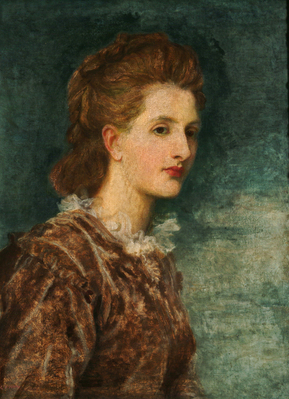
Born into the noble family of the de Bretton’s of Copenhagen, Alice Florence de Bretton (c.1851 – 1926) married Charles John Spencer George Canning, third Baron Garvagh on 9 August 1877. This portrait by Watts depicts the future Lady Garvagh at the age of 23, shortly before her marriage. In this half-length portrait, Garvagh appears statuesque against a rich-blue green background. Evoking they sky, this colour was frequently used as a background for Watts’s female portraits.
Alice Florence de Bretton is believed to have been born in 1851. The youngest daughter of Baron Joseph de Bretton of Cophenhagen, the family were known to have been plantation owners in the Danish West Indies since the 18th century. In 1877 she married Charles John Spencer George Canning, the third Baron Garvagh in London [1]. This Anglo-Irish noble family gained the title in the Peerage of Ireland in 1818 and resided in Garvagh House, near Garvagh in County Londonderry.
Shortly before her marriage, Watts painted this portrait in 1874. Painted on a taller canvas than usual for his portraits, Garvagh is painted from the waist up and appears grander and more commanding than some of Watts’s other female sitters. Her hairstyle which sits high on her head also increases her statue.
Appearing in three quarter profile, Garvagh looks out towards her left, with a deep blue-green mass of colour, in an indistinguishable form making up the background. Throughout his career, Watts often painted his female sitters against blue backgrounds to heighten the paleness and luminosity of their skin. The blue was often used to evoke the sky, as can be seen in works including Miss Marietta Lockhart (COMWGNC.10, 1845) and Lady Lilford (COMWG.31, 1860). The background in this portrait is extremely matt and in the passage to the right of Lady Garvagh, it appears lighter. This may indicate that depth was being attempted, or that Watts had decided to scrub out an earlier addition.
If one looks closely at the area of paint surrounding her head and hair, it appears darker than the rest of the background. There is also a definite outline to the hair which demonstrates that Watts reinforced it after painting. Although there is evidence of overworking in the thick paint layers of the face and hair, Garvagh’s dress is thinly and quite roughly painted. The pale ground is visible underneath the brown paint. Thinly applied white paint, the same used for the frill at her neckline, then appears to have been added on top of the brown paint to create highlights indicating the folds of the dress at her shoulder and chest.
This was not the only portrait that Watts painted of Lady Garvagh. In the same year he painted a replica for his northern patron Charles Rickards. That portrait was entitled A Danish Lady and was sold to A Miss Mary J. Chesworth [2]. Indeed, on the stretcher of the canvas of the Watts Gallery Trust version, a handwritten label titles this work as A Portrait Study. The work was exhibited in several high-profile exhibitions both across the country and further afield including those at the Grosvenor Gallery in 1881-2, New York in 1885 and Brussels in 1895. This reluctance to name his portraits after their female sitters and his instruction for Rickards to ‘suppress’ names of sitters for replica works was communicated in reference to other works, such as those regarding Lady Lilford and Violet Lindsay [3].
Although little is known about Lady Garvagh’s life, separate from that of her husband and her father, her name appeared in the 1918 Birthday Honours List appointed by King George V. In that list, the former Lady Garvagh approaching her seventieth year appeared as Alice Florence, Baroness Garvagh and was appointed as a Member, Order of the British Empire (MBE) for her service as an ‘Organiser of Working Parties for Prisoners of War’ [4].
Explore:
Miss Marietta Lockhart [COMWGNC.10]
Lady Lilford [COMWG.31]
Footnotes:
[1] Mary Seton Watts, Catalogue of Portraits by G.F. Watts O.M. R.A., Vol. I, c.1915, p.58.
[2] Mary Seton Watts, Catalogue of Portraits by G.F. Watts O.M. R.A., Vol. I, c.1915, p.58.
[3] Letter from G F Watts to C.H. Rickards, 20 December 1872, Watts Correspondence, Heinz Archive, National Portrait Gallery, GFW/1/2 and Letter from G F Watts to C.H. Rickards, 23 February 1890, Watts Correspondence, Heinz Archive, National Portrait Gallery, GFW/1/3.
[4] The London Gazette (Supplement), 7 June 1918, pp. 6717-6749.
Further Reading:
The London Gazette (Supplement), 7 June 1918, pp. 6717-6749.
‘The Danish Colony in the West Indies’, The National Museum of Denmark,
Mary Seton Watts, Catalogue of Portraits by G.F. Watts O.M. R.A., Vol. I, c.1915.
Watts Correspondence, Heinz Archive, National Portrait Gallery, GFW/1/2 and GFW/1/3.
Text by Dr Stacey Clapperton
|
|
