


- Reproduction
- ObjectnummerCOMWG2007.496
- Vervaardiger
- Titel
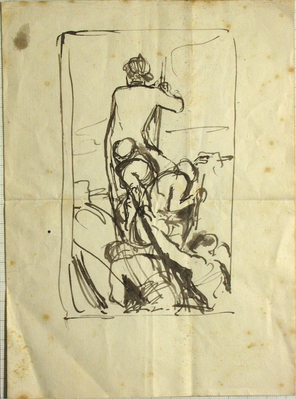
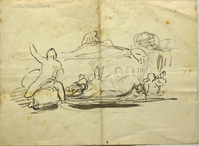
Early Pen and Ink Compositional Study for Carlton House Terrace Fresco 'Arion' and a Pen and Ink Compositional Study of Five Watching Figures
- Datumfrom 1854 - to 1856
- Materiaal
- Formaat
- drawing height: 20.5 cm
drawing width: 30 cm - Beschrijving
In the mid-1850s, Watts was occupied by a monumental fresco cycle at 7 Carlton House Terrace. This was the London home of his patroness Virginia Somers-Cocks, Countess Somers, and her husband Charles, 3rd Earl Somers. The whole cycle is referred to as The Elements, showing mythological scenes of earth, air, fire, and water, as well as more abstract concepts. This early pen and ink study outlines Arion and the Dolphin, the scene for water. The fluid sketch, which shares a page with another, unidentified study, shows the major compositional elements already worked out. Arion on his dolphin dominates the scene while nymphs look on. In the background, a giant sleeps on a mound of land, connecting this scene to the others in the fresco cycle.
This pen and ink drawing shows an early compositional study for one of Watts’ frescos in The Elements series at 7 Carlton House Terrace, the London home of Watts’ friend Lady Virginia Somers-Cocks, Countess Somers (née Pattle). The subject, Arion, was a seventh-century BCE Greek poet sometimes credited with inventing the dithyramb, a poetic format used in celebrating Dionysus (the Greek god of wine). None of Arion’s poems survive, and modern knowledge of Arion’s life primarily comes from Herodotus, who invented or embellished much of his material. Herodotus reports an episode where Arion threw himself into the sea and was saved by a dolphin [1].
In the finished fresco, Watts paraphrased figures from the famous Galatea fresco by Raphael, in the Villa Farnesina in Rome, not directly copying but deriving elements from the sea nymphs and cherubs [2]. The Watts Gallery holds a small rough sketch in oils of the mythological subjects in the Elements fresco cycle (COMWGNC.1). A related small oil study is held at the Walker Art Gallery in Liverpool. The fresco is now held in Malvern College, Worcestershire, having been removed from the walls of 7 Carlton House Terrace after 1973 and displayed at Eastnor Castle in Herefordshire by relatives of the Somers family from 1976 until 1988 [3].
In the Elements cycle, the Arion section stood for Water. Arion, a famous and successful poet and harpist, toured Greece and made a fortune. On his trip home, he was taken captive by the sailors on his ship, who coveted his wealth and ordered him to either kill himself, to be buried on land, or to throw himself into the sea. Arion requested that he be allowed to dress himself in his finest clothing and play one last song; the sailors, happy to hear the greatest living musician, allowed him this. He stood on the deck and played for them, then threw himself overboard while the ship sailed on without him. He was rescued by a dolphin, who carried him back to his homeland. When the ship arrived back at port, they reported to Arion’s king that they had left him safe and sound back in Italy, but Arion revealed himself to be alive and got them all convicted. This, according to Herodotus, was reported by both Corinthians and Lesbians, but we must take it all with a grain of salt. Ovid also gives this story in the Fasti, noting that Arion ‘paid his fare’ to shore on the back of the dolphin by playing the lyre the whole way; in exchange for the dolphin’s good deed, Zeus/Jupiter put it into the heavens as a constellation [4].
Watts’ Arion leaves off key narrative elements, such as the ship and his ‘full dress,’ and introduces an aquatic audience of Oceanids and Tritons. In this sketch, the main elements are outlined: Arion at the left on his dolphin (which, by convention, looks more like a monstrous fish in the finished fresco than any dolphin we might recognise), the cuddling oceanic couple and watchers, and the sleeping giant at the back of the composition on land. This sleeping giant ties even this early sketch for the fresco to Watts’ lifelong interest in the figure of the slumbering titans, which appear in his Chaos (COMWG.413, 1875-1882) canvases as well as The Titans (COMWG.109, 1848-1875) these stand for the timeless, pre- and post-human Earth and cosmos.
Footnotes:
[1] Herodotus, trans. Henry Cary, Herodotus; a new and literal version from the text of Baehr, with a geographical and general index by Henry Cary (New York: Harper & Brothers Publishers, 1876), pp. 9-10.
[2] Raphael, ‘The Triumph of Galatea’, 1512, Villa Farnesina, Rome.
[3] Nicholas Tromans, ‘“The Elements”: A Fresco Cycle by George Frederic Watts,’ in Tributes to Jean Michel Massing, ed. Mark Stocker and Phillip Lindley (Turnhout: Brepols Publishers, 2016) pp. 313-4.
[4] Ovid, trans. James Frazer and revised G.P. Goold, Fasti (Cambridge, MA: Harvard University Press, 1931) 2.III, pp. 63-5.
Text by Dr Melissa Gustin
|
|

