


- Reproduction

- Номер объектаCOMWG.452
- Создатель
- Название
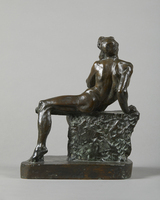
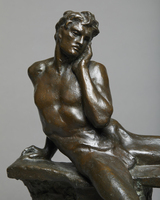
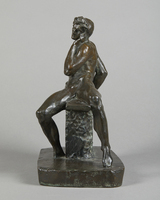
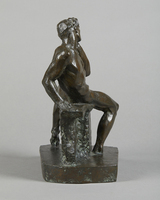
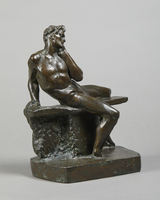
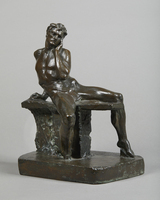
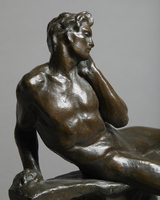
Bronze Study for the Male Nude Figure in the 'Genius of Greek Poetry'
- Датаafter 1904
- Материал
- Размерность
- Sculpture height: 30 cm
Sculpture width: 24 cm
Sculpture depth: 16.5 cm - Описание
Watts preferred to work with small models or maquettes in plaster, clay, and wax, rather than live models. This model, which would have originally been modelled in wax or plaster. It was later cast in bronze after Watts’s death in 1904, likely to preserve it for the future. It depicts the central figure of Genius from the painting Genius of Greek Poetry. He is seated on a rocky support, his legs dangling either side. He holds his hand to his face and gazes outwards. In the final composition he is within a dreamy seascape full of swooping and diving figures. The reclining male torso imitated the works of the Parthenon Frieze in Athens, which Watts owned a plaster cast. It also drew from one of his other great historical heroes, Michelangelo. The twisting male nudes of Michelangelo’s Sistine Chapel closely resemble the figure of Genius.
Watts often worked on paintings for many years, experimenting in form, colour and composition. He also often produced small sculptural studies for figures in clay, plaster and wax as a way of working out poses and forms. This provided him an opportunity to work with more permanent representations than live models. This study in bronze, likely modelled in plaster or wax was the maquette for a figure who appears in several Watts works, most notably his Genius of Greek Poetry (COMWG.22, 1857-1878). It presents the central figure of Genius, a seated nude man reclining, supported on his right arm as his legs dangle either side of his seat.
The figure’s musculature and pose were strongly rooted in the sculptural forms of ancient Greece. It has traditionally been understood as inspired by the reclining figures of Ilissos and Dionysus from the Parthenon, due to the pose and naturalism of the body [1]. Watts owned reduced casts of the Illissos (COMWG2007.941, 1851) and Dionysus as well as a horse head (COMWG2007.928) from the pediment and a section of the Panathenaic riders from the Parthenon frieze (COMWG2007.977, 1853). These would have provided Watts with scale models of the artworks he most admired to study and engage with in his own studio, as was the common artistic practice of the period.
The figure does, however, draw strong resemblance to Michelangelo’s twisting male nudes of the Sistine Chapel and allegorical drawing The Dream (Il Sogno). Watts’ Genius is much closer in style and form to the Michelangelo figures, who contort and lean in contemplation and serenity. The reclining male figure of Genius also appears in the mural Achilles and Briseis, created by Watts for a fresco at Bowood House. In Genius of Greek Poetry (COMWG.22, 1857-1878) and Achilles and Briseis (COMWG.94, 1858-1860) Watts uses the human body as a vehicle for the expression of symbolist themes, particularly through the contemplation of the landscape and the genius of the art of the ancient world. This contrasted the idealist neoclassicism of the period, instead presented sculptural bodies full of meaning, similar to the work of symbolist sculptors like Auguste Rodin.
This study is one of only a few bronze casts of Watts works in the Watts Gallery Collection. Others include small full-length bronzes of his Alfred Lord Tennyson (COMWG.478) and Physical Energy (COMWG2007.931). These two, however, are casts in bronze of later models by Thomas Wren, who worked as a clay modeller for the Compton Potteries. This cast also dates to after Watts death in 1904, the purpose of which is unclear.
Footnotes:
[1] Andrew Wilton & Robert Upstone (ed.), The Age of Rossetti, Burne-Jones and Watts: Symbolism in Britain 1860-1910, (London: Tate Gallery Publishing, 1997), p.206.
Text by Dr Nichole Cochrane
|
|


