


- Reproduction
- Номер объектаCOMWG.138
- Создатель
- Название
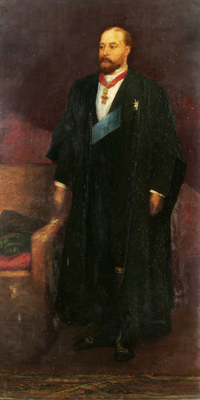
Study for the Portrait of Edward VII as H.R.H. Edward Albert Prince of Wales (later King Edward VII)
- Датаexact 1874 - exact 1874
- Материал
- Размерность
- Painting height: 235 cm
Painting width: 118.1 cm - Описание
Painted when the Prince of Wales was 33 years old, this full-length portrait depicts Queen Victoria and Prince Albert’s eldest son. The future Edward VII was the only member of the British royal family that Watts was commissioned to paint. Painted in various locations, over a number of years and at irregular intervals, Watts struggled with the commission. On completion, the portrait was exhibited to the public at the Grosvenor Gallery in 1882. However, due to negative reviews from the critics, Watts withdrew the work from display and never exhibited it again.
During Watts’s lifetime, five monarchs sat on the British throne. Despite being one of the leading portraitists of the day, Watts was only approached once during his career to paint a future monarch. H.R.H Albert Edward, Prince of Wales (1841–1910), the eldest son of Queen Victoria and Prince Albert, was 33 years old when the Benchers of the Middle Temple (senior members of the Bar and Judiciary) commissioned Watts to paint his portrait in 1874 for the price of 1000 guineas [1].
Edward had a close relationship with the Middle Temple as he became their first Royal Bencher in 1861, the same year that he opened their newly built library. He later became Treasurer in 1866 and dined there frequently [2].
In this full-length portrait, the Prince wears a dark velvet robe with a white shirt underneath. Around his neck is the ribbon and Insignia of the Spanish Order of the Golden Fleece, an order of chivalry established in 1430. As Prince of Wales, Edward was automatically appointed to the Order of the Garter, the most senior order of knighthood in Britain and the blue riband, or sash, which he wears over his left shoulder and pinned at his right hip was introduced by King Charles I in the 17th century. Around his left calf is the ceremonial garter comprised of a velvet ribbon and gold lettering bearing the motto ‘Shame on him who thinks evil of it’.
Sittings for the portrait were less than ideal for Watts and disrupted his preferred practice. Due to the future monarch’s schedule, not all sittings could take place at Watts’s studio which he argued was where the work could ‘be best and most conveniently done’ [3]. As a result, several sittings were arranged at the royal residence of Marlborough House, which meant that lighting conditions differed. There were also frequent interruptions, which meant that the portrait took years to complete. In June 1877, Watts informed the Middle Temple that he only needed one more sitting to complete the picture and it would be ready for delivery in three or four months [4]. The following month, Watts wrote to his patron Charles Rickards that ‘I am expecting the Prince of Wales here this morning to give me a sitting for the picture’ [5]. Often Watts worked without the Prince present, which according to Mary, was ‘a thing he never cared to do when painting from life’ [6]. By April 1880, the painting had not still not been completed.
A refined head study in chalk is in the National Portrait Gallery collection and a smaller scale, full-length oil study can now be found in the Ashmolean Museum of Art and Archeology, University of Oxford. Both studies are attributed to this commission.
The resulting full-length portrait was heavily critiqued when it was first exhibited at the Grosvenor Gallery in 1882. The critic for the Observer was confused by the ‘mild-eyed melancholy which sits queerly on this well-known personality’ [7]. The Times called it ‘a most unfortunate work’, whereas the Pall Mall Gazette simply described the portrait as ‘a failure’. [8] Following the criticism, Watts withdrew the portrait from display and on returning the original payment to the Middle Temple, begged them to ask the painter Frank Holl to provide their portrait instead [9].
As was his primary concern, Watts’s wished to reveal the inner man and not just the outward likeness when painting portraits, he achieved this ‘largely through the face and head’ [10]. Close examination of the picture surface reveals the degree to which Watts struggled to paint the Prince. The surface of the face is extremely overworked, and the paint is so dense in places, particularly in the nose and left eyebrow, that the surface appears to have been moulded using materials intended for sculpture.
The original commission to paint a member of the royal family would have heightened Watts’s status as a portrait painter. The commission’s failure meant that the portrait was never again exhibited publicly and remained in Watts’s personal collection. Full length male portraits, already rare in his oeuvre do not occur again after this date.
Footnotes:
[1] Mary Seton Watts, Catalogue of Portraits by G.F. Watts O.M. R.A., Vol. II, c.1915, p.165.
[2] ‘June 2017: Royalty and the Inn’, The Honourable Society of the Middle Temple,
[3] G F Watts quoted in 20 January 1874 Meeting Minutes, Middle Temple Archives, London, Volume U., p.100.
[4] G F Watts quoted in 30 June 1874 Meeting Minutes, Middle Temple Archives, London, Volume U., p.391.
[5] Letter from G.F. Watts to C.H. Rickards, 30 July 1877, Watts Correspondence, Heinz Archive, National Portrait Gallery, GFW/1/3.
[6] Mary Watts, George Frederic Watts: Annals of an Artist’s Life, vol. I (London: Macmillan and Co. Ltd., 1912), pp.280-281.
[7] ‘The Grosvenor Gallery’, Observer, 30 April 1882, p.9.
[8] 'The Grosvenor Gallery', The Times, 25 May 1882, p.4, 'The Grosvenor Gallery', Pall Mall Gazette, 8 May 1882, p.4
[9] Mary Watts, George Frederic Watts: Annals of an Artist’s Life, vol. I (London: Macmillan and Co. Ltd., 1912), pp.280-281.
[10] Veronica Franklin Gould, G.F. Watts: The Last Great Victorian (London: Yale University Press, 2004), pp.167-8.
Further Reading:
‘The Grosvenor Gallery’, Observer, 30 April 1882, p.9.
'The Grosvenor Gallery', The Times, 25 May 1882, p.4.
"The Grosvenor Gallery", Pall Mall Gazette, 8 May 1882, p.4
"June 2017: Royalty and the Inn," The Honourable Society of the Middle Temple.
Barbara Bryant, G.F. Watts in Kensington: Little Holland House and Gallery (2009).
Barbara Bryant, G. F. Watts Portraits. Fame & Beauty in Victorian Society (2004).
Veronica Franklin Gould, G.F. Watts: The Last Great Victorian (London: Yale University Press, 2004).
Mary Seton Watts, George Frederic Watts: Annals of an Artist’s Life, vol. I (London: Macmillan and Co. Ltd., 1912).
Mary Seton Watts, Catalogue of Portraits by G.F. Watts O.M. R.A., Vol. II, c.1915.
Meeting Minutes, Middle Temple Archives, London, Volume U and V.
Watts Correspondence, Heinz Archive, National Portrait Gallery, GFW/1/3.
Text by Dr Stacey Clapperton
|
|
