


- Reproduction
- Номер объектаCOMWG.41
- Создатель
- Название
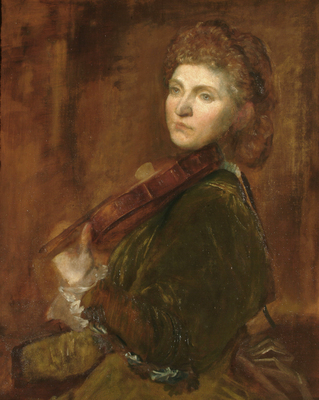
Lady Halle also known as Woman Playing Violin
- Датаcirca not before 1865 - circa not after 1881
- Материал
- Размерность
- Painting height: 73.7 cm
Painting width: 61 cm
Frame height: 94 cm
Frame width: 83 cm - Описание
A former child prodigy who became the violinist appointed to Queen Alexandra, Lady Wilma Hallé (1838–1911) was an influential musician of the 19th century. Moravian-born, Wilma Neruda first rose to prominence in England in 1849. In that year at the age of 11, she completed a tour of the country playing concerts in London and Manchester. Painted in 1888, after the sitter’s second marriage to the conductor, pianist and newly knighted Sir Charles Hallé, this portrait shows the musician in a confident and commanding pose.
Painted almost in profile, a lady in a green dress with bustle and voluminous sleeves turns her head over her left shoulder. Poised and graceful, her violin is tucked under her chin as if she is about to play. Formally known as Woman Playing the Violin, this portrait has been identified as Lady Hallé. The likeness which Watts captures in this portrait, with her tightly curled hair sitting neatly on top of her forehead and the slight turned down tip of her nose was recorded by photographers and reproduced in collectible picture postcards of the day.
As demonstrated by the quick wash which forms the background colour, the broad and dry brushstrokes which render the skirt of the dress, the missing peg-box and scroll of the violin and the incompleteness of the fingers on the left hand, the portrait is not finished to a high degree. This may indicate that the portrait was executed in a single, short sitting. Regardless, a harmonious colour balance is achieved with the earth tones of brown, green and umber of Hallé’s hair and dress, matching those of her instrument and the background.
Compositionally, this portrait of Hallé shares similarities with an earlier portrait of Lady Lindsay Blanche, 1876-7, now in a private collection. Both women are depicted in half-length portraits, wearing rich, green dresses, standing with their violins raised and the heads turned over their left shoulders. In her portrait, Blanche’s right hand is raised, with her bow hovering above as if she is about to play, whilst she gazes directly out to the viewer in anticipation.
The portraits of Lady Hallé and Lady Lindsay Blanche belong to a series of works in which Watts links music with portraiture. In 1867, Watts had painted the portrait of Hungarian born Joseph Joachim (COMWG.34, 1867), which he exhibited widely. He then painted the portrait of the pianist and composer Charles Hallé in c.1870 which entered the National Portrait Gallery collection as part of Watts’s ‘Hall of Fame’ series. Artistic portrayals of individuals with musical instruments while not unknown in British art, gained a renewed relevance during the 1860s [1]. Although a frequent theme in Pre-Raphaelite art, even Francis Grant, the then President of the Royal Academy, painted a portrait of the British general Sir James Hope Grant, c.1861, with his violincello, which was exhibited at the first Grosvenor Gallery exhibition in 1877 [2].
When she sat for Watts in 1888, Hallé would have been aged 47. In that year, on the 26 July she had married her second husband, Charles Hallé whom had recently been knighted. Both Joachim and Charles Hallé had been regular guests at Little Holland House. As Hallé’s son recalled: ‘Here on Sunday afternoons in summer, men who were famous and women who were beautiful would assemble […] often far into the night, my father and Joachim would take to their instruments, and convey the thoughts of the great masters of their art to the ears of Tennyson and Swinburne, Burne Jones and Rossetti, Watts, Browning, Leighton, Millais […]’ [3].
It is possible, that after introducing his wife into this circle, Charles Hallé commissioned Watts to paint this portrait of the new Lady Hallé, in order to commemorate the marriage and celebrate her career. Although it was short-lived, their marriage was a happy one. The popularity of the musical pair saw them perform frequently in England, and they subsequently toured together in Australia in 1890 and 1891 and South Africa in 1895. In 1901 she was appointed violinist to Queen Alexandra. Among her last performances in Britain were those with the Hallé Orchestra in Manchester in November 1907 and at the London memorial concert for Joseph Joachim on 25 January 1908 [4].
Explore:
The Portrait of Dr. J Joachim also known as A Lamplight Study [COMWG 34]
Footnotes:
[1] Barbara Bryant, G.F. Watts: portraits; fame & beauty in Victorian society (London: National Portrait Gallery, 2004), p.157.
[2] Barbara Bryant, G.F. Watts: portraits; fame & beauty in Victorian society (London: National Portrait Gallery, 2004), p.157.
[3] C.E. Hallé, Life and Letters of Sir Charles Hallé (London: Smith, Elder, & Co., 1896), pp. 162-163.
[4] Michael Kennedy, ‘Hallé [other married nameNorman-Neruda], Wilma [néeVilemína Maria Franziška Nerudová], Lady Hallé’ Oxford Dictionary of National Biography, 23 September 2004.
Further Reading:
Barbara Bryant, G.F. Watts : portraits; fame & beauty in Victorian society (London: National Portrait Gallery, 2004).
C.E. Hallé, Life and Letters of Sir Charles Hallé (London: Smith, Elder, & Co., 1896).
Michael Kennedy, ‘Hallé [other married nameNorman-Neruda], Wilma [néeVilemína Maria Franziška Nerudová], Lady Hallé’ Oxford Dictionary of National Biography, 23 September 2004.
Michael Kennedy, The Hallé Tradition: A Century of Music (Manchester: Manchester University Press, 1960).
Leoneé and Richard Ormond, G. F. Watts: The Hall of Fame: portraits of his famous contemporaries, National Portrait Gallery (Compton, Surrey: Watts Gallery, 2012).
Mary Seton Watts, Catalogue of Portraits by G.F. Watts O.M. R.A., Vol. II, c.1915.
Text by Dr Stacey Clapperton
|
|
