


- Reproduction
- Номер объектаCOMWG.90
- Создатель
- Название
Love Triumphant
- Датаfrom 1893 - to 1898
- Материал
- Размерность
- Painting height: 132.1 cm
Painting width: 50.8 cm
Frame height: 178 cm
Frame width: 100 cm - Описание
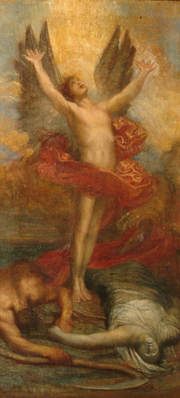
Love Triumphant is perhaps one of Watts most hopeful symbolist paintings. It depicts Love’s victory over both the march of time and the inevitability of death. Love, a youthful man with strong red wings, raises his arms to the sky bathed in a beam of sunlight. At his feet lie Death and Time, recognisable also in Watts’s work Time, Death, and Judgement. The version in the Watts Collection is a small study for a much larger work, now in the Tate Collection. This version is produced on hessian fabric which lends texture to the surface of the work.
Love Triumphant is perhaps one of Watts most hopefully symbolist painting. It expressed Love’s victory over the passage of time and the inevitability of death. The central figure of love is portrayed as a winged young man, his arms outstretched toward the sun whose beams shine down upon him, serving as an allegory for love’s eternal permanence. At his fit lie the defeated figures of Time, identifiable by his scythe, and a pale woman in white robes representing Death. Writing on the symbolic meaning of the work, Watt wrote: ‘Time-constructor and destroyer – sinks and falls; Death sleeps who once put all to sleep; Love alone Triumphant spreads his wings, rising to seek his native home, his abiding place’[1].
While not planned as a triptych, Love Triumphant, along with Love and Death (c.1885-7, Tate Collection) and Love and Life (c.1884-5, Tate Collection) form an informal series reflecting of the importance of love for existence. The paintings repeat similar allegorical motifs unique to Watts which he felt demonstrated his symbolic meanings. Love is depicted in a way which rejected eroticism, as a youthful and exuberant man. His use of love as an allegory was rooted in spirituality, writing, ‘I want to plant the feet of Love distinctly on the ground. In this life all that is spiritual must get its impetus from the ground beneath our feet’ [2]. The figures of Time and Death use the same visual motif Watts employed in the painting Time, Death, and Judgement. These paintings show that in Watts’s symbolist paintings he was employing a new universal allegorical language. This unifying scheme would have brought together paintings in Watts never realised ‘House of Life’ series into one arching narrative of life, death and human consciousness.
Love’s bold gravity defying fabric which swirls around the figure in a deep red is unusual for Watts’s work, who made extensive studies of the naturalistic way fabric and drapery fell upon the body in his sketchbooks. Mary Seton Watts records how the painting may have been in part inspired by Watts’s loss felt at the death of close friend Sir Frederic Leighton (1830-1896), and it is possible some of Leighton’s bold and gravity-defying classical draperies may have inspired Watts’s treatment of Love Triumphant. The bold red-orange of the drapery also linked to Time, Death and Judgement, described as the ‘last trail of the robe of Judgement as it passes out of sight’ [3].
Watts completed two versions of Love Triumphant, this smaller oil study and a larger version, given as part of the Watts Gift to the nation in 1900. The earlier version in the Watts Collection was exhibited while still unfinished at the New Gallery in 1896-7. A reviewer for the Art Journal, upon seeing the painting at the Royal Academy praised the works, stating: ‘In its solemnity and dignity the work stands alone, and in that respect is another illustration of the master’s splendid isolation – an isolation akin to that which Sanzio saw in Michelangelo’ [4].
Explore:
Love and Life [COMWG.175]
Footnotes:
[1] Mary Seton Watts, The Annals of an Artists Life, Vol. II, (London: Macmillan and Co., 1912), p.256.
[2] ibid.
[3] Mary Seton Watts, Catalogue of Subject Pictures by G. F. Watts O.M. R.A., Vol. I, c.1912.
[4] Art Journal, 1898 , p.172.
Text by Dr Nicole Cochrane
|
|
