


- Reproduction
- ObjektnummerCOMWG.26
- Upphovsman
- Titel
Study for Eve Repentant
- Datumcirca not before 1860 - circa not after 1869
- Medium
- Dimensioner
- Painting height: 61 cm
Painting width: 28 cm
Frame height: 80 cm
Frame width: 49 cm - Beskrivning
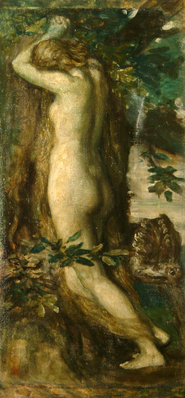
In Eve Tempted Eve engulfs herself in nature, in Eve Repentant nature is the hiding place and it shows a different aspect. ‘Note how all this beauty and luxuriance disappear in the picture “Eve Repentant”; nature there has taken on a hue of sadness,’ wrote Mary in 1905. In this painting the physicality of the forms is even more evident than in Eve Tempted, the figure heavier and the leaves and branches more clearly defined, suggesting the weighty burden of sin. The positioning of the figure of Eve in the trilogy was conceived by Watts as fundamental to its meaning: ‘the first representing perfect strength, the second entire weakness, the third a return to the first but requiring support’. Eve was tempted by the serpent to eat the fruit of the Tree of Knowledge of Good and Evil. She gave the fruit to Adam to eat. God punished them for disobedience and expelled them from the Garden of Eden. (Genesis 3.1-24) Watts designed three paintings showing the story of Eve: 'And She Shall be Called Woman' (The Creation of Eve); 'Eve Tempted' and 'Eve Penitent'. He painted several versions of each between the late 1860s and 1904. This is a small early version. The painting shows Eve's shame and regret after her disobedience. Her face is hidden - her pose shows her emotions.
This small study was done in preparation for one of Watts’s monumental compositions of Eve Repentant (COMWG.141, 1868-1903). However, the colours of this study are starker, but perhaps less luminous, less golden, than in the many different versions of Watts’s Eve, in the Watts Gallery Collection.
This study, with Eve’s long golden blonde hair that skims her leg and her porcelain skin recalls contemporary representations of Hamadryads by, for example, the French artist Émile Bin The Hamadryad from 1870. Rather than illustrating Genesis, Watts drew on Ovid and Milton to depict Eve as a repentant wood nymph, almost seeming to want to merge with the tree. While it is a biblical picture, it is not a scene from the Bible. Together with Eve Tempted (COMWG.142, 1868) it was one of Watts’s most celebrated pictures.
Many of Watt’s contemporaries note how Watts used the form and composition of this work in order to portray Eve’s agony. In his biography of Watts G.K. Chesterton highlighted these aspects. He wrote:
Eve Repentant (that fine picture), in which the agony of a gigantic womanhood is conveyed as it could not be conveyed by any power of visage, in the powerful contortion of the muscular and yet beautiful back, is the first that occurs to the mind [1].
John Ernest Phythian also put forward this interpretation when he stated:
we see Eve, leaning against a tree, her back turned towards us, not now enjoying the pleasures of sense- for all the luxuriance of fruit and flower has gone, and the very leaves are withered and tortured by a bitter blast — but wrung, as her whole frame shows, with the agony of remorse [2].
Both of these authors note how the Eve’s pose against this tree embodies the realization of her actions and her contrition.
Mary Watts takes this interpretation further. In the second volume of The Annals of an Artists Life Mary notes that this pose, combined with the poses Mary has in the previous two works of this cycle represent Eve’s attitudes in all three works. She stated:
In the third — the Eve Repentant — all is changed, the earthly paradise is wrecked, and the agony of remorse is expressed by the attitude of the tragic figure. It is perhaps interesting to observe the elemental lines of the three compositions, which are these: … upright, … bent, and… leaning lines which any country labourer capable of building a wall, or even putting in a post, would understand— the first representing perfect strength, the second entire weakness, the third a return towards the first but requiring support [3].
With statement Mary highlights this work can be interpreted on its own or as a part of a trilogy of paintings. She notes that on its own this work shows Eve as full of “agony and remorse” and that paradise is now gone. However, when the figures of Eve in each of these works is examined Eve moves from being strong and standing on her own in the first work to weakness, then to needing support.
Footnotes:
[1] G.K. Chesterton, G.F. Watts, page 63.
[2] John Ernest Phythian, George Frederick Watts, page 106.
[3] Mary Watts, The Annals of an Artist’s Life, Volume 2 page 141.
Text by Dr Eva-Charlotta Mebius
|
|
