


- Reproduction
-001 cutout.jpg&width=400&height=400&imageformat=jpg ";")
-002 detail.jpg&width=200&height=200&imageformat=jpg ";")
-003 detail.jpg&width=200&height=200&imageformat=jpg ";")
-004 detail.jpg&width=200&height=200&imageformat=jpg ";")
- ObjektnummerCOMWG.71
- Upphovsman
- Titel
Lady Somers
- Datumexact 1860 - exact 1860
- Medium
- Dimensioner
- Painting height: 121.9 cm
Painting width: 89 cm
Frame height: 163 cm
Frame width: 124 cm - Beskrivning
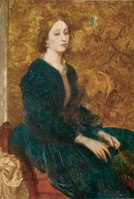
A portrait of ‘the great beauty’ of the Pattle family. On first meeting Virginia Pattle (1826–1910), Watts became infatuated. This portrait was painted ten years after she left him bereft when she decided to marry Lord Charles Eastnor (later Lord Somers) in the autumn of 1850. Her forlorn expression is a result of the recent death of her youngest daughter at the age of three. An air of mourning is amplified with the inclusion of a peacock feather fan which she holds in her left hand; symbolising rebirth and immortality.
Lady Somers began her life as Virginia Pattle, the sixth of the seven Pattle sisters. Watts became acquainted with her whilst she was living with her sister Sara Prinsep and her husband Henry Thoby Prinsep in Chesterfield Street, prior to their move to Little Holland House, which Watts facilitated and where he became a permanent artist-in-residence. Soon after, Watts developed an infatuation with Virginia. However, with ‘every eligible bachelor in London at her feet’, Virginia chose to marry Lord Charles Eastnor (later Lord Somers) [1]. Allegedly and with bitter irony, the future Lord Somers was first attracted to Virginia through Watts’s portrait of her which he exhibited at the Royal Academy Summer Exhibition in 1850. Watts was heartbroken and her sister Sara is believed to have tended to his health and aided in his recovery after he fell into a depression [2].
Despite not reciprocating his romantic feelings, Virginia, as with all of her sisters admired Watts’s work and its aims. Mary Watts recalled Virginia declaring: “I was never dazzled by any other painter’s brush, all other brushes were like boot-brushes to me” [3]. The future Lady Somers sat for Watts several times and two sensitively rendered portrait studies on paper remain in the Watts Gallery Trust collection today.
In this three-quarter length portrait, Lady Somers is seated wearing a voluminous deep blue dress, with full sleeves. It is paired with an orange chemisette which fills the open front of the dress with a faintly rendered white, transparent lace detailing appears at the wrists and neckline. With her hair styled in centre parting with a low chignon and braid, ‘the perfect oval of [her] face’ and ‘the dark, heavy-lidden eyes’ are in full view [4]. The beauty that appeared in earlier portraits is retained here, yet the smile which was reported as being able to light up rooms, is absent [5]. Instead it has been replaced with a ‘careworn expression’, as the result of her youngest daughter dying at the age of three, due to diphtheria, shortly before this portrait was begun [6].
In her original catalogue of her husband’s portraits, Mary testified that Watts began the portrait in 1860. However, the sleeve of the right arm, the lower section of the picture and the background remained unfinished for years. It wasn’t until 1889 that they ‘were completed by the artist, but never touched the head or hands’ [7].
A photograph of the painting dated before 1889 by Frederick Hollyer, demonstrates how the right-hand sleeve of the dress was radically altered from ‘Renaissance style to more conventional dress’ [8]. Close examination of the painting allows us to refute Mary’s claim.
Evidence of Watts reworking the positioning of the hands is visible through the thin paint layers. For example, the positioning of the sitter’s right thumb and the curvature of the left hand as it is bent to hold the peacock feather were initially different. Interestingly, the profile of the face is outlined with a broad, brown band of paint, which appears thicker in application next to the sitter’s left eye. This is suggestive that Watts may have altered the position of the face and then attempted to strengthen the outline against the elaborately floral tapestry background, painted in thinly applied paint.
Exhibited extensively in Watts’s lifetime, travelling to Munich in 1893, Stockholm in 1897 and Dresden in 1900, the painting has always remained in the Watts Gallery collection. After Watts’s death, the work was championed by the critic and painter Roger Fry. He believed it to be ‘one of the great examples of British portraiture’ and argued that ‘the impressionist swirls of the floral tapestry backdrop and the heavy eyelids and languid pose’ pre-empted the Bloomsbury Group’s style of painting in the early twentieth century [9].
Explore:
Sketchbook of G.F. Watts featuring silverpoint portrait study c. 1849 [COMWG 2007.201]
Metalpoint portrait study c.1849-50 [COMWG 2008.157]
Footnotes:
[1] Wilfred Blunt, ‘England’s Michelangelo’: A Biography of George Frederic Watts (London: Hamish Hamilton, 1975), p.74.
[2] Barbara Bryant, G.F. Watts : portraits; fame & beauty in Victorian society (London: National Portrait Gallery, 2004), p.15.
[3] Mary Watts, George Frederic Watts: Annals of an Artist’s Life, vol. I (London: Macmillan and Co. Ltd., 1912), pp.122.
[4] Wilfred Blunt, ‘England’s Michelangelo’: A Biography of George Frederic Watts (London: Hamish Hamilton, 1975), p.72.
[5] Wilfred Blunt, ‘England’s Michelangelo’: A Biography of George Frederic Watts (London: Hamish Hamilton, 1975), p.72.
[6] Marks Bills and Barbara Bryant, G.F. Watts: Victorian Visionary (New Haven and London: Yale University Press in association with Watts Gallery Compton, 2008), p.142.
[7] Mary Seton Watts, Catalogue of Portraits by G.F. Watts O.M. R.A., Vol. II, c.1915, p.145.
[8] Marks Bills and Barbara Bryant, G.F. Watts: Victorian Visionary (New Haven and London: Yale University Press in association with Watts Gallery Compton, 2008), p.142.
[9] Marks Bills and Barbara Bryant, G.F. Watts: Victorian Visionary (New Haven and London: Yale University Press in association with Watts Gallery Compton, 2008), p.142.
Further Reading:
Marks Bills and Barbara Bryant, G.F. Watts: Victorian Visionary (New Haven and London: Yale University Press in association with Watts Gallery Compton, 2008).
Wilfred Blunt, ‘England’s Michelangelo’: A Biography of George Frederic Watts (London: Hamish Hamilton, 1975).
Barbara Bryant, G.F. Watts : portraits; fame & beauty in Victorian society (London: National Portrait Gallery, 2004).
Mary Watts, George Frederic Watts: Annals of an Artist’s Life, vol. I (London: Macmillan and Co. Ltd., 1912).
Mary Seton Watts, Catalogue of Portraits by G.F. Watts O.M. R.A., Vol. II, c.1915.
Text by Dr Stacey Clapperton
|
|
-001 cutout.jpg&imageformat=jpg ";")
-002 detail.jpg&imageformat=jpg ";")
-003 detail.jpg&imageformat=jpg ";")
-004 detail.jpg&imageformat=jpg ";")
