



- Object numberCOMWG.101
- Artist
- Title
The Sower of the Systems
- Production dateexact 1902 - exact 1902
- Dimensions
- Painting66Painting53.3Frame96Frame84
- Description
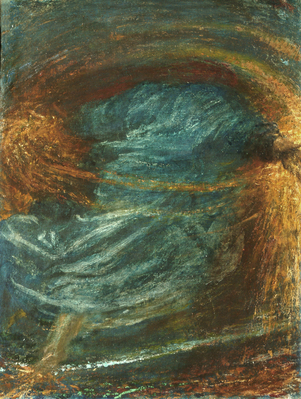
Watts once wrote: ‘there is only one great mystery – the creator’. Exploring this theme, Sower of the Systems was one of Watts most abstract works. It was completed just two years before his death in 1904. The painting depicted Watts’s ideal of the creator of the universe. The ambiguous figure wears a deep blue robe. They are shown in movement, their clothing sweeping behind them. From their hands and below their feet bursts of light and colour spew forth like stars or galaxies. The painting shows Watts’s interest in the links between religion and astronomy.
- In depth
Completed in the final years of Watts’s life, Sower of the Systems was one of his most abstract and philosophical works. The composition depicted an obscured figure in deep blue robes. The way the robes shift and flare suggests a rushing, forward movement towards darkness, while the swirling and sparkling lights in yellow and orange that swirl around the figure suggesting light and stars of the cosmos. According to Mary Seton Watts, he aimed to ‘paint an unpaintable subject’, going on to state it depicted a ‘a figure impelled rapidly forward, while stars, suns and plants flue from hands that scatter them as seeds are scattered’ [1]. In many of Watts symbolist works he approached a non-denominational view of God and creation, seen in Dweller in the Innermost and The All-Pervading (COMWG2007.504). Sower of the Systems combined Watts interest in an agnostic Creator with the new Victorian interest in astronomy and the cosmos [2].
It showed an ambiguous deity in the act of creating the cosmos, particularly the stars and constellations. Watts wished to move beyond depictions of the universal creator as a bearded man in advanced age, instead wishing to create ‘a symbol of the Deity- […] as great vesture into which everything that exists is woven’ [3]. He makes specific reference to Michelangelo’s depictions of God from the Sistine Chapel ceiling and likely was inspired by The Creation of the Plants for Sower of the Systems. He purposely shifts the depiction of the Creator to be that of ambiguity, with Mary Seton Watts later recording his description as:
my attempts at giving utterance and form to my ideas, are like the child’s design who, being asked by his little sister to draw God, made a great number of circular scribbles, and putting his paper on a soft surface, struck his pencil through the centre, making a great void [4].
Watts had a keen interest in astronomy and his network included several notable men of science. The Princep’s social circle included the polymath Sir John Herschel (1792-1871), who observed the great comet of 1857 at Little Holland House. Watts expressed a sadness at having never completed a portrait of the scientist [5]. Watts was also familiar with another astronomer, Sir James South (1785-1867), who he would visit at his home in Campden Hill, using his telescope to observe the stars. Watts had great respect for scientists and sought out several for his Hall of Fame portraits. In 1899 he wrote to the British editor W. T. Stead: ‘science has revealed to me laws, or rather the law, by which the physical universe is governed; awestruck by its sublimity and unity, I have learned to wonder, excepting at The Why!’ [6]. Sower of the Systems shows this growing interest in how science and spirituality could work in tandem to bring new knowledge to the fore.
The version of the painting in the Watts Collection is a smaller preparatory study for the full version, now in the collection of the Art Gallery of Ontario, Canada. The larger version is slightly more defined in its depiction of the creator, especially in the folds of the robes and the addition of flowing hair. In this smaller version, the treatment of light is almost impressionist in its addition of paint. In both this early and final version these bursts of colour spring forth from the creator’s hands and below their single foot silhouetted in the lower corner.
The smaller Watts Collection version was exhibited at the Royal Academy in 1903, and later not largely exhibited after his death in 1904. Despite this, the work anticipated many artistic developments in both the Symbolists and the Modernists in its use of abstraction and a secular approach to creation and divinity.
Footnotes:
[1] Mary Seton Watts, The Annals of an Artists Life, Vol. II, (London: Macmillan and Co., 1912), p. 302.
[2] See for example the widespread popularity of Agnes Mary Clerke’s A Popular History of Astronomy During the Nineteenth Century, first published in 1885.
[3] ibid, p. 245.
[4] ibid, p. 302
[5] Mary Seton Watts, The Annals of an Artists Life, Vol. I, (London: Macmillan and Co., 1912), p. 203.
[6] Watts Papers, WGAV, Watts to W.T. Stead, 6 Jan 1899.
Text by Dr Nicole Cochrane
|
|

