


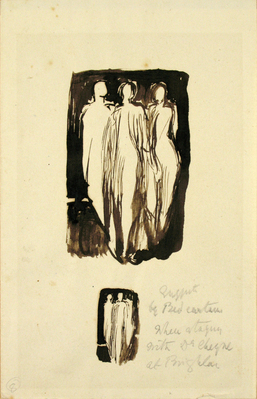
- Object numberCOMWG2006.22
- Artist
- Title
A Composition Suggested by Bed Curtains; Possibly Inspiration for 'Olympus on Ida'
- Production datenot before 1872 - not after 1873
- Medium
- Dimensions
- drawing height: 17.3 cm
drawing width: 10.9 cm
mount height: 36.42 cm
mount width: 27.53 cm - Description
Watts often found inspiration for paintings in the most unlikely places. This drawing was inspired by the shapes made in bed curtains while Watts was laid up following a kick to the shin from a horse. Watts wrote on the drawing in pencil, ‘Suggest. By Bed curtain when staying with Dr Cheyne at Brighton.’ The loose shapes of the three light figures against a dark background became two painting compositions, Olympus on Ida and The Judgement of Paris. When Watts started to work this rough ink drawing up to start painting, he used drawings he had made years earlier as the models. He had made many studies of his favourite model, Long Mary, in the 1860s, and these—not a live model—were the basis for the finished paintings.
- In depth
In a catalogue of Sir Richard Brinsley Ford’s collection, he noted that this drawing was one of the examples of Watts’ ability to derive compositions from the world around him—here, the shadows playing in bed curtains while he was laid up following a kick on the shin from a horse [1]. This inauspicious start, however, led to the development of three paintings and innumerable sketches on the theme of the female nude and the Judgement of Paris. The Watts Gallery holds the least-finished but most ‘opalesque’ version (COMWG.30, 1885), in Mary Watts’ words, as well as the present sheet and several pencil, ink, and charcoal studies of the composition and individual figures [2]. Finished versions of the picture are held in the Faringdon Collection, BUscot Park, as The Judgement of Paris and at the Art Gallery of South Australia, as Olympus on Ida; a third oil painting closely related to the Faringdon picture has been at auction several times [3].
Where earlier artists had focused on the narrative content of the Judgement of Paris, such as Peter Paul Rubens’ version of the subject acquired by the National Gallery, London, in 1844, wherein the prince of Troy, Paris, judged the beauty of the three leading Olympian goddesses, Watts’ versions of the composition are more concerned with Watts’ version of the ideal female nude [4]. Watts drew from his repository (COMWG2007.396) of (COMWG2007.397a) drawings (COMWG2006.36) of Long Mary (COMWG.180), a housemaid at Little Holland House whose long and strong limbs fit, or shaped, Watts’ vision of the perfect human woman in art. While Mary Bartlett was no longer modelling for Watts by this time, having married and possibly died by the 1870s, Watts had drawn her extensively for years and had both a huge selection of reference material and an acute visual memory and imagination to work from.
Mary Watts recorded that it was sometimes said George never used a model, but that rather, ‘In earlier years a large number of studies were made from a model whom he always called “Long Mary,” who sat to him, and to him only, from the early 'sixties and onwards for several years. He told me he never made use of her, or of any other model, when painting a picture. He said, “I don't want individual fact in my pictures where I represent an abstract idea. I want the general truth of nature" [5]. She noted
When painting, Signor referred to the studies made in charcoal on brown paper from this most splendid model noble in form and in the simplicity and innocence of her nature a model of whom he often said that, in the flexibility of movement as well as in the magnificence of line, in his experience she had no equal’ [6].
Footnotes:
[1] Brinsley Ford & John Christian. The Sixtieth Volume of the Walpole Society: 'The Ford Collection.' Vol. II, London: The Walpole Society, 1998. Cat. RBF528, p. 259
[2] Mary Seton Watts, Catalogue of Subject Pictures by G.F. Watts O.M. R.A., v. I, c. 1912, p. 109.
[3] Most recently, Sotheby’s London, Victorian, Pre-Raphaelite and British Impressionist Art, December 17, 2015, Lot 10.
[5] Mary Seton Watts, George Frederic Watts: the Annals of an Artist’s Life, vol. 2 (London: Macmillan and Co., Ltd, 1912), p. 44.
[6] Mary Seton Watts, George Frederic Watts: the Annals of an Artist’s Life, vol. 2 (London: Macmillan and Co., Ltd, 1912), p. 44.
Further Reading:
Ken Montague, ‘The Aesthetics of Hygiene: Aesthetic Dress, Modernity, and the Body as Sign,’ Journal of Design History Vol. 7, No. 2 (1994), pp. 91-112.
Text by Dr Melissa Gustin
|
|
