


- Reproduction
-001.jpg&width=400&height=400&imageformat=jpg ";")
-002 detail.jpg&width=200&height=200&imageformat=jpg ";")
-003 detail.jpg&width=200&height=200&imageformat=jpg ";")
-005 detail.jpg&width=200&height=200&imageformat=jpg ";")
-004 detail.jpg&width=200&height=200&imageformat=jpg ";")
- رقم الكائنCOMWG.200
- المنشيء
- العنوان
Lady Dalrymple also known as Sophia Dalrymple
- التاريخ1851 - 1853
- الأبعاد
- Painting198Painting78.7Frame230Frame108
- الوصف
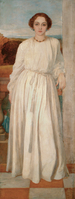
A favourite model and muse, Sophia Dalrymple was the youngest of seven Anglo-Indian sisters. In this monumental sized canvas, the young woman who was responsible for Watts’s affectionate ‘Signor’ nickname, can be seen standing on the balcony of Little Holland House. The subdued colour palette, restrained paint application and the simple style of her long dress evokes the classical past which dominated Watts’s portraiture during the early 1850s. Previously catalogued as circa 1851.
Sophia (1829 – 1911) was the youngest of seven sisters of the Anglo-Indian Pattle family. She married John Warrender Dalrymple at the age of eighteen, but due to her husband’s postings with the Bengal civil service, she lived with her sister Sara and her husband Thoby Prinsep at their home in Little Holland House. During this time, Watts also came to live at the house in Kensington, becoming a type of artist in residence and it is Sophia that coined the nickname ‘Signor’ for the beloved artist.
Around the time that this full-length and full-frontal portrait was painted, Sophia had welcomed her first born; a daughter named Virginia in 1850. Four years later, Virginia gained a younger brother named Walter. One could assume that the long, simple gathered dress that Sophia wears in this portrait is because she had recently given birth or was indeed in the early stages of her next pregnancy. However, these dresses were characteristic of the Pattles sisters’ style, as evident in the double portrait of Sara and Sophia and in the many drawings and photographs that survive today.
This style of dress and its subdued colour would have appealed greatly to Watts. He is known to have studied the Elgin marbles in great detail in his younger years and his surviving sketchbooks are filled with studies of the folds and fabric carved in classical sculpture. He urged students to ‘draw constantly from drapery’ because it allows the eye to be ‘in tune with the law of form and line’ [1]. In this portrait, Sophia takes on the character of a Greek sculpture.
During the 1850s, Watts became preoccupied with experimenting with the Italian Renaissance technique of fresco. Indeed, this portrait in its restrained approach to paint application, yet created on an ambitious scale, evokes fresco murals and is similar to his Self-Portrait 'Venetian Senator'. Both works were painted whilst the artist was undertaking work for the Lincoln’s Inn mural commission.
Parallels can be drawn between this portrait and that of The Sisters (COMWG.137, 1850-1851). In both portraits, they stand on the tiled floor of a balcony, with a classical balustrade running behind them and a garden in the distance. This tells us that both works were painted at Little Holland House, and intended for display in the house. However, it is not known if this single portrait of Sophia was painted first, or that of the two sisters.
Intriguingly, a handwritten label attached to the back of the Sophia’s portrait reads: ‘The picture is half of a portrait of two sisters, the second sister being Sara wife of Thoby Prinsep’. On close inspection of the picture surface, there is evidence that the canvas has been altered. Tracing the line around Sophia’s left hand, it is clear that the painted canvas has been cut and then reapplied to a new one, no doubt removing the figure from a double portrait. If we look along the right hand edge of the painting, at first it appears as if a column has been painted. Yet, its colour does not coordinate with the bottom of the balustrade that appears on the left-hand side of the canvas and there is no apparent base visible.
More curiously, Sophia’s left elbow, is bent as if she is leaning on someone or something. But in this composition, the elbow is bent too high to be resting comfortably on the balustrade behind her, or on the column next to her. It is possible that she was originally leaning on her sister, in a composition similar to the existing double portrait. It remains a mystery as to why Watts decided to alter the painting into a single portrait of Sophia. The missing half featuring Sara has never been found.
Explore:
Sisters also known as Sophia Dalrymple and Sara Prinsep [COMWG.137]
Virginia Dalrymple [COMWG 200A]
Self-portrait 'Venetian Senator' [COMWG2014.10]
Footnotes:
[1] As quoted in Mary Seton Watts, ed., George Frederic Watts: Annals of an Artist’s Life: Writings on Art, vol. III (London: Macmillan and Co. Ltd., 1912), p.16.
Further Reading:
Barbara Bryant, G.F. Watts : portraits; fame & beauty in Victorian society (London: National Portrait Gallery, 2004).
Barbara Bryant, G.F. Watts in Kensington: Little Holland House and Gallery (Compton, Surrey: Watts Gallery, 2009).
Marks Bills and Barbara Bryant, G.F. Watts: Victorian Visionary (New Haven and London: Yale University Press in association with Watts Gallery Compton, 2008).
Victoria Franklin Gould, G.F. Watts: the last great Victorian (New Haven and London: Yale University Press, 2004).
Mary Seton Watts, ed., George Frederic Watts: Annals of an Artist’s Life: Writings on Art, vol. III (London: Macmillan and Co. Ltd., 1912).
Mary Seton Watts, Catalogue of Portraits by G.F. Watts O.M. R.A., Vol. II, c.1915.
Text by Dr Stacey Clapperton
|
|
-001.jpg&imageformat=jpg ";")
-002 detail.jpg&imageformat=jpg ";")
-003 detail.jpg&imageformat=jpg ";")
-005 detail.jpg&imageformat=jpg ";")
-004 detail.jpg&imageformat=jpg ";")
