


- Reproduction
- InventarnummerCOMWG2007.593b
- Hersteller
- Titel
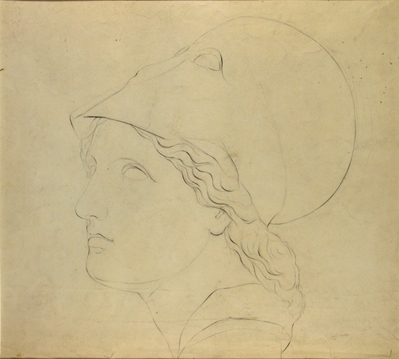
Large Outline Study of the Helmeted Head of Athena, After the Mattei Athena
- DatumJuly 1843 - August 1843
- Medium
- Format
- drawing height: 34.8 cm
drawing width: 39.1 cm
mount height: 42 cm
mount width: 59.5 cm - Beschreibung
This drawing was probably made on the spot in the Louvre, Paris, during Watts’ visit in 1843. Watts spent several weeks in Paris on his way to Italy. While his time in Paris is not well documented, this drawing provides evidence for Watts’ activities. It depicts the head of the so-called Mattei Athena (Roman Minerva) from the Louvre. Watts regularly used drawings he had made years earlier as references for paintings. This drawing provided the details of Athena’s helmet and breastplate for his fresco of The Battle of the Gods and the Giants at 7 Carlton House Terrace. Watts’ other depictions of Athena, in paintings of the Judgement of Paris, leave off her armour. These reflect his interest in the female nude more generally rather than the differences between the three goddesses Athena, Hera (Juno), and Aphrodite (Venus). Athena was the goddess of skilled crafts and the arts, strategic warfare, and the city of Athens.
In 1843, following his success in the competition for designs for the new Houses of Parliament, Watts travelled to Italy via Paris [1]. While the four years he spent in Florence (with small trips to other cities accompanying his various patrons) are correctly seen as some of the most formative of his artistic career, the weeks he spent in Paris were also informative. Watts spent several weeks in Paris in the company of Edward Armitage, another young painter who had won another of the prizes in the Houses of Parliament competition. Armitage, of an age with Watts, was born into a wealthier family and had already travelled; Mary Watts suggests that during his time in Paris Watts ‘saw something of the merry life of the young French students of the time,’ probably introduced by the more worldly Armitage [2].
While little documentation about this time exists, if any, it is certain that Watts visited the Louvre, where the present drawing of the Athena Mattei was made; while the possibility exists that Watts had access to a cast of this particular sculpture, on the opposite side of this sheet is a study from Germain-Jean Drouais’s painting Marius at Minturnae (1786), which was also in the Louvre [3]. Wilfred Blunt also suggests that Armitage, who had studied with Paul Delaroche, probably took Watts to see the Hemicycle by Delaroche and his students in the Ecole des Beaux-Arts, given Watts’ emulation thereof in Lincoln’s Inn [4]. Watts’ earliest artistic training took place in a sculptor’s studio, where he would have been tasked to draw from antique sculptures; this was also a major exercise at the Royal Academy, where Watts was a student for a short time [5].
This drawing is interesting enough on its own as material from a poorly documented but important period in Watts’ early career, but also shows how Watts’ drawings functioned as a visual resource or record for him throughout his life. The head of the Athena Mattei and her asymmetrical aegis seem to make an appearance in Watts’ red-chalk composition drawing for the fresco The Battle of the Gods and The Giants (COMWG2006.56, 1854-1855) at 7 Carlton House Terrace, in the collection of the Watts Gallery, as well as a detailed pen and ink drawing in an uncatalogued album and in the fresco itself [6]. Although this fresco would not be commissioned until 1854, over a decade later, Watts’ studies from earlier travels provided reference material.
The Athena Mattei is in fact a surprising choice of subject, considering it was in the same museum as the far more famous Venus de Milo, discovered in 1820 and still a recent, high-profile addition to the Louvre in 1843. While Watts would later acquire a hollow plaster cast of the torso from navel to neck, no drawings of the sculpture remain in the Watts collection from this period. The Louvre also had the monumental Athena Velletri, with extant traces of polychromy [7]. Additionally, the Athena Medici-Ingres was in Paris by 1840 although it is not catalogued in the Louvre until 1913; it may have been at the Ecole des Beaux-Arts or with Jean-Auguste-Dominique Ingres, as he was responsible for bringing it back to Paris from Rome where it had been in the Villa Medici during his presidency of the French Academy [8]. The Athena Mattei is a marble copy of a bronze Greek original, probably designed by the sculptor Euphranor, not Watts’ beloved Pheidias; in 1959, what is believed to be the bronze original from which the marble was copied was discovered on the Piraeus [9].
Athena is the Greek goddess of wisdom, war (particularly strategic warfare), artisans and crafts, and the city of Athens. She appears, sans armour, in Watts’ two versions of the classical myth known as the Judgement of Paris and related drawings, the first and most traditional at Buscot Park, and at Watts Gallery as Olympus at Ida (COMWG.30, 1885) and an abstract ink study, A Composition Suggested by Bed Curtains; Possibly Inspiration for 'Olympus on Ida' (COMWG2006.22, 1872-1873). As noted, Watts used the present sketch as a reference point for Athena in the Battle of the Gods and the Giants (COMWG2006.56, 1854-1855) at 7 Carlton House Terrace, but overall he seemed more interested in other mythological figures like Diana, Endymion, and subjects from Ovid’s Metamorphoses than the rest of the Olympians.
Footnotes:
[1] Wilfred Blunt, England’s Michelangelo (London: Hamish Hamilton, 1975) pp. 24-5.
[2] Mary Seton Watts, George Frederic Watts: the Annals of an Artist’s Life, vol. 1 (London: Macmillan and Co., Ltd, 1912), p. 44.
[3] Germain-Jean Drouais, Marius prisonnier à Minturnes, 1786. Oil on canvas, Louvre INV 4143, Pen and Ink and Watercolour copy after Drouais' 'Marius at Minturnaue' (COMWG2007.593a, 1843).
[4] Wilfred Blunt, England’s Michelangelo (London: Hamish Hamilton, 1975) pp. 24-5.
[5] Mary Seton Watts, George Frederic Watts: the Annals of an Artist’s Life, vol. 1 (London: Macmillan and Co., Ltd, 1912), p. 19-26.
[6] The Battle of the Gods and the Giants (COMWG2006.56, 1845-1855), GFW album 33.
[7] Plaster Cast Shell of the Torso from 'Venus de Milo' (COMWG2007.1073), Louvre MA 464.
[8] “16. ATHENA MEDICI,” Bulletin of the Institute of Classical Studies, Vol 56, Iss. Supplement 105 Part 1 ‘Sculptures associated with Pheidias’, May 2013, p. 469,
[9] ‘Piraeus Athena,’ Perseus (Tufts)
Text by Dr Melissa Gustin
|
|
