


- Object numberCOMWG.118
- Artist
- Title
Outcast Goodwill
- Production dateexact 1895 - exact 1895
- Medium
- Dimensions
- Painting height: 99.1 cm
Painting width: 66 cm
Frame height: 122 cm
Frame width: 88 cm - Description
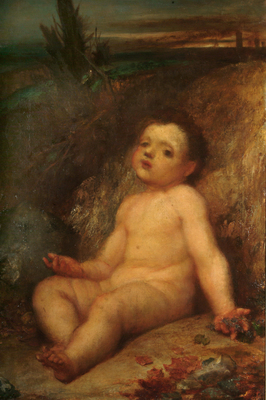
Watts developed this symbolic painting when he was also working on the large and small canvases of Peace and Goodwill. Goodwill is similarly shown as a young child, perhaps to show the innocence and the vulnerability of the concept. Another version exists in the Castle Museum Norwich where the child holds a dove. In the present version the mood is more desolate. The factory chimneys in the background suggest how modern industrial society creates social tension.
- In depth
Mary Watts, when describing this work in the catalogue of G.F. Watts’ work compiled after his death, listed two different versions of this work. She notes that G.F. Watts completed both in 1895, and while the first was given to the Society for the Prevention of Cruelty to Children in 1901, and both were displayed at the Royal Academy in 1895 [1]. Furthermore, while the first one was displayed in London, Liverpool, Leeds, and York during Watts’s lifetime, the second (the one described here) was only displayed the one time prior to the completion of the catalogue [2]. She goes on to add that G.F. Watts completed both works while working on another work- Peace and Goodwill (COMWG.2, 1887) [3]. Consequently, while Mary Watts did not interpret either work, she provided a brief history of them.
In The Vision of G F Watts Veronica Franklin Gould, Hilary Underwood, and Richard Jefferies interpret this Symbolist painting. They note that the child in this work is holding a flower in one hand while opening their other hand for alms or donations [4]. Furthermore, they highlight the smokestacks in the background, which combined with the image of the child in the foreground represent the idea that Trust, Innocence, and Love have been kicked out this society [5]. Like his other Symbolist works in Outcast Goodwill G.F. Watts emphasized the idea that modern society alienates and excludes virtues and the virtuous in favour of industry and greed.
Footnotes:
[1] Mary Watts, Catalogue of Works by G.F. Watts, pages 113-114.
[2] Mary Watts, Catalogue of Works by G.F. Watts, pages 113-114.
[3] Mary Watts, Catalogue of Works by G.F. Watts, page 114.
[4] Veronica Franklin Gould, Hilary Underwood, and Richard Jefferies, “64. Outcast Goodwill,” The Vision of G F Watts (ed. Veronica Franklin Gould), page 64.
[5] Veronica Franklin Gould, Hilary Underwood, and Richard Jefferies, “64. Outcast Goodwill,” The Vision of G F Watts (ed. Veronica Franklin Gould), page 64.
Text by Dr Ryan Nutting
|
|
