


- Reproduction
- Numero oggettoCOMWG.141
- Creatore
- Titolo
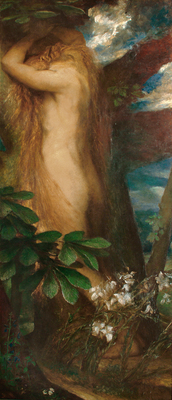
Eve Repentant
- Datanot before 1868 - not after 1903
- Materiale
- Dimensioni
- Painting height: 251.5 cm
Painting width: 114.3 cm
Frame height: 284 cm
Frame width: 143 cm - Descrizione
To tell his own version of the biblical story of Eve Watts utilized the traditional religious format of a triptych, or three-part work of art. As the third painting in this series, preceded by “Creation of Eve” and “Eve Tempted”, this work concludes the story of Eve and the Garden of Eden. Here the viewer can see that repentant Eve turns her head away in shame after she gave into temptation. In theology, this act of original sin is said to have brought sexual shame and death upon humanity. Watts described how, in his final scene, Eve is ‘restored to beauty and nobility by remorse’
Here we see Eve repentant after having eaten the forbidden fruit. Leaning against a fig tree, hands clasped, she regrets her actions. She almost seems to want to disappear into the fig tree, dissolving into its bark. As he had found inspiration for Eve Tempted in John Milton’s epic poem Paradise Lost (1667) here Watts was straying even further from his Biblical source. In Eve Tempted (COMWG.142, 1868) and Eve Repentant, Watts transformed Eve into a Miltonic and Ovidian wood nymph, a hamadryad, a Pomona. As the distinguished Victorian art critic and editor M. H. Spielmann once perceptively observed, ‘if his more serious works were viewed during the execution of Beethoven’s ‘Moonlight Sonata,’ or during the reading of the Book of Job, or Paradise Lost they might be felt in harmony and keeping’ [1].
While Watts was considered a master of the nude by his contemporaries, such as the French art historian Ernest Chesneau and the painter Ford Madox Brown, his Eve trilogy goes beyond the merely ornamental, much like Titian’s poesie, his six paintings of Classical myths commissioned by Philip of Spain in 1551 [2]. Watts’s Eves may be viewed as illustrations of Milton’s Eve in Paradise Lost, rather than the Eve of Genesis. In turn, she is thereby also an Ovidian wood nymph, a Pomona, since John Milton found inspiration for his Eve in the account of Pomona and Vertumnus in Ovid’s Metamorphoses (8 AD). Watts’s Eve recalls contemporary depictions of hamadrayads, such as Émile Bin’s The Hamadryad from 1870. In Book 14 of the Metamorphoses, the Roman god Vertumnus enters the orchard of the goddess Pomona disguised as an old woman. It is a complex narrative that deals with questions of consent, deception, and seduction. John Milton modelled his Eve on the wood nymph Pomona, who is also a hamadryad.
A hamadryad is a particular kind of tree nymph ‘whose fate depended on particular trees, together with which they were supposed to be born, and to die’ [3]. We find a particularly famous story of the fate of a hamadryad in the tale of Erysichthon in Ovid’s Metamorphoses too. Hamadryads were popular with Victorian painters from John William Waterhouse to Watts’s friend Evelyn de Morgan.
For the critic and author G. K. Chesterton, the strong back of the Eve Repentant exhibited Watts’s ‘statuesque quality in drawing’ [4]. Eve’s back was expressive of ‘the agony of a gigantic womanhood’ conveyed ‘as it could not be conveyed by any power of visage, in the powerful contortion of the muscular and yet beautiful back’.[5]. In this painting, Watts completely inverted the soft and welcoming lines of the sensual figure in Eve Tempted (COMWG.142, 1868). Watts’s realisation of what Chesterton called the ‘mystery of the human back’ was revolutionary to the critic who thought that Watts had ‘realized this as no one in art or letters has realized it in the whole history of the world: it has made him great. [6]. The turned back is a prominent feature in some of Watts’s most striking paintings, such as For He had Great Possessions (COMWG.36, 1894), Love and Death (c. 1885-7 Tate), and Sower of the Systems (COMWG.101, 1902).
In a review of the then recently opened Watts Gallery from 1906, Eve Tempted (COMWG.142, 1868) and Eve Repentant were mentioned in the Art Journal as outstanding examples of works full ‘of resplendent colour, and with subjects such as Watts alone could treat with delicacy and success’ [7]. In his review, the critic and editor David Croal Thomson argued that nothing ‘finer in quality’ had ever been ‘produced by the Master’ [8]. Thomson wrote that the great pair of pictures ‘alone are worth a pilgrimage to see’ [9]. To this day, visitors to the Gallery in Compton marvel at Watts’s monumental and luminous pictures of Eve.
Footnotes:
[1] M. H. Spielmann, ‘Mr G. F. Watts: His Art and His Mission’ in The Nineteenth Century 41. 239 (1897), pp. 161-172, p. 168.
[2] Ibid., p. 172 See also Ernest Chesneau translated by L. N. Etherington, The English School of Painting (London: Cassell & Company, 1885).
[3] Anon. A Dictionary of Polite Literature;or, Fabulous History of the Heathen Gods and Illustrious Heroes Vol II (London: Proprietors, 1804).
[4] G. K. Chesterton, G. F. Watts (London: Duckworth, 1904), p. 20.
[5] Ibid., 63.
[6] Ibid., 63.
[7] David Croal Thomson, ‘The New Watts Gallery at Compton’ in the Art Journal (Nov 1906), pp. 321-324, p. 323.
[8] Ibid., p. 323.
[9] Ibid., p. 323.
Text by Dr Eva-Charlotta Mebius
|
|
